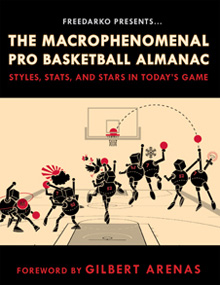
FreeDarko Presents The Macrophenomenal Pro Basketball Almanac: Buy it ... Now
If you’ve spent any quality time on the internet over the past few weeks, then there’s a decent chance you’ve seen both bloggers and
real
writers alike discussing
The Macrophenomenal Pro Basketball Almanac
. The book is a unique look at today’s NBA through the lens of the game’s biggest stars and oddballs, complimented by masterful illustrations and statistical analyzes you’d never imagined, such as a comparison between Tim Duncan’s numbers and the Fibonacci sequence.
↵
↵And it also happens to be co-authored by The Sporting Blog’s own Bethlehem Shoals, along with the rest of the FreeDarko Collaborative. Here’s part of their description of Macrophenomenal:↵
↵↵⇥Whereas past sports-literary endeavors have attempted to paint sports as a metaphor for life or life as a metaphor for sport, we depict the National Basketball Association as a universe unlike any that one would encounter in daily existence. The NBA is a sphere in which Indiana farmboys, housing project messiahs, African tribesmen, and escapees from war-torn Eastern Bloc countries, coalesce by the nature of their superhuman physicality.↵↵You can read many of the book’s reviews for yourself, or you can just listen to me when I tell you it’s outstanding. And I don’t like the NBA. I can’t even watch an entire game, yet I can thoroughly enjoy
The Macrophenomenal’s
essay on Leandro Barbosa, for example, a player I don’t care about, and honestly, have never had much interest in watching play the game of basketball. Yet this book makes his story, style, and speed interesting to me, the non-fan. And if it speaks to me, it will no doubt speak to the diehards, as well.
↵↵But I’ll let you form your own judgments. Here are some excerpts from two of the essays. ↵
↵
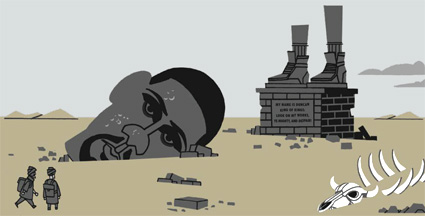 ↵
↵↵↵First, from Tim Duncan: “Mechanical Gothic”: ↵
↵↵⇥While other players wind-sprint through↵⇥the season, Duncan marathons, going deep↵⇥into the playoffs year after year. While his↵⇥foes throw their hearts and minds into the↵⇥thick of competition, Duncan stands at a remove,↵⇥his every action rich with intent. His↵⇥brain operates with the dull precision of the↵⇥TI-83 calculator. Can Duncan feel pain? He↵⇥has faced his share of knee and foot injuries↵⇥over the years, yet they have slowed him only↵⇥as an oil leak slows a robot. Does Duncan↵⇥love? His wife, Amy, a former Wake Forest↵⇥cheerleader, conveys a forced plastic smile in↵⇥public appearances, suggesting that not even↵⇥she knows. Do the concepts of free will or↵⇥consciousness mean anything to him? If so,↵⇥he does not experience these capacities as you↵⇥and I do. Referee Joey Crawford once issued↵⇥a technical foul to Duncan simply for laughing↵⇥while on the bench; Crawford more than↵⇥anything was probably startled at Timmy’s↵⇥capacity to display human feeling. In his eternal drudgery, Duncan moves forward with a↵⇥single purpose, as though preprogrammed to↵⇥achieve the sole end of winning. Cognition,↵⇥emotion, intention -- all are merely incidental↵⇥to the goal at hand.↵↵
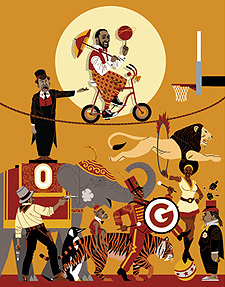
And from Gilbert Arenas: “The Court is a Carnival”: ↵↵⇥In spite of his All-Star appearances and↵⇥playoff heroics, Arenas somehow remains the↵⇥eternal underdog; he’s one of the league’s most↵⇥visible young stars, yet hailed mostly as a cult↵⇥figure. While Arenas exudes humor and glee,↵⇥his triumphs are pure acid, revenge against a↵⇥basketball establishment that has continually↵⇥done him wrong. At this point, his goofball↵⇥reputation seems like an elaborate, highconcept↵⇥taunt. The world sees him as a fool,↵⇥but this fool [messes] up his opponents like he↵⇥was the baddest man on the planet. Gilbert↵⇥Arenas knows that people underestimate↵⇥him; he’ll take advantage of this on the court↵⇥and in the media, using slights as table settings↵⇥at what amounts to an endless coming out↵⇥party. There are streamers on the walls↵⇥and cake, but about half his guests end up↵⇥watching from a stretcher.↵⇥↵⇥[…]↵⇥
↵⇥↵⇥Few moments in his career captured this↵⇥quality as perfectly as Game 6 of the Wizards’↵⇥2006 playoff tangle with the Cleveland↵⇥Cavaliers. With the Wizards down by three↵⇥points, facing elimination, and staring at↵⇥ten seconds left to rescue their season, Arenas↵⇥nonchalantly dribbled down the court↵⇥and launched a three from at least five feet↵⇥behind the line. It was not a quality shot, it↵⇥left time on the clock, and almost nothing↵⇥about it made sense. But it sent the game into↵⇥overtime -- where Arenas, normally an effortless↵⇥free throw shooter, bricked two key ones↵⇥that handed the ballgame to the Cavs. For any↵⇥other baller, this would be an agonizing medley↵⇥of grace and shame. For Gilbert Arenas, it↵⇥was just something that happened.↵⇥
↵↵Visit the book’s website for much more information, including these excerpted essays in their entirety (legally, we were limited to 500 words in this space*). And visit Amazon, or your local bookstore, to buy your copy -- or one for that special somebody on your holiday list.↵
↵*Excerpted words by FreeDarko, reprinted by permission of Bloomsbury USA↵↵
↵
This post originally appeared on the Sporting Blog. For more, see The Sporting Blog Archives.
See More:


