Before the off-season even began, Buster Olney reported that some in the industry saw Kyle Lohse pulling in $60-75 million as a free agent despite his already being 34 years old. There were snickers from those who thought Lohse was setting himself up for failure as he had the last time he was looking for a four-year deal. The difference this time? The market is supporting the idea that someone like Kyle Lohse should get paid. It's a scary new reality, but it's where, under a new collective bargaining agreement and in a world flush with television money, we find ourselves these days.
What to expect from Kyle Lohse
Draft-pick compensation means he’s still a free agent, but will his performance be worth the price anyway?

Jim McIsaac
There is one major caveat, though, and it's the reason Lohse hasn't been paid, despite the above. Unlike Anibal Sanchez, Ryan Dempster, and the other non-elite starting pitchers who have been signed this winter, Lohse was given a qualifying offer by his previous team, the Cardinals. That qualifier has been something of a scarlet letter for Lohse, warning other teams to shun the hurler, as mingling with him comes at a cost: the relinquishing of his new club's first unprotected selection in the 2013 draft.
While compensation rules didn't stop teams from signing the non-elite in the past, the fact that the new collective bargaining agreement makes it more difficult to stockpile draft picks, combined with the loss in draft budget for each selection sacrificed to free agency, has changed the situation. Rafael Soriano finally overcame that hurdle on Tuesday, but Lohse remains in limbo. Should he, though? In the right situation, Lohse could easily be worth giving up a draft pick, just like Soriano might in his specific situation.
There are legitimate concerns surrounding Lohse, so before we build him up, let’s break him down. He’s spent the last few years in the NL, in pitcher-friendly Busch Stadium. Lohse, a righty, was able to throw half of his innings in a park that cuts into lefty production. During his four seasons as a Cardinal, Lohse gave up just a .248/.294/.384 line at home, and a more robust .285/.329/.450 outside its walls. To be fair to Lohse, though, much of that was pre-2011 -- since then, he lowered those road figures to .255/.286/.398. Still not great, but far superior.
That drop, in part, has to do with Lohse’s increased sinker usage. His two-seamer hasn’t increased his ground-ball rates, but the downward trajectory of the pitch has helped to lower his batting average on balls in play two years running. The sample is small, so it’s hard to know for sure, but he could be inducing weaker contact with the pitch -- if true, it makes it easier to believe Lohse will continue to be productive going forward.
Still, it’s fair to have some concern about his future line, especially were he to leave the NL. That’s because of how well Lohse has done against opposing pitchers during his time in the Senior Circuit. In 2012, the average NL pitcher allowed a line of just .172/.223/.242 to those ninth in the batting order, or, a 465 OPS. Lohse, however, held pitchers to an even more pitiful .145/.181/.145, or 325 OPS. While that might not seem like a significant difference, it carries weight. If you cut out plate appearances against number-nine hitters entirely in 2011, when Lohse allowed just a 250 OPS to pitchers, his batting average against jumps from .241 to .262, and his slugging against from .390 to .418. If you assume a designated hitter is in the lineup, rather than a pitcher, things would jump even higher.
While the park might not end up being a significant problem on its own, combine it with having to face a designated hitter, and there could be issues. The thing is, these problems wouldn’t make him a pointless acquisition: it would just keep him from being what he’s been with St. Louis over the last two seasons. Context made him that way but, if he can throw 200 innings or more and maintain an ERA around the average, he can still be a productive fourth starter for a squad in need of reliability and durability.
Is that worth a draft pick? It depends on who you’re asking about. A team on the bubble, one who needs another couple of wins to be a legitimate playoff contender and has a spot in the rotation to upgrade, could justify spending on Lohse easily, even with the draft pick cost. Before he was picking presidents, Nate Silver wrote about this concept, the marginal economic value of a win, in Baseball Between the Numbers, and Neil deMause later updated it at Baseball Prospectus. While today’s CBA has changed the math a bit, the primary points apply:
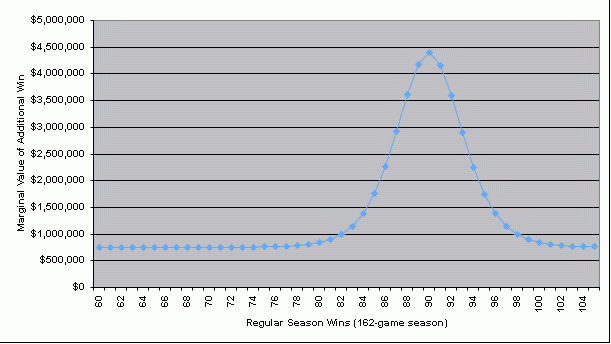
Get those couple of wins needed to make yourself a contender, and free agent contracts will pay for themselves. There’s the cost of a draft pick, but for a team a Kyle Lohse away from being seriously competitive, that’s the cost of running a successful team. Who is just a couple of wins away from contention, though, and can compensate for or lessen Lohse’s deficiencies?
The Rangers, who have been connected to Lohse, can't do anything about giving him a better park to pitch in. And pitching for an AL team, Lohse would have to face a lot of DH's. With their defense, though, and in a division loaded with pitchers' parks and the Astros, he might be worth it as someone to solidify the back-end of a rotation that features sometimes starter, sometimes reliever Alexi Ogando, 22-year-old Martin Perez, and eventually, elbow surgery recipient Colby Lewis. The Rangers are ahead of the above win curve, but now that the Angels have loaded up again, the Athletics won the division in 2012, and Texas suffered the losses of Josh Hamilton and Mike Napoli, they still fit the bill in places where wins can be added.
Plus, who else might vie for his services? The Royals could use someone like Lohse a lot more than Luke Hochevar or Bruce Chen, especially after trading Wil Myers and more for a win-now starter like James Shields. But, since they are paying Hochevar and Chen, they probably can't afford Lohse. The Cardinals wouldn't need to sacrifice a draft pick, but their rotation is full, and they're publicly uninterested. The Orioles, who have an eight-man rotation with maybe two-and-a-half real starters in it, could also use (and afford) Lohse, but the draft pick might be the deal breaker.
Compensation delayed the initial Lohse market, and might keep him from making the kind of bank that similar hurlers have this winter. If he’s in the right place, though, he should be able to earn his keep, compensation included. If someone will give him a chance.
See More:


