The valuable manager is the one who isn't flummoxed when he doesn't have an obvious solution to a problem. Handed Rickey Henderson, Wade Boggs, and Babe Ruth, any manager would probably decide to bat them in that order -- speedy OBP guy first, high-contact OBP guy second, power-hitter third. That isn't proof of his managerial IQ, but more like proof that he can think at all. It's when the manager is given something less obvious, say Willy Taveras, Scott Rolen, and Joey Votto, that you need him to be thoughtful and perceptive about the skills of all the players involved and make a smart decision.
10 years after the Bartman Game, Dusty is still to blame
Sometimes a team willingly swallows the hemlock that will destroy it -- just ask the Marlins, who are laughing a little more than a team in their position should.

Christopher Hanewinckel-US PRESSWIRE
Today is the 10-year anniversary of Game 6 of the 2003 National League Championship series between the Marlins and the Cubs, better known as the Steve Bartman game. As our Al Yellon suggests here, Bartman was a scapegoat:
What Dusty Baker did in the aftermath of the Bartman incident was unconscionable. Managers have very few moments during the course of a game where they can singularly affect what goes on in the subsequent action. This was one of those moments... Mark Prior was rattled. His focus and concentration had been broken. Remember that Prior had just turned 23 and was in his first full major-league season. Right then it was the manager's job to come to the mound and slow the game down. ... Some managers would have brought in their closer at that point, given that Prior had thrown 112 pitches... But none of that happened. Baker sat on his butt until it was too late. That's his singular failure as a manager.
I disagree with Al in one way and one way only, and that is his use of the word “singular.” Singular in this context would suggest “extraordinary, remarkable, exceptional.” I would argue that Baker’s failure to intervene in the Bartman game may be his most exceptional in-game failure, but that his overall failings as a manager are systemic and therefore not exceptional, but get repeated day in, day out.
Baker finds himself unemployed just now, let go by the Reds after six years with the team and 20 years as a big-league manager overall. The proximate cause of his dismissal might have been his handling of his pitching staff, particularly in the Wild Card play-in game with the Pirates, and there's something to that: Managers have become so rigid about the situations in which they go to the bullpen, and relievers so good, that teams don't blow too many good performances by their starting pitchers anymore. Baker always has been about average or a little below average in that department, pushing a little too long. The Bartman game was emblematic of that. The Johnny Cueto game, in its own way, was emblematic of that as well.
Find more Cubs news and views at Bleed Cubbie Blue More Reds info and invective at Red Reporter Be reminded the Marlins still exist at Fish Stripes
As a former outfielder, you would think Baker would have more empathy for the offensive side of the game, but his antipathy to on-base percentage as a measure of offense is well known, and once you subtract his having Barry Bonds, one of the greatest hitters of all time, on hand in San Francisco, most of his offenses haven't been good. The extent to which an optimized batting order can have an impact on a offense has been overstated, but Baker has long since proved that unless he's given an obvious leadoff man such as Kenny Lofton he can't or won't put a good player in the leadoff spot. Consider the rankings his team's leadoff-spot OPS over the years below. It took the arrival of Shin-Soo Choo for Baker to have his leadoff breakthrough, and even then you have to wonder if the general manager ordered him to put Choo there.
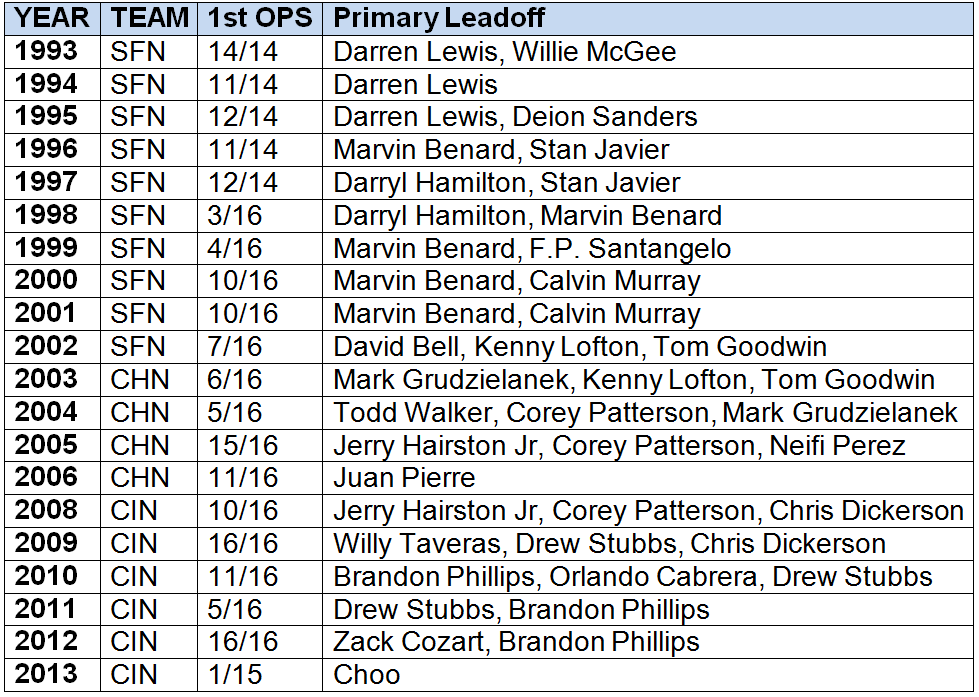
Baker balanced out Choo's excellence by scorching the earth around his No. 2 spot, getting less production from his hitters at that position than any team on the circuit except the Miami Marlins.
Baker's saving grace was that he was supposed to be a player's manager, someone whose charges would run through a wall for him. The thing is, at key moments it hasn't been true. The Reds went cold down the stretch this year and played sloppily in the wild card game, and in the aftermath of the '03 Game 6 debacle, his players were ready to surrender (see the quote from Moises Alou in the piece linked above). When a manager who is strategically inept but is supposedly inspiring fails to inspire, there really isn't a great argument for his continued employment. Five division titles in 20 seasons of managing is better than, say, Jimmy Dykes did, but Jimmy Dykes never managed Barry Bonds or Joey Votto or Kerry Wood and Mark Prior at the short-lived peak of their powers. Affability has its limitations, and Baker has convincingly demonstrated them over the last 20 years.
The relevance to the Bartman Game is this: You can never know what would have happened had another manager been running the '03 Cubs or any of Dusty's teams. Maybe the Cubs would have lost that game with Connie Mack or John McGraw as the manager. Anyone can win or lose a postseason game on a bad hop or two -- entire World Series have turned on plays like that, misplays that owe everything to chance and nothing to skill. Yet, to invoke Branch Rickey's famous aphorism, luck is the residue of design, and what seems equally possible is that a team with a skipper who was more able to accentuate his team's positives instead of emphasizing their weaknesses might have scored more runs or allowed fewer and therefore not been in the position of needing to win a close game in the first place.
Today the Marlins are having an unearned laugh at the expense of Cubs fans’ pain:
That was a good night. RT @MLB 10 years ago today, THIS happened at Wrigley: http://t.co/42IiYk3II6 pic.twitter.com/rwST22iM04
— Miami Marlins (@Marlins) October 14, 2013
They should know better: A team is always one pitch away from having the forces of entropy scatter their winning effort to the winds, or having the owner gut the team to service his own cupidity, which is just another way of saying the same thing (Jeff Loria: The Banality of Avarice). Sometimes a team willingly embraces the very thing that is going to destroy it. In the Marlins’ case, that’s their owner, and they cannot escape him. In the Cubs case, it was an ownership and front office that put their trust in a highly flawed manager. They have subsequently shed all three. Guess which one is better off now?
More from SB Nation MLB:
See More:


