Last week, the Braves signed young shortstop Andrelton Simmons to a seven-year, $58 million extension. He is but the latest in a cavalcade of contract extensions the Braves have extended to their maturing young players, with Jason Heyward, Craig Kimbrel, Julio Teheran, and Freddie Freeman preceding Simmons to the railway car in Compiègne for the formal signing. After a quiet winter in which an onslaught of current and future arbitration cases seemed destined to overwhelm a team whose conservative ownership and outdated television contract has them on a fixed budget, the Braves have locked the core of their team in place.
Can the Braves’ Andrelton Simmons keep it up?
Simmons had a historic defensive season in 2013, setting himself up to receive a contract extension taking him through 2020. But how often do shortstops repeat at such a high defensive level?

Daniel Shirey-USA TODAY Sports
 More from our team sites

More from our team sites
It is cliché to quote "The Godfather," but in this case I find it unavoidable, because the sudden spasm of activity out of Atlanta is so reminiscent of the climax of that film. "Barzini is dead. So is Phillip Tattaglia. Moe Greene. Stracci. Cuneo. Today I settled all family business." The Braves have indeed settled almost all family business, except perhaps for Mike Minor, and for all we know he's up next. The problem is the analogy breaks down when it comes to the real world: The credits never roll on a baseball team. There is nothing like solving your problems with the permanency of murder, but only temporary accommodations with entropy. By this I mean that the Braves have committed to the players that they have out of necessity, but having done so they still need to win the bets they have placed -- and chances are, in at least some cases, they will prove to have guessed wrong.
One easy candidate for first-guessing is the way that Heyward’s two-year extension closes out his arbitration years but stops short of delaying his free agency. A defensive standout in right field who four years into his major league career has alternated solid offensive campaigns with anemic showings that were frayed by injuries. Just 24, he’s still in the prime of his career and even if his hitting level settles somewhere between his 2010 (.277/.393/.456) and 2012 (.269/.335/.479) and he never has the kind of MVP-level offensive season predicted for him as a prospect, when you combine that kind of hitting with a standout glove you have a seriously valuable player who the team may come to regret not reserving for their future use. (Of course, with all of these extensions of late, it’s fair to wonder if the Braves settled for two years because it’s all they could get Heyward and his considerable talent to agree to.)
More from Jane Hammond at Talking Chop: Braves Support Venezuela Schuerholz, Wren talk Heyward and extensions
Nothing stops the Braves from signing Heyward to another extension any time between now and the expiration of his deal, but what they risk is that he has another strong season or two or even takes a step forward and then will require a serious premium to keep. Given that Freeman’s relative lack of power might mean that he’s just a mid-range run-producer in a typical season (read: one in which he does not hit .319), Kimbrel might not be able to maintain his current level of dominance (very few relief pitchers do), Teheran is relatively unproven, and Simmons almost certainly cannot maintain this high level of defense, Heyward may prove to have been the real keeper in the bunch.
The Simmons deal has been widely hailed as a victory for the Braves, and given the nigh-historic season he had in 2013 it’s tough to argue that it’s anything but. In signing the shortstop through the 2020 season, the Braves wiped out all of Simmons arbitration years (which were not necessarily imminent given that he might or might not have qualified for 2015) and his first two years of free agency. In return, Simmons receives the security of a long-term contract and $58 million. His annual salary will start at $1 million this year and rise to $15 million by 2020.
By one measure, Baseball-Reference's fielding runs, Simmons had the best defensive season by any shortstop in history last year, pocketing 41 more runs than the average player at his position. The previous best had been 35 by Mark Belanger with the 1975 Baltimore Orioles. Simmons is a genius with the glove, as any highlights video will show you, but his bat is still a work in progress -- .248/.296/.396 qualifies as "in progress" -- so unless he takes a step forward at the plate, it's his fielding that will keep him in the ranks of the elite players. Given his age -- he's just a month younger than Heyward -- that offensive improvement is a real possibility, but is it realistic to expect consistency with the glove?
The answer is both yes and no. By definition, the best defensive season ever is unprecedented, and it’s unrealistic to think that a player will maintain at that level or continue to top himself. This may not even be wholly attributable to the player -- imagine a scenario in which Simmons or Belanger or Ozzie Smith winds up in front of the wrong pitching staff in the wrong season -- a bunch of fly ball-inducing right-handers who face a disproportionate number of left-handed hitters. The great defensive shortstop would be all dressed up with no place to go, because you can’t field grounders that aren’t hit to you.
That's an extreme hypothetical, but consider that there hasn't been anything like consistency at that level, perhaps because just as players have good offensive seasons and bad, they also have good defensive years and bad ones, fighting injuries and the distribution of baseballs. Simmons is the only shortstop to reach the 40-run plateau, and just eight other players have had seasons of 30 or more in the last 112 years. None have reached that plateau more than once, whether we're talking about Belanger, Smith, or more recent players such as Jack Wilson, Adam Everett, and Troy Tulowitzki.
That is not to say that, given good health, Simmons won’t continue to play defense at a high level, assuming we define “high level” as “about a win above average.” As you can see from the table at right, if that’s all you expect, you shouldn’t have too many disappointments. However, at that higher, two-win level? Those seasons are few and far between; even the best shortstops have failed to perform consistently at that level. Again, some of that may be the fluctuations of ability and results that ballplayers experience in all phases of the game from year to year, some the distribution of baseballs -- there are only so many balls hit to shortstop each year that would be just out of reach for the average infielder but are gettable by a superior glove like Simmons’.
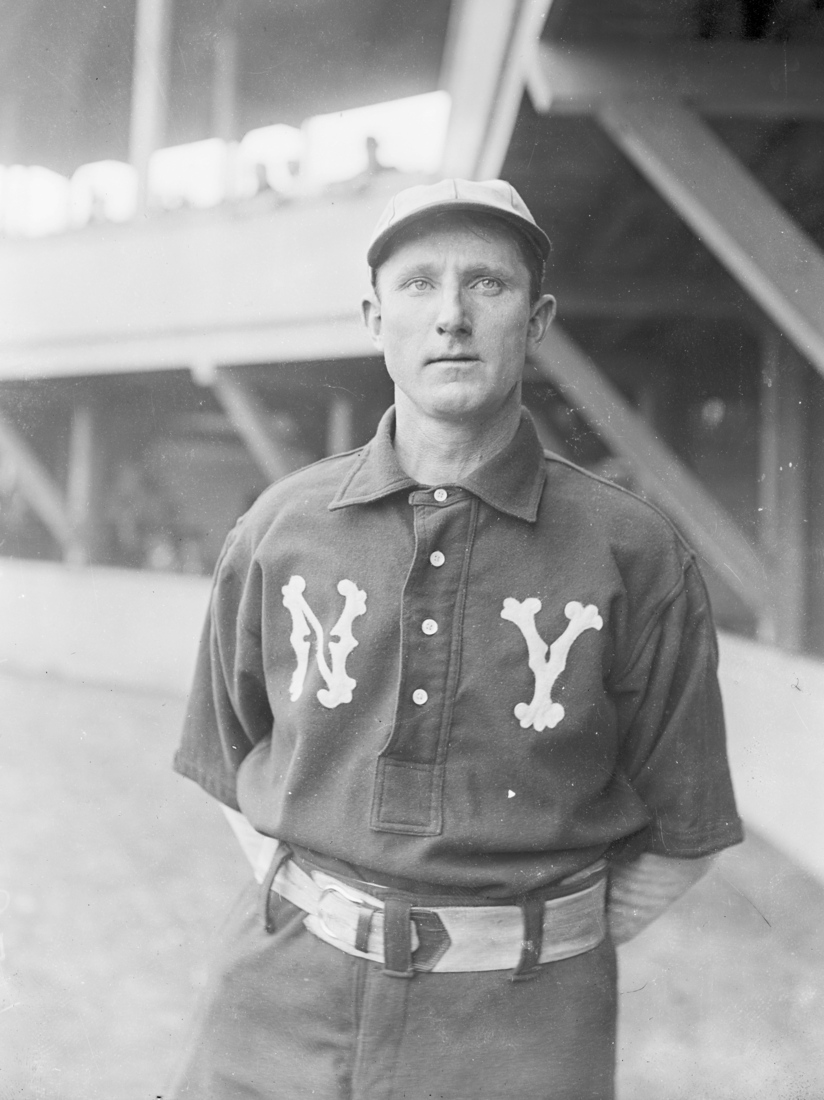 The Braves' franchise leader in games played at shortstop remains Herman Long, who last suited up for the team in 1902. (Getty Images)
 Now, Simmons could lose two-thirds of those runs on defense, still be a well above-average glove, and offset it all with better offensive production and would therefore still be worth it to the Braves, but that’s all speculative. Many commentators have pointed to Simmons’ very low batting average on balls in play last year (.247 against a league average of .297) as reason to believe that better offensive seasons lie in his future. Again, that’s possible, but we don’t know -- it remains in the realm of possibility that Simmons could stagnate offensively and fail to put up more historic defensive seasons.
None of the foregoing means that Simmons wasn’t a gamble worth taking, but given that he wasn’t anywhere near arbitration eligibility, it might have been worth delaying until he had a second full season in the books -- if year two was not as defensively dominant, the Braves would have had a better perspective on the range of possibilities for Simmons: either he’s an unprecedented defensive talent or he’s going to regress.
Regardless, the Braves' flurry of contract extensions, the result of the club's more optimistic economic profile in the wake of its decision to pursue a new stadium in the Atlanta suburbs, is good news for fans that were bracing for the core of the team's talent to fly away due to restrictive budgeting. What isn't clear is if the first great career shortstop in Atlanta Braves history has finally arrived. On a one-season basis it has already happened. The rest of the story has yet to be told.
See More:


