All things considered, the first quarter of the 2013-14 season should be viewed as a success for the Charlotte Bobcats. Even with the stagnant development of Michael Kidd-Gilchrist and Bismack Biyombo, first-year coach Steve Clifford has the team playing pretty good basketball -- if the season ended Thursday, Charlotte would have the No. 5 seed in the Eastern Conference.
The Bobcats are getting better, but they can’t shoot
Things have looked better in Charlotte lately, but the Bobcats still lack probably the most important skill in the modern NBA.

Jeremy Brevard-USA TODAY Sports
 Bookmark This
But looking closer at the team’s resume, it seems like the Bobcats are taking a pretty unconventional route to short-term success. Where the rest of the NBA has become enamored by the three-pointer and its almighty efficiency, Charlotte has been quite comfortable going in the other direction.
More Bobcats coverage

More Bobcats coverage
If there’s any overarching truth in the modern NBA, it’s the power of shooting. For everything that coaches do to trick defenses and find open shooters, making shots is the single most valuable skill in the league. Right now, no team is worse at making long distance shots than the Bobcats.
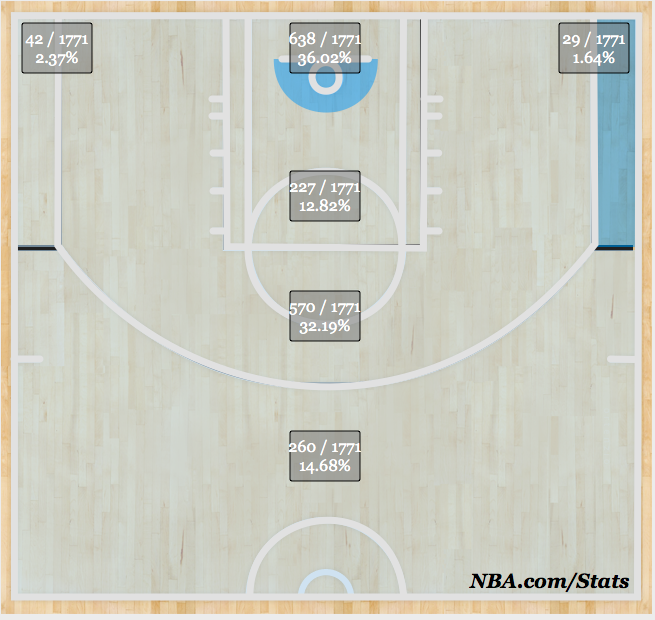
But in this day and age, the formula is putting them at a distinct disadvantage.
Compare that chart to the same one for the Heat:
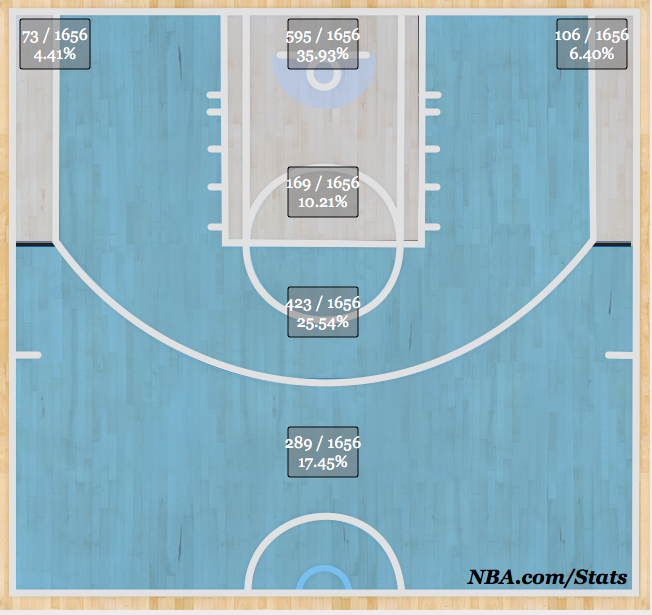
The Bobcats take 19 percent of their shots from beyond the arc and 32 percent from mid-range, via NBA.com. For the Heat, those same numbers are 28 percent and 25.5 percent, respectively. Considering teams typically hit shots from 18-20 feet at a similar rate to shots from 23-25 feet, you can see the easy math behind Miami’s decision-making. Three is greater than two.
And it’s not just the volume of three-pointers; Charlotte is taking worse three-pointers than a team like Miami as well. Statistically, corner threes are hit at a much higher rate than threes on the wings and at the top of the key. But the Bobcats take just 21 percent of their threes from the corners. It’s 38 percent corner threes for Miami.
In the end, this all puts the Bobcats’ offense at a standstill. Even with the high volume of free throws, defenses are happy to give up some of those post opportunities at the expense of open corner threes, essentially the bane of every coach’s existence at this point. It’s an offense that’s failing to strategically take advantage of its opportunities.
And then you look at who's actually shooting the threes. Of the roughly 13-14 three-pointers that Charlotte takes each game, nearly nine of them come from Josh McRoberts, Jeff Taylor and Anthony Tolliver. Gerald Henderson and Ramon Sessions aren't taking threes. Ben Gordon has lost his shot. Kemba Walker's taking them, but hitting just 32 percent of his attempts.
It’s become a fundamental problem for the Bobcats’ offense. They’re just not challenging defenses in a meaningful way from beyond the arc, and it’s allowed teams to adjust and challenge them to win inside. In the perimeter-oriented game of the present day, that’s a questionable formula, particularly when your post options aren’t incredible. Remember, we’re talking about Big Al and McBob here. Not exactly world-beaters.
And all of this stands to hold back a legitimately improving team. On defense, on the boards ... the Bobcats have become a seriously formidable bunch. But this is a shooter’s league, and Charlotte’s poor shooting will likely be its Achilles’ heel. Teams embrace shooting for a reason, and the Bobcats will likely need to follow suit.
More from SB Nation NBA:
See More:


