Avery Bradley has spent his first three seasons in the NBA developing a reputation.
Can Avery Bradley be more than a specialist?
We know Avery Bradley is one of the NBA’s best defensive guards, but with the Celtics now rebuilding, can he seize the opportunity to be something more?

USA TODAY Sports

Ricky O'Donnell has covered basketball at all levels for more than a decade at SB Nation. He’s currently the Associate Director of Programming.
From running down opposing guards in the open floor for LeBron-like chase down blocks, to his signature brand of full-court pressure defense, Bradley’s consideration as one of the NBA’s most ferocious on-ball defenders is no accident. Last season, opposing players shot just 30.8 percent when they were being guarded by Bradley. He allowed only 0.697 points per play defensively, the best mark in the league, as ESPN Boston noted.
Bradley is the NBA’s wiry straightjacket, a sub-200-pound package of athletic fury, competitive fire and dogged determination. As Bradley enters a contract year in his fourth season, he’s now out to prove he’s more than just a defensive specialist.
Bradley’s ability to carve out a niche at the beginning of his NBA career has been impressive, but he wasn’t always considered a one-trick pony. Bradley was a consensus top-five recruit out of high school in 2009, ranked No. 1 overall by ESPN, ahead of players like John Wall, DeMarcus Cousins and Derrick Favors.
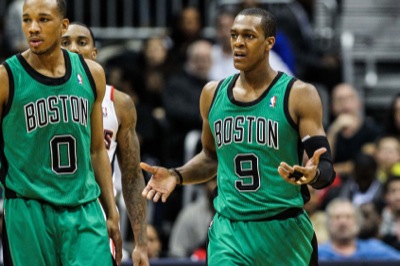
Upon his commitment to Texas, Rivals wrote that Bradley was “a big time scoring threat from the off guard position” and added “there might not be a better midrange scorer in the class nor a better on the ball defender than Bradley.”
It was high praise he couldn’t live up to during his one season with the Longhorns. Bradley averaged 11.6 points per game on 43 percent shooting from the field for a Texas team that was ousted in the first round of the NCAA Tournament as a No. 8 seed. That isn’t the type of substantial impact top recruits are supposed to have as freshmen, but it was enough for the Celtics to nab Bradley at No. 19 overall in the 2010 draft.
Since entering the pros, Bradley’s career has been distinct by battling injury. As a rookie, he lost his first training camp while recovering from surgery to repair bone chips in his left ankle. The lockout wiped away the opening months of his second season, and a shoulder injury halted his progress in the first round of the playoffs just as it seemed he was breaking out. Last season, Bradley missed the first 30 games of the year recovering from offseason surgery on both shoulders.
Boston has never had to question his impact when he’s on the floor, though. The Celtics won six out of Bradley’s first seven games back last season, and looked like they could be another tough out in the playoffs before star Rajon Rondo tore his ACL in April.
Bradley turns 23 years old days before the start of the new season, already with three years of experience under his belt. Rondo will be back sooner rather than later, but the Celtics will have an unmistakably different feel. Doc Rivers is in Los Angeles, Kevin Garnett and Paul Pierce are in Brooklyn. Brad Stevens, the new coach of the Celtics, is the youngest in the league and has spent the majority of his career competing in the Horizon League.
 Visit Celtics Blog for even more Celtics coverage.
 It’s a new day for the Celtics, but one that doesn’t come without its own intrigues. Bradley is at the forefront of that, with this season dictating not only his next contract, but also his future in Boston. The Celtics are loaded with future first-round picks and could be poised to make a move for a star-level player in the next year or two. Whether Bradley is part of the Celtics’ core moving forward or merely an intriguing trade chip depends on his development.
Bradley has reportedly added 15 pounds of muscle this offseason, and the added strength could go a long way. There aren’t many pro shooting guards weighing in at 180 pounds. Bradley did last season. He was regularly giving up 30-40 pounds a night against other starting shooting guards in the Eastern Conference. Joe Johnson, of the Celtics’ division rival in Brooklyn, actually had a 60-pound weight advantage over Bradley.
The extra strength should help Bradley finishing at the rim, where he converted only 46.4 percent of his 153 attempts last season. The Celtics are also hoping it helps keeps him healthy.
Don’t let the single-digit PER he posted last season fool you: Bradley is the type of player winning teams need to have. Now it’s up to him to prove he’s more than just an elite perimeter stopper.
More from SB Nation NBA:
See More:


