
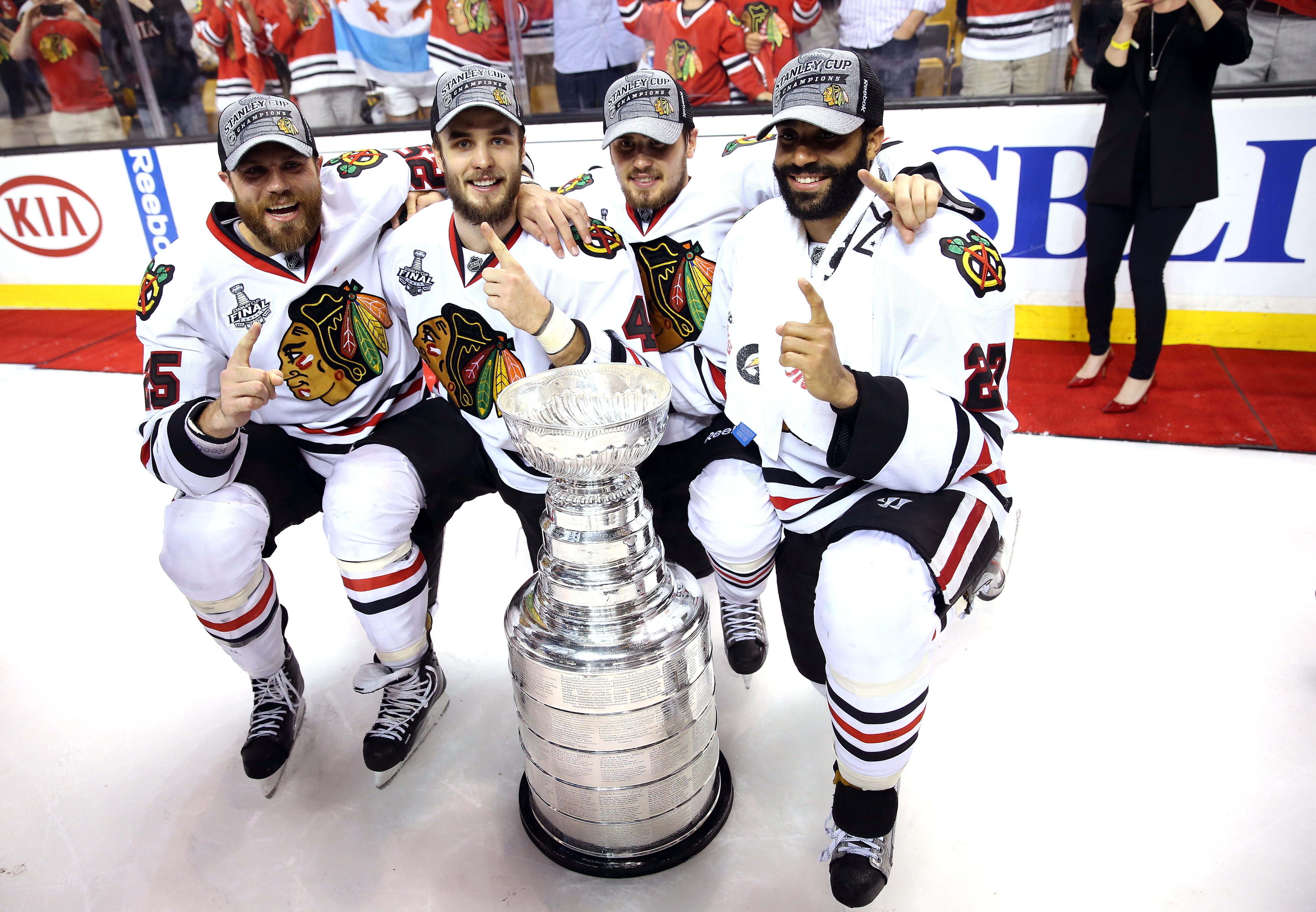
BOSTON -- It's appropriate the Chicago Blackhawks became the first Stanley Cup champion to win multiple titles in the salary cap era of the NHL, as the Blackhawks were able to adapt despite having to shed salary after winning in 2010 to capture another championship just three years later Monday night in Boston.
Stanley Cup Final: 2010 purge didn’t decimate Blackhawks
The Blackhawks shipped away half their team following their 2010 win, making their quick rebound even more impressive four years later.
Back in 2010, the Blackhawks went all-in for a Stanley Cup championship and maxed near the cap, in part thanks to the addition of big-ticket free agent Marian Hossa on a 12-year, $62.8 million contract. Thanks to the gamble, Chicago was able to capture the team's first championship since 1961, but even as the players skated the trophy around the ice in Philadelphia, they did so full-well knowing that would be the end to that group.
The Final we deserved
 We almost didn't get NHL hockey this year, but we waited and were rewarded with the Stanley Cup Final we all deserved.
 With Patrick Kane and Jonathan Toews owed big raises in the summer following the 2010 Cup win, major changes and salary dumping was inevitable as Chicago.
Days after the parade, Chicago traded away Dustin Byfuglien, Ben Eager and Brent Sopel to Atlanta, Colin Fraser to Edmonton, Kris Versteeg to Toronto and Andrew Ladd to the Thrashers. In July Chicago had to match an offer sheet from San Jose for Niklas Hjalmarsson, forcing them to part wit starting netminder Antti Niemi.
Chicago was squarely against the salary cap, having gambled the one run at the Cup would pay off. But thanks to some shrewd move and good drafting, the team retooled quickly and was able to challenge again for the title in short order.
Of the four past Stanley Cup champions who ended up in the Conference Finals this season, Chicago had undergone the biggest transformation. The Kings were still largely intact from last year's club that was able to capture the trophy. Boston had a very similar core from the one in 2011, the biggest difference being in goal. And the Penguins were perhaps better than the team that won in 2009, having added Jarome Iginla and loaded up themselves at the trade deadline.
But Chicago was the one that had the most dramatic turnover, as while the core of Patrick Kane, Jonathan Toews and Patrick Sharp remained intact, the supporting cast largely changed. And despite the changes, the Blackhawks didn't fade from contention despite being squarely up against the salary cap, they were able to remain competitive, and Monday night, captured just the fifth Stanley Cup in team history three years after its last.
“I think there’s something about our core,” Patrick Kane said about 2010 and this year’s team. “Hopefully we can stay together a long time, because that’s two Cups in four years, and we seem to only be getting better and better as players as time goes on here.
“It’s unbelievable to be in this situation. There’s role players on the 2010 team that meant a lot to us that couldn’t stay for us for the next year. I think nine or ten or 11 guys got moved, and the Blackhawks did a great job of drafting and filling in those holes. You look at guys they drafted: [Brandon] Saad, [Andrew] Shaw, a big trade for [Nick] Leddy who’s going to be a big player in the future. And then just little signings like Rozsival, picking up Stalberg who’s got great speed. We can go up and down the line and name off guys and how they contributed to this team and this game. It’s just a great group, and it’s going to be fun to celebrate with them.”
This time around, despite the cap going down to $64.3 million in 2013-14, Chicago is in much better shape to retain some of its role players, with this year’s club relying on younger skaters for depth than the last title team.
Asked about the possibility of a third Cup for this group, coach Joel Quenneville simply wanted to enjoy the one he had just won.
“We’re going to enjoy this one first and have fun with it, and then we’ll talk about that one.”
With that has shown the ability to adapt in the salary cap era, the Blackhawks will certainly be a threat to win the Cup again in short order, and this time around, the Blackhawks won’t need to make major changes for their title defense next season.
More in the NHL:
See More:


