Red Sox and Giants fans have something to argue about to distract them from the possible lack of playoff appearances. Both fan bases have pointed fingers at bloated contracts for players that aren't producing as part of the reason they sit where they do in the standings, and they should, as each team has one of the players that best represents why it's often a bad decision to spend big on free-agent pitching.
Barry Zito vs. John Lackey... Fight!
In a battle where there are no winners, who comes out on top, John Lackey or Barry Zito?

Getty Images
Before the 2010 season, John Lackey signed a five-year deal for $82.5 million with the Red Sox; for their money, the Sox have received a performance that could generously be described as that of a fifth starter. Barry Zito signed a seven-year, $126 million deal with an option for an eighth season before the 2007 season, and while the Giants have won a World Series in that stretch, attributing much of the credit to Zito, who has also pitched like a back-end starter, would be disingenuous at best.
But which of these two has it worse, from this point forward? Other than financially, as both of them are owed roughly $46 million over the rest of their contracts (three years for Lackey, and two years plus a $7 million buyout for Zito)? To figure this out, we turn to the age-old dispute settler: Street Fighter II.

Barry Zito’s Move Set
- Sweeping Curveball: ←, ←, ↓, Punch. While this curveball was sharper and more effective in older versions of the game, it's still a powerful weapon in the right context.
- Left-Handed Flurry: ↖, ↗, ↘, ↙, Punch. Unlike the Dread Pirate Roberts, Zito actually is left-handed. He can't hit as hard as right-handers, but this move lets him assault his foes with a flurry of lower-velocity punches, in order to help him set up that curve.
- AT&T Park: ↑, →, ↓, Kick: This move will transport the fighters from wherever they are to Zito's home park in San Francisco, but we're not sure why he would do that. Sure, it will make Zito more effective, but Lackey only serves to gain from switching divisions and home stadiums.
- Hadouken: ↓, ↘, →, Punch: Baseball fans and Street Fighting enthusiasts alike are perplexed by Zito and his decision not to use his hadouken against opposing batters, but given he has hit 88 batters with pitches in his career, this decision was probably for the best.
John Lackey's Move Set
- Texas Heat: →, ↓, ↙, Punch. Lackey's heater isn't the best Texas has ever seen, but he can still utilize the inherent powers of his native state to decimate opponents. He has taken that very literally in 2011, as he leads the league with 19 hit batsmen, and has plunked 101 in his career.
- Cold Stare: ←, ←, Block: Lackey deflects incoming attacks and counters with a stare that freezes opponents in their tracks. This was used in combat as recently as Monday night, and is his go-to tactic following a poor performance:
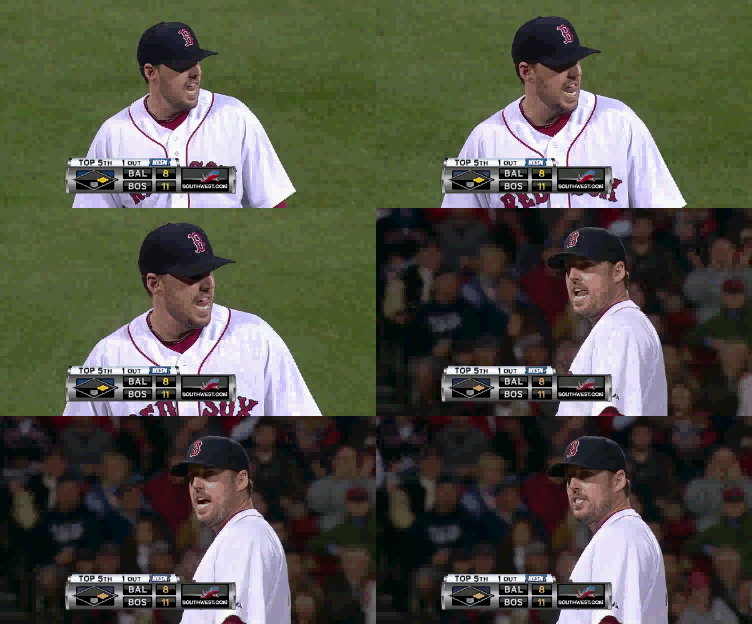
Lackey doesn’t have any other tricks up his sleeve. Why else did you think he was pitching so poorly this year?
Conclusion
In the end, you have to like Lackey over Zito, as he has pitched in a more difficult environment in terms of both his home park and his division, while Zito has been able to skate by with help from some offensively-anemic division foes as well as a pitcher-friendly home park. Lackey is owed the same amount of money as Zito, and has an extra year on his contract, so you get more for your money (in a sense, at least). There’s also the high likelihood that Lackey is in need of some medical attention, as the cortisone shot in his elbow earlier in the season indicated -- considering he’s been worse the further away from that shot he gets, it’s a theory worth throwing out there. Zito, on the other hand, is just not very good anymore.
Of course, with the way these two have been, it wouldn’t be surprising if they both just sat at opposite ends of the screen shooting off hadoukens at each other in between jumping out of the way of the previous hadouken.
See More:


