As you’ll likely recall (though if you blocked it from memory already, we understand and are impressed), Penn State defeated Michigan in a 43-40, four-overtime thriller on Saturday. The game looked to be in Michigan’s hands at the end of regulation, with Penn State needing to go 80 yards in under a minute with no timeouts, then doing precisely that for the tying score.
Conservative play-calling doomed Michigan at Penn State
Michigan faltered in overtime in its 43-40 loss to Penn State, but its biggest failures were at the end of regulation, before Penn State even got the ball back.

Matthew O’Haren-USA TODAY Sports
The overtime was its own cavalcade of blunders, none of which merit much revisiting (unless you want to read me saying “you shouldn’t miss field goals or commit turnovers” for 450 words, which I doubt), but let’s go back to the fact that Penn State was driving for the tie in the first place.
With 3:10 left in the game, Michigan faced a 1st and 10 at Penn State’s 28-yard line with a 34-27 lead. Penn State was out of timeouts, which meant that another first down would effectively end the game. Penn State would have a tough task of scoring no matter what, but central to that task was one condition: Penn State gets the ball back in a one-score game. If Michigan doesn’t allow that, it wins.
Bleeding the clock was important too, obviously, as the clock was a Michigan ally. Leaving as little time as possible on the clock before Penn State sees the ball again makes the task of scoring more difficult, of course, but only incrementally so, and with the timing rules stopping the clock after every first down the “no timeouts” thing isn’t nearly as big a deal in college as it is in the pros. But using time in that situation pales in comparison to getting that one more first down, as there’s no team that can clear three minutes off the clock in four downs. No, not even in the Big Ten.
So what does Michigan do? Obvious run by Fitz Toussaint, one-yard gain. Obvious run by Fitz Toussaint, no gain. Then a delay of game penalty on third down which made things substantially worse, but again, it should never have been in that position to begin with. Toussaint and the Michigan offensive line had virtually zero success against the Penn State front all game long (a pattern that continued into overtime). Devin Gardner hadn't had a perfect game by any stretch, but he ended up averaging 8.6 yards per pass and 5.0 yards per rush on the day. Toussaint: 27 yards on 27 carries. All you need is 10 yards and the game's over; use the guy that can get you them.
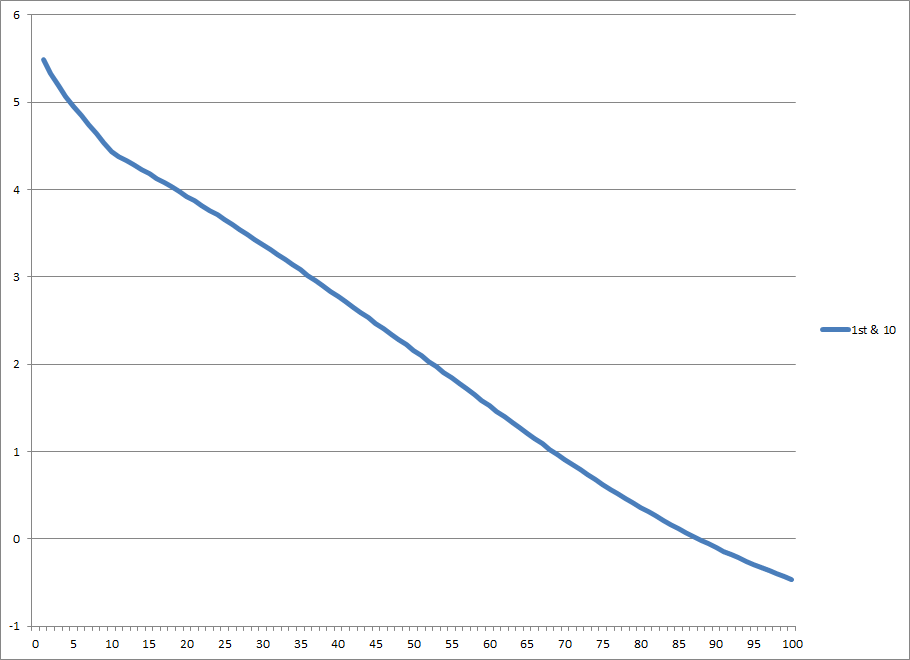
Michigan’s conservative approach doomed itself. With a 1st and 10 at the 28, per Outside the Hashes, Michigan’s expected points were about 3.5. And the Wolverines didn’t even need points, necessarily; just a first down would have won the game, and any substantial gain of yardage would have solidified Michigan’s place in comfortable field goal range.
Instead, Michigan called the plays that almost never worked that day, and sure enough, those plays didn’t work. Michigan’s expected points dropped down to 2.2 points on third down even before the false start; after that, it was 1.5.
And so Michigan went right back to Toussaint and lost three more yards.
Even then, even after Brady Hoke took the ball out of his play-making quarterback's hands, Michigan could still ice the game with a made field goal or a first down. Going for it on 4th and 17 probably wasn't going to end well (though it could have). A field goal was on the very edge of Brendan Gibbons' range, but that hadn't stopped Michigan from letting Gibbons make one from 52 against Nebraska last year, and it didn't end up stopping Michigan from trying a 52-yarder to end regulation. That one fell short, but not by much, and with a game-clinching score at stake it's probably worth more of a shot than giving up on scoring altogether.
Yet giving up on points is exactly what Michigan did, giving Penn State its one shot at tying the game, and we know what happened from there.
That was a farcically mismanaged last possession by Michigan once victory was in sight. That more confidence was shown in the unproductive ground game than in Devin Gardner (who finished with 361 total yards, even after being effectively neutered by play-calling in the last couple minutes and overtime) is, to put it bluntly, a mistake. Yes, Gardner committed three turnovers in the first half, but Toussaint was virtually never an effective option for the offense, no matter how many times Hoke called his number. Hoke ignored his offenses’ successes and failures on the day when the situation was most important, and he paid for it by handing his team a loss in a game it really, really should have won.
More from SB Nation college football:
See More: