Hello. This is the silliest thing you’ll read all offseason, probably. It solves no problems, offers no lessons for the future, and only ends up affirming that there are many college football teams at the FBS level. In short, it is very important, and yes, we all have too much free time on our hands in March.
Directional Michigan: Combining the MAC’s 3 Michigan schools into a SUPERPOWER
Central, Eastern, and Western Michigan have had a few years of individual football success here and there. But what if they’d joined forces at some point to create a single university with a single football program?

Let us now begin constructing the Directional Michigan football program by smashing together the middling MAC programs at CMU, EMU, and WMU. I will not apologize for spending a small portion of my life on this.
Location
First, we’re going to need a place to put Directional Michigan University, home of the DMU Directionals. The team could try playing football games in three different cities. But no. We’re going to combine three universities into one and plunk it down at a central location. Not a Central location.
This part is easy. First, the MAC map, via Wikipedia:
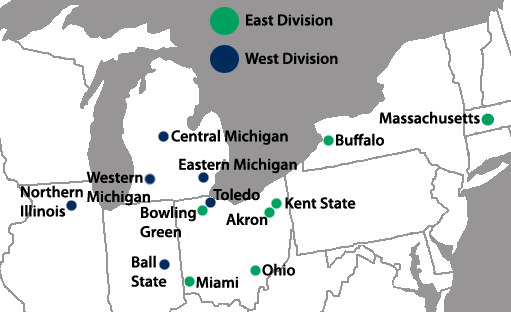
Next, we can eyeball the triangulation between Kalamazoo, Mt. Pleasant, and Ypsilanti, via Google Maps:

And so it’s settled. We’ll set up shop just north of Lansing, the state capital, whose metro area is about half a million. Michigan State’s about 10 minutes to the east. Also, our enrollment has just soared to about 75,000 students, making us the largest campus in the United States, but that’s not a sports thing.
Money
First things first.
The MAC Michigans currently rank Nos. 75, 80, and 88 in the latest athletic department revenue database. Combining their resources would rocket Directional Michigan to $82.7 million in sportsbucks. That would be good for No. 24 and ahead of Washington, North Carolina, and Nebraska.
But let’s note Directional Michigan wouldn’t need (“need”) anywhere near as much in school athletics subsidies. Central, Eastern, and Western currently give an average of $20.2 million per year to each of their athletic departments, according to USA Today. So let’s drop the school subsidy figure from three portions of $20.2 million to just one. That would leave us with $41.7 million in athletics revenue every year, both uniting the schools’ spending power and cutting state subsidy money by $41 million.
We’d lose another $200,000 because of Directional Michigan only getting one slice of the MAC’s ESPN contract, rather than three.
That new figure, $41.5 million (pending perhaps a few more minor deductions), would rank No. 60 among all FBS schools, ahead of programs like UCF, Utah, and Houston. That $20.2 million subsidy is still very large, and would rank No. 15 among FBS schools -- we could slash it in half and still be the MAC’s richest program. But we’ve already saved the system $41 million, so let’s hold for now.
Facilities and attendance
First order of business for all that money: build a new stadium. DMU can’t just play at the home of the Lansing Derby Vixens forever.
The Michigans’ current football stadiums were opened in 1939, 1969, and 1972. Each has been renovated or expanded within the last 25 years, but about as ornately as you’d expect.
The stadiums’ combined capacity is more than 90,000, but considering their combined 2013 attendance was all of 34,622 fans per week (mashing the three into one team means nearing ACC range, at least!), that’s a little bit roomy. So we won’t stack them on top of each other, quashing your dreams of the first MAC football arcology.
Here’s a way to figure out what kind of building Directional Michigan might have if it had ganged up a few decades ago. According to Wikipedia the three stadiums’ inflation-adjusted, combined construction budgets would come out to $106.6 million. That’s about what Houston announced in 2012 that it hoped to spend on this new 40,000-seater, which is about 12,000 seats bigger than the typical MAC stadium:
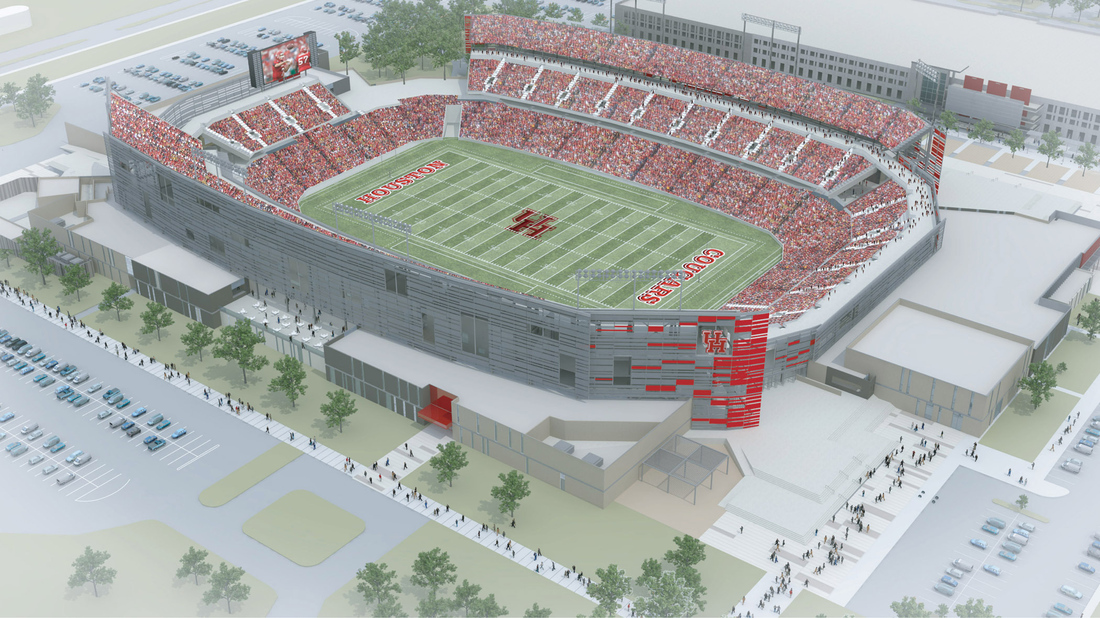
That would more than suit 2013’s attendance demands, and since Directional Michigan would actually win games, it would likely sell out now and then. Directional Michigan would challenge for the MAC attendance crown every year. We are really accomplishing things here.
Coaches
According to USA Today’s 2013 coaching salaries database, each _MU paid its head coach about $375,000 for the season. Pooling those budgets would’ve meant about $1.2 million for a head coach.
That would mean Directional Michigan could’ve perhaps lured Fresno State’s Tim DeRuyter or Bowling Green’s Dave Clawson (who both got big raises after the season), a top power-program coordinator (we* could give Michigan State defensive coordinator and Broyles Award-winner Pat Narduzzi a $300,000 raise over his 2014 salary), or a name like East Carolina’s Ruffin McNeil, Marshall’s Doc Holliday, Ohio’s Frank Solich, or Utah State’s Matt Wells. And maybe DMU could’ve kept Brian Kelly or Butch Jones from Cincinnati for another year or so.
* At some point, it felt right to start referring to Directional Michigan as “we.”
At worst, we could still turn stuff like this by Eastern Michigan ...
| 2013 | Ron English (2-10) |
| 2012 | Ron English (2-10) |
| 2011 | Ron English (6-6) |
| 2010 | Ron English (2-10) |
| 2009 | Ron English (0-12) |
| 2008 | Jeff Genyk (3-9) |
| 2007 | Jeff Genyk (4-8) |
| 2006 | Jeff Genyk (1-11) |
| 2005 | Jeff Genyk (4-7) |
| 2004 | Jeff Genyk (4-7) |
| 2003 | Jeff Woodruff (3-9) |
| 2002 | Jeff Woodruff (3-9) |
| 2001 | Jeff Woodruff (2-9) |
| 2000 | Jeff Woodruff (3-8) |
| 1999 | Rick Rasnick (4-7) |
| 1998 | Rick Rasnick (3-8) |
| 1997 | Rick Rasnick (4-7) |
| 1996 | Okay okay okay we get it, it goes on like this forever, make it stop, make it stop |
... into something more like this resounding hall of champions, made up of the most successful CMU, EMU, and WMU coaches:
| 2013 | Dan Enos (6-6) |
| 2012 | Dan Enos (7-6) |
| 2011 | Bill Cubit (7-6) |
| 2010 | Bill Cubit (6-6) |
| 2009 | Butch Jones (11-2) |
| 2008 | Butch Jones (8-5) |
| 2007 | Butch Jones (8-6) |
| 2006 | Brian Kelly (9-4) |
| 2005 | Brian Kelly (6-5) |
| 2004 | Brian Kelly (4-7) |
| 2003 | Gary Darnell (5-7) |
| 2002 | Gary Darnell (4-8) |
| 2001 | Gary Darnell (5-6) |
| 2000 | Gary Darnell (9-3) |
| 1999 | Gary Darnell (7-5) |
| 1998 | Gary Darnell (7-4) |
| 1997 | Gary Darnell (8-3) |
| 1996 | Dick Flynn (5-6) |
| 1995 | Dick Flynn (4-7) |
| 1994 | Dick Flynn (9-3) |
| 1993 | Al Molde (7-3-1) |
| 1992 | Al Molde (7-3-1) |
| 1991 | Al Molde (6-5) |
| 1990 | Al Molde (7-4) |
| 1989 | Jim Harkema (7-3-1) |
| 1988 | Jim Harkema (6-3-1) |
| 1987 | Jim Harkema (10-2) |
| 1986 | Herb Deromedi (5-5) |
| 1985 | Herb Deromedi (7-3) |
| 1984 | Herb Deromedi (8-2-1) |
| 1983 | Herb Deromedi (8-3) |
| 1982 | Herb Deromedi (6-4-1) |
| 1981 | Herb Deromedi (7-4) |
| 1980 | Herb Deromedi (9-2) |
| 1979 | Herb Deromedi (10-0-1) |
| 1978 | Herb Deromedi (9-2) |
| 1977 | Roy Kramer (10-1) |
| 1976 | Roy Kramer (7-4) |
| 1975 | Roy Kramer (8-2-1) |
| 1974 | Bill Doolittle (3-8) |
| 1973 | Bill Doolittle (6-5) |
| 1972 | Bill Doolittle (7-3-1) |
| 1971 | Bill Doolittle (7-3) |
| 1970 | Bill Doolittle (7-3) |
| 1969 | Bill Doolittle (4-6) |
| 1968 | Bill Doolittle (3-6) |
| 1967 | Bill Doolittle (5-4) |
| 1966 | Bill Doolittle (7-3) |
| 1965 | Bill Doolittle (6-2-1) |
| 1964 | Bill Doolittle (3-6) |
| 1963 | Merle Schlosser (2-7) |
| 1962 | Merle Schlosser (5-4) |
That’s such a fine list of leaders, we don’t even have room for the father of two NFL head coaches, Jack Harbaugh (25-27-3 at Western Michigan, 1982-1986).
Recruiting
Now for the most important component.
Instead of squabbling over who’s the No. 3 school in the state of Michigan, we’d automatically leave no doubt. And our upgrades in coaching, facilities, program prestige, the student body, and number of academic majors mean we could actually challenge Michigan and Michigan State for certain players.
As for how this would’ve changed 2014, I don’t know how else to put this. Western Michigan recruited the shit out of the MAC in 2014. Its 153.7 class rating in the 247 Sports Composite makes it the conference’s highest-rated class in the ratings era. It’s so far ahead of everyone else in the conference that runner-up Toledo could’ve added No. 1 national recruit Leonard Fournette and still finished short. That’s a ridiculous piece of evidence, but that’s what the internet says.
Creating a composite Directional Michigan recruiting class for 2014 is kind of pointless. Replacing the lowest-rated players in Western’s class with the best players from Central and Eastern (using 247 Sports’ Class Calculator) barely nudges the needle. Here’s WMU’s class with CMU and EMU players added in -- 14 of the top 15 are still Broncos:

But of course it wasn’t always like that. Central had the higher-rated class the previous two years, and Eastern ... isn’t always quite so bad.
Combining their 2013 classes bumps the Michigans from Nos. 4, 8, and 10 in the MAC to No. 1, for example. Nationally, the Michigans rise from Nos. 100, 112, and 114 to No. 72*, ahead of Boston College, Georgia Tech, and Syracuse.
After glancing at previous years, I think we can say Directional Michigan would be the MAC’s recruiting power almost every year. And that’s before we start blowing that $41.5 million on recruitment gadgets.
* Western Michigan’s 2014 class ranked No. 70 all by itself. Recruited the shit out of the MAC, I tell you.
Players
The simplest way to figure out the kind of talent Directional Michigan could generate is to go by NFL Draft picks. We could use the schools' All-America picks, but there aren't many. Or All-MAC picks, but the all-time All-MAC list isn't the simplest database to mess with.
Central had the No. 1 NFL Draft pick last year. Both Eastern and Western have had first-rounders, with five total all-time first-rounders between the three. Respectively Central, Eastern, and Western have had 17, 16, and 19 players drafted in the top 255 of a given Draft class (we’ll cut it off there, since the modern Draft goes for far fewer rounds than the Drafts of yore did).
Combining those Draft histories gives us this, via NFL.com:
| 2013 | 1 | 1 | Eric Fisher | OT | Kansas City Chiefs |
| 2012 | 7 | 244 | Jordan White | WR | New York Jets |
| 2012 | 7 | 251 | John Potter | K | Buffalo Bills |
| 2010 | 6 | 181 | Dan LeFevour | QB | Chicago Bears |
| 2010 | 6 | 195 | Antonio Brown | WR | Pittsburgh Steelers |
| 2009 | 4 | 109 | T.J. Lang | T | Green Bay Packers |
| 2009 | 2 | 33 | Louis Delmas | DB | Detroit Lions |
| 2009 | 7 | 217 | E.J. Biggers | CB | Tampa Bay Buccaneers |
| 2008 | 2 | 54 | Jason Jones | DT | Tennessee Titans |
| 2007 | 1 | 28 | Joe Staley | OT | San Francisco 49ers |
| 2007 | 2 | 62 | Dan Bazuin | DE | Chicago Bears |
| 2007 | 6 | 199 | Drew Mormino | C | Miami Dolphins |
| 2006 | 2 | 52 | Greg Jennings | WR | Green Bay Packers |
| 2006 | 2 | 61 | Tony Scheffler | TE | Denver Broncos |
| 2005 | 4 | 119 | Eric Ghiaciuc | C | Cincinnati Bengals |
| 2005 | 5 | 153 | Adam Kieft | T | Cincinnati Bengals |
| 2005 | 7 | 237 | Chris Roberson | DB | Jacksonville Jaguars |
| 2004 | 1 | 27 | Jason Babin | OLB | Houston Texans |
| 2003 | 7 | 255 | Kevin Walter | WR | New York Giants |
| 1999 | 1 | 21 | L.J. Shelton | T | Arizona Cardinals |
| 1998 | 2 | 60 | Charlie Batch | QB | Detroit Lions |
| 1997 | 7 | 230 | Scott Rehberg | T | New England Patriots |
| 1995 | 7 | 221 | Tom Nutten | C | Buffalo Bills |
| 1994 | 6 | 166 | Steve Hawkins | WR | New England Patriots |
| 1993 | 6 | 152 | Paul Hutchins | T | Green Bay Packers |
| 1990 | 3 | 71 | Joel Smeenge | DE | New Orleans Saints |
| 1989 | 5 | 133 | Kevin Haverdink | T | New Orleans Saints |
| 1988 | 7 | 172 | Gary Patton | -- | New York Jets |
| 1987 | 7 | 177 | Brian Williams | -- | Philadelphia Eagles |
| 1987 | 6 | 146 | Mark Garalczyk | DT | St. Louis Cardinals |
| 1986 | 2 | 52 | John Offerdahl | LB | Miami Dolphins |
| 1985 | 2 | 52 | Jim Bowman | DB | New England Patriots |
| 1985 | 8 | 207 | Curtis Adams | RB | San Diego Chargers |
| 1985 | 4 | 102 | Tom Toth | G | New England Patriots |
| 1982 | 9 | 236 | Mike Hirn | -- | Pittsburgh Steelers |
| 1981 | 7 | 191 | Ken Miller | -- | Dallas Cowboys |
| 1980 | 5 | 133 | Gary Hogeboom | QB | Dallas Cowboys |
| 1978 | 1 | 22 | Ron Johnson | DB | Pittsburgh Steelers |
| 1976 | 7 | 204 | Clarence Chapman | WR | Oakland Raiders |
| 1975 | 3 | 54 | Mike Franckowiak | RB | Denver Broncos |
| 1974 | 6 | 132 | Jim Pietrzak | C | New York Giants |
| 1973 | 3 | 72 | Paul Krause | -- | Kansas City Chiefs |
| 1973 | 7 | 167 | Bill DuLac | G | Los Angeles Rams |
| 1972 | 6 | 142 | Dave Pureifory | DE | Green Bay Packers |
| 1972 | 7 | 170 | Will Foster | LB | Philadelphia Eagles |
| 1972 | 8 | 196 | Larry Ratcliff | -- | Philadelphia Eagles |
| 1972 | 7 | 181 | Bill Slater | -- | Minnesota Vikings |
| 1971 | 3 | 72 | Al Clark | DB | Detroit Lions |
| 1968 | 9 | 231 | Billy Sinkule | -- | St. Louis Cardinals |
| 1968 | 3 | 83 | Dale Livingston | K | Cincinnati Bengals |
| 1967 | 2 | 43 | Bob Rowe | DT | St. Louis Cardinals |
| 1967 | 10 | 251 | Torre Ossmo | -- | San Diego Chargers |
That's 52 players drafted in the Super Bowl era, if the Drafts had all been of about the same length. Miami (Florida) has had about that many in the last decade alone, but Miami (Ohio) sure hasn't, and that's what matters more for Directional Michigan.
We could also use that Draft list to slap together the beginnings of an all-time Directional Michigan team, if so inclined.
Football history
So let’s say Directional Michigan had been established decades ago. If it had resources along the way comparable to what we’ve given it here, it would’ve produced the MAC’s best all-time program. But if we based it on the individual histories of each school, maybe not by all that much.
Going back and simulating every season would turn up more accurate (and probably more complimentary) results, but using the combined best seasons of the three schools gives us a baseline.
Directional Michigan would probably have at least 10 all-time MAC championships, based on the 10 won by Central, Eastern, and Western. That’s as many as anybody else since 1966 (Toledo has 10) and the most since 1979 (nine), but fewer all-time than Miami, which has 15.
As for FBS bowl games, Central has three wins in seven tries. Eastern won its only attempt, in 1987. Western is 0-4. If we combine their bowl records into one (which does require jamming some of their bowl trips into different years) ...
| 2012 | Little Caesars Bowl win |
| 2011 | Little Caesars Bowl loss |
| 2010 | GMAC Bowl win |
| 2009 | Motor City Bowl loss |
| 2008 | Texas Bowl loss |
| 2007 | Motor City Bowl loss |
| 2006 | International Bowl loss |
| 2005 | Motor City Bowl win |
| 1994 | Las Vegas Bowl loss |
| 1990 | California Bowl loss |
| 1988 | California Bowl loss |
| 1987 | California Bowl win |
... we'd likely have at least a 4-8 all-time bowl record, which isn't too bad. In terms of both trips and wins, it's about on par with 4-9 Nevada or 3-9 Iowa State and better than, say, 3-9 Duke or 2-7 Northwestern. And a seven-year bowl streak emerges, which is actually really hard to do.
Directional Michigan would likely at least tie with Bowling Green and NIU for all-time bowl wins and more bowl trips than any other MAC school besides Toledo, which has 13.
Also, Directional Michigan would have won every Michigan MAC Trophy ever.
See More:


