
Almost every hole at Augusta National has a signature landmark, whether it’s a spot on the fairway, a hazard, a bunker, a green, a bridge, or a tree. It’s a course and a setup that many have memorized, with each hole on the march into the clubhouse having a defining characteristic. At Augusta’s penultimate hole, that landmark is the Eisenhower Tree, which acquired the name due to frequent ANGC player and former President Dwight D. Eisenhower’s persistent lobbying of the club to remove the daunting arboreal menace up the left side of the fairway.
Augusta National Golf Club loses famous 17th hole Eisenhower Tree from ice, snow storms
The most famous course in America loses a landmark after recent ice storms.

But on Sunday night, news surfaced from Augusta that the tree had not survived last week’s ice storms that pounded Georgia and, specifically, the Augusta area. The images of an ice-covered Magnolia Lane spread all around the Internet, and led to immediate speculation about just how much damage was done to the course.
Ice vs Snow Part 2: @The_Masters Sign of trouble @kevinfaiglewrdw @JM_Sullivan pic.twitter.com/2oEXnr5Zxi
— Scott Michaux (@ScottMichaux) February 13, 2014 On Sunday night, longtime Augusta Chronicle writer Scott Michaux delivered the bad news that a damaged Eisenhower tree, perhaps the most famous tree on the course, would be taken down.
Augusta National chairman Billy Payne released a short statement confirming the demise of the famous tree (via Golf Channel):
The loss of the Eisenhower Tree is difficult news to accept. We obtained opinions from the best arborists available and, unfortunately, were advised that no recovery was possible … We have begun deliberations of the best way to address the future of the 17th hole and to pay tribute to this iconic symbol of our history -- rest assured, we will do both appropriately.
I can report that the golf course sustained no major damage otherwise. We are now open for member play and will be unaffected in our preparations for the 2014 Masters tournament.
From Michaux, here what remains of the tree on No. 17:
Another last look at the world famous Eisenhower Tree, a once majestic loblolly pine. pic.twitter.com/3zz1QERb8a
— Scott Michaux (@ScottMichaux) February 17, 2014 Eisenhower, an avid golfer and member at Augusta, repeatedly drove his ball into the pine on the left side of the 17th hole. He asked to have it removed, but curmudgeon Clifford Roberts, then the tyrannical chairman, strongly objected to the alteration and it simply became known as Eisenhower’s tree.
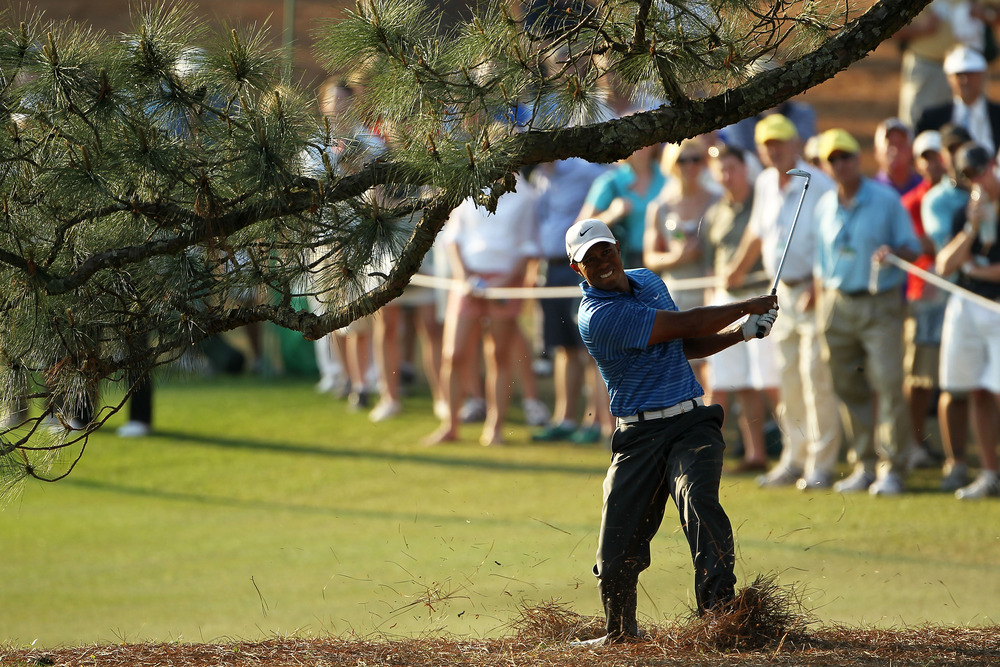
(Photo via Jamie Squire/Getty Images)
The tree has knocked down several tee shots over the years, and probably made its biggest impact in 2011 when Tiger Woods put his ball under it. Woods attempted a vicious punch shot (pictured above) off the pine straw underneath the Eisenhower, injuring his achilles which led to four months off and two missed majors. It was a huge moment in the ongoing injury-riddled majors drought that has interrupted Tiger’s career and march to Jack Nicklaus’ record.
It would appear that Augusta already has a plan in place to have the hole playing no differently than it did with the Eisenhower:
Augusta National, as you might expect, was prepared for a day without Ike's Tree. Years ago the club planted a group of pines beyond it.
— Mike O'Malley (@GD_MikeO) February 16, 2014 Augusta National guy, years ago, on replacing key trees there: "Mike, we do have the wherewithal to bring in considerable replacements."
— Mike O'Malley (@GD_MikeO) February 17, 2014 A few players reacted to the news, including Sunday’s winner at Riviera, Bubba Watson, whose bombs off the tee made the obstruction antiquated:
2012 masters champ Bubba Watson on the Eisenhower Tree: "let's be honest, that tree was never in my way."
— Adam Schupak (@GolfweekSchupak) February 17, 2014 Very sad news. RT @rogeraspark @IanJamesPoulter I see that the Eisenhower Tree is no more. Is that a good thing or not? #Augusta
— Ian Poulter (@IanJamesPoulter) February 16, 2014 There will obviously be much snark, some justified, over all the laments on the loss of a tree. But such is the nature of Augusta and the Masters, the most-watched event in golf on a course where every hole, and sometimes tree, is recognizable.
More from SB Nation Golf:
See More:


