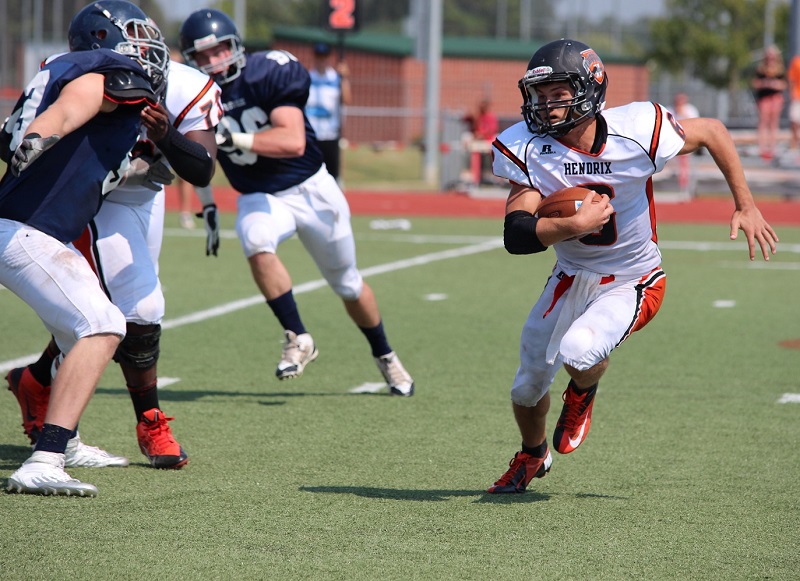
Casey Caton never figured he'd play a starring role in securing college football's longest two-game winning streak.
An all-conference wide receiver coming out of Rogers High School (Ark.), Caton imagined he would help Harding University in Arkansas vie for the NCAA Division II championship. Instead, in his three seasons at Harding, the playing time he envisioned never materialized in its triple-option offense, frustration mounted and last fall he quit the team. With just a few classes left before graduation, his football dreams - it seemed - were over.
Then Caton learned that Hendrix College, widely perceived to be the most liberal college in Arkansas, was resurrecting its football program this fall after dropping the sport in 1960. Caton, who describes himself as "definitely on the conservative side," would have never considered attending Hendrix before the news.
The more he learned, however, the more he could see himself on campus and playing football for the Warriors. He met and liked Hendrix's coaches and the prospect of getting plenty playing time. Although Division III competition would be a step down, and the tuition price tag a couple steps up, he would also be getting a degree from one of the most academically prestigious small colleges in the South.
"I didn't want to end a game I had played my whole life on such a bad note," said Caton, who learned the fundamentals from his father, a high school coach. "I really wanted to finish on a positive, actually getting to do what I felt like I could do." Caton transferred this summer.
The Hendrix squad is full of young men like Caton, guys who otherwise might have never considered attending the Conway, Ark. school, a place that celebrates the fact there are no sororities and fraternities on campus and where you are as likely to see students fighting with foam swords as chucking footballs.
It’s a trend. Smaller colleges are starting football programs or restarting those shuttered long ago.
 (Photo courtesy Evin Demirel)
 It's a trend. In recent years, more and smaller colleges and universities are starting football programs or restarting those shuttered long ago. In an era when many major colleges are grappling with increasingly bloated athletic budgets, between 2008 and 2012, 29 smaller colleges started lower-level football programs. And in 2013, despite the fact that mounting medical evidence concerning brain damage has placed the future of an entire sport at risk, 12 more colleges started football programs this fall. In Division III alone, 10 schools have started football programs in the past five years.
Why?
To understand the reason so many small college administrators find football to be a lucrative proposition, take a visit to Hendrix's season opener on Sept. 7 against Westminster University. Pay no mind to the "Undefeated since 1960" orange T-shirts worn by Warrior fans filling the metal bleachers of the brand new Young-Wise Memorial Stadium, or the concession table covered by Hendrix Warrior seat cushions, pennants, umbrellas and replica jerseys. Note that not a single ticket stub litters the ground. At Hendrix, all games are free. Ticket sales and merchandising are insignificant to the financial benefits of fielding a football team.
Instead, look to the alumni in the stands, and the players in their brand new uniforms. In the stadium are about 30 representatives of the old guard - players from the 1950s and the 1960 team who have come to cheer on the torchbearers they never expected to see. During a pregame ceremony, an announcer said, "After a 53-year timeout, we'll now start the clock over on Hendrix football," and the captains of Hendrix's 1960 team took the field and handed a ball used in their last game to Caton and Hunter Lawler - captains of the 2013 edition. Many from the 1960 team are on the Hendrix booster club, which recently raised more than $50,000 for athletic facilities and equipment.
But the real money is on the field. Focus on the 6'2 Caton, who strides onto the field for the first game with authority, one of only a handful of Warriors who have actually played in a college game before. Then look at his 53 teammates, mostly true freshmen, as they take the field on this blistering hot afternoon.
Only a couple hundred feet to the north sits a glistening new field house, including a locker room with 93 player lockers. Long before they were stuffed with mouth guards and sweaty helmets, each of these climate-controlled spaces held a promise. Every new player gives future Hendrix teams the depth to one day be a serious contender on the field. At the same time, each of those players also provides Hendrix College an influx of the cash it needs to remain relevant in a world where pure liberal arts education is increasingly becoming an endangered species.
As students of the Classics discover, ancient Greeks and Romans prized the principle captured in the Latin phrase mens sana in corpore sano ("A sound mind in a healthy body"), and considered sports and exercise important parts of a well-rounded education. In some ways, the future viability of the traditional liberal arts education is rooted in this ethos. Today, without the influx of sports like football, certain schools in coming decades may otherwise be forced to cut back on courses such as ancient history and language.
+++++
The first thing to know about Division III football is its student-athletes aren't paid to sweat. Scholarships can't be awarded based on athletic leadership, ability or performance. This separates Division III from Division I football, which provides full athletic scholarships, and from Division II or the National Association of Intercollegiate Athletics football, where partial scholarships are standard.
At this level, football pays.
 Wide receiver Casey Caton. (Courtesy of Hendrix College)
 This is not to say most Division III players go it alone. The average Hendrix student gets about $24,000 in financial aid to defray the school's annual $48,000 price tag. Almost all Hendrix football players are on some mix of academic, service and leadership scholarships.
But many of its football players - or their families - still pay the sizeable difference. That's money the school banks, and can count on banking, no matter how many losses it suffers, no matter how many people show up to its games or buy its merchandise. Tuition and room and board will just keep rolling in, eventually from as many as 80 players or more. In fact, although a few leagues impose their own restrictions, there is no regular-season roster limit in DIII.
Division I programs are only allowed 85 total football scholarships, and most limit the number of walk-ons. Hendrix, however, has enough space in its new field house to expand to as many as 117 lockers and one day hopes to use them all. Were the parents of each of those students to pay half the annual cost to attend Hendrix, the school would take in nearly an extra $3 million. At this level, football pays. The University of Mount Union, a northeast Ohio Division III powerhouse that produced Washington Redskins receiver Pierre Garçon, entered the 2008 season with an astounding 215 players at all levels, including junior varsity. According to Vance Strange, a longtime member of Hendrix's booster club, and Amy Weaver, Hendrix's athletic director, once start-up costs such as equipment (only $900 per player) are covered, a projected roster of only 65-70 players would still net the school $1.8-$1.9 million a year. Players and their families are more than willing to pay the price, and Hendrix is happy to take the money.
Decades ago, generating revenue from football wasn't really necessary for small colleges; many parents could pay the tuition and were happy to do so. For much of the early 20th century, a college education was for the privileged few and usually entailed a well-rounded curriculum that included literature, Latin, philosophy, history, math and science. But after World War II, returning soldiers flooded the market, swelling enrollments at many state universities as they sought job skills and credentials. Many of these former G.I.s saw the role of higher education as less a way to become culturally refined as a way to secure one of the well-paying career tracks in a rapidly expanding American economy.
Many small colleges couldn't adapt, and rapidly escalating costs put many schools at risk. Between 1967 and 1990, according to Vincent Ferrall Jr's, "Liberal Arts at the Brink," 167 private four-year colleges closed. Only those with extensive networks of well-heeled alumni donors and ample endowments survived. Yet in recent years, economic pressures due to the recession and a relative scarcity of top-notch high school students have increased and even put some of these schools at risk. Colleges like Hendrix have to ratchet up enrollment and recruit nationwide in an increasingly competitive environment to remain financially viable. Their challenge, writes Ferrall, "has become not how to choose which applicants to admit but how to attract enough students to fill their dormitories and provide sufficient tuition income to continue operating at current levels."
As a result, football programs have suddenly become attractive to many small colleges as a significant part of more comprehensive campus expansion campaigns.
Hendrix's decision in 2008 to resurrect the sport came on the heels of a long-term decision to push for rapid growth. From 2001 to 2013, the school's enrollment increased by 40 percent, to more than 1,400 students, while the college completed a $100 million comprehensive capital campaign that included the new Student Life and Technology Center, two new student apartment complexes and the Wellness & Athletic Center.
Hendrix's new football stadium, finished this summer, is part of a roughly $6 million expenditure that also included an indoor tennis center with three courts and an 18,000-square-foot training facility that includes the football team's locker room.
Much of that building is state of the art. The bottom of each locker has a computer that operates a fan, sending in air to dry out uniforms and equipment. A nearby equipment room includes vaulted storage units operating on a track. Former NFL Pro Bowler Keith Jackson, who won a Super Bowl with Green Bay in 1997 and is a native of nearby Little Rock, checked out the facility late this summer. He told the Log Cabin Democrat that the Packers didn't have an equipment room that nice when he played for them.
++++++
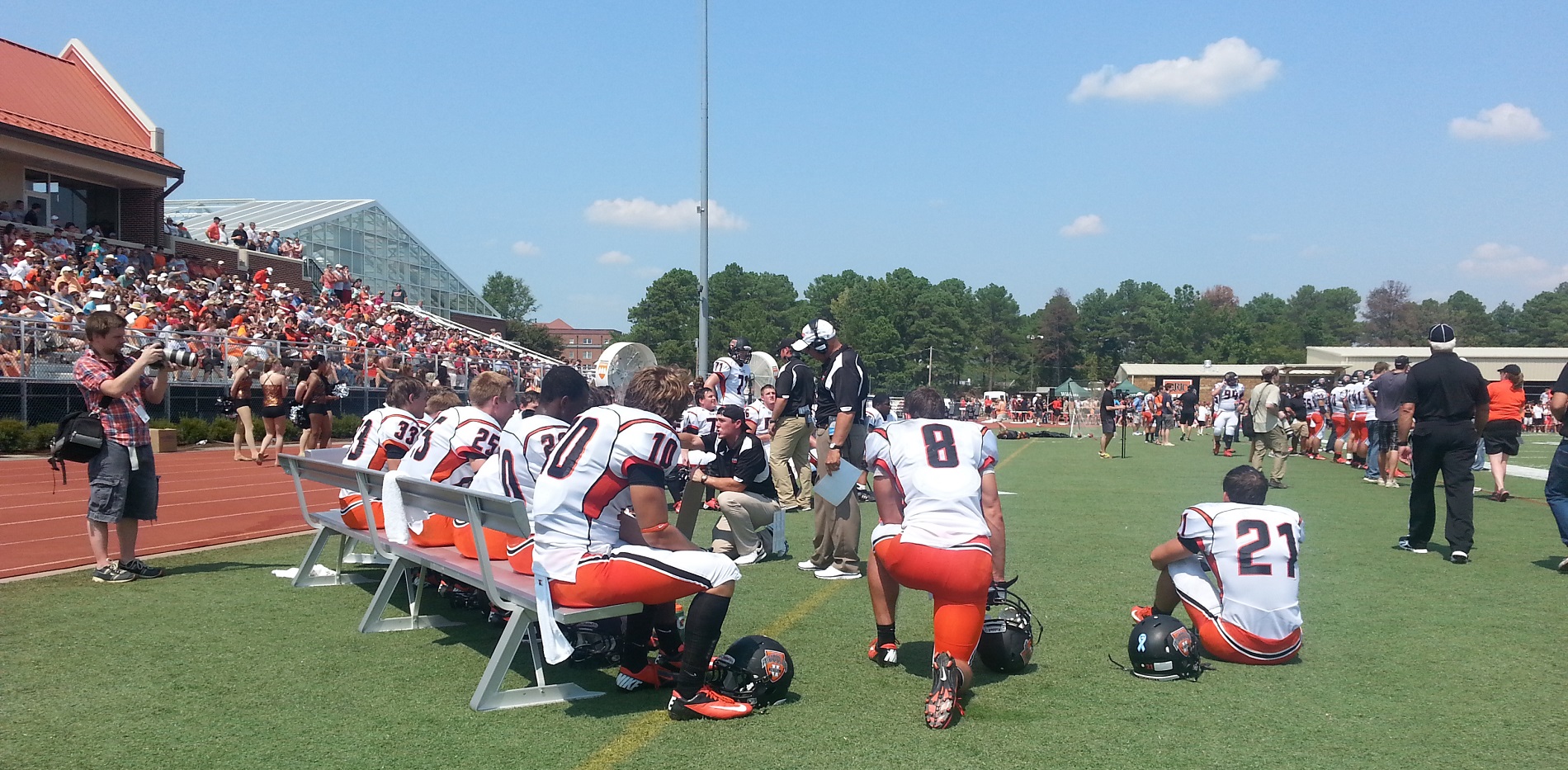
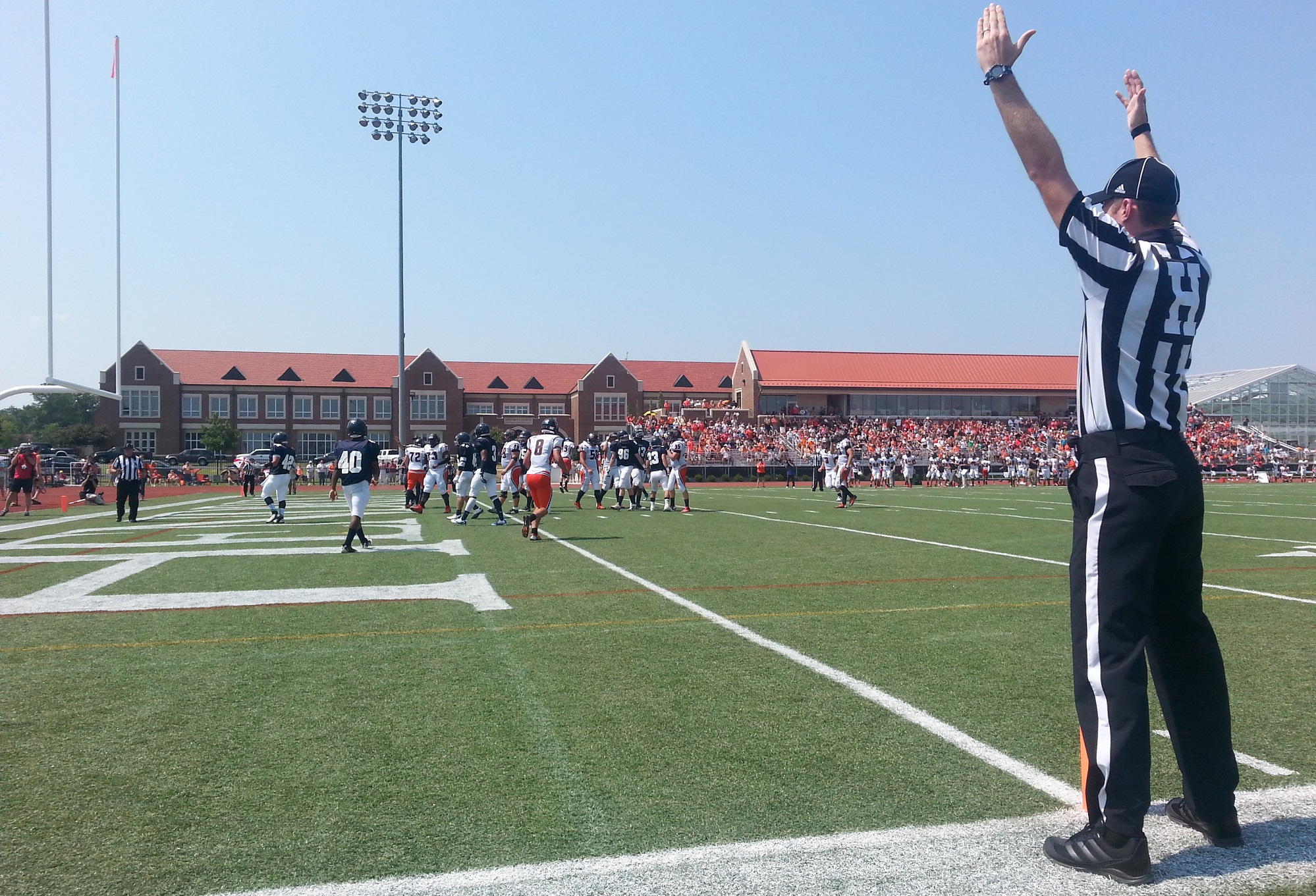
 (Courtesy of Evin Demirel)