storefront bars where you can buy a box of bullets with your beer.
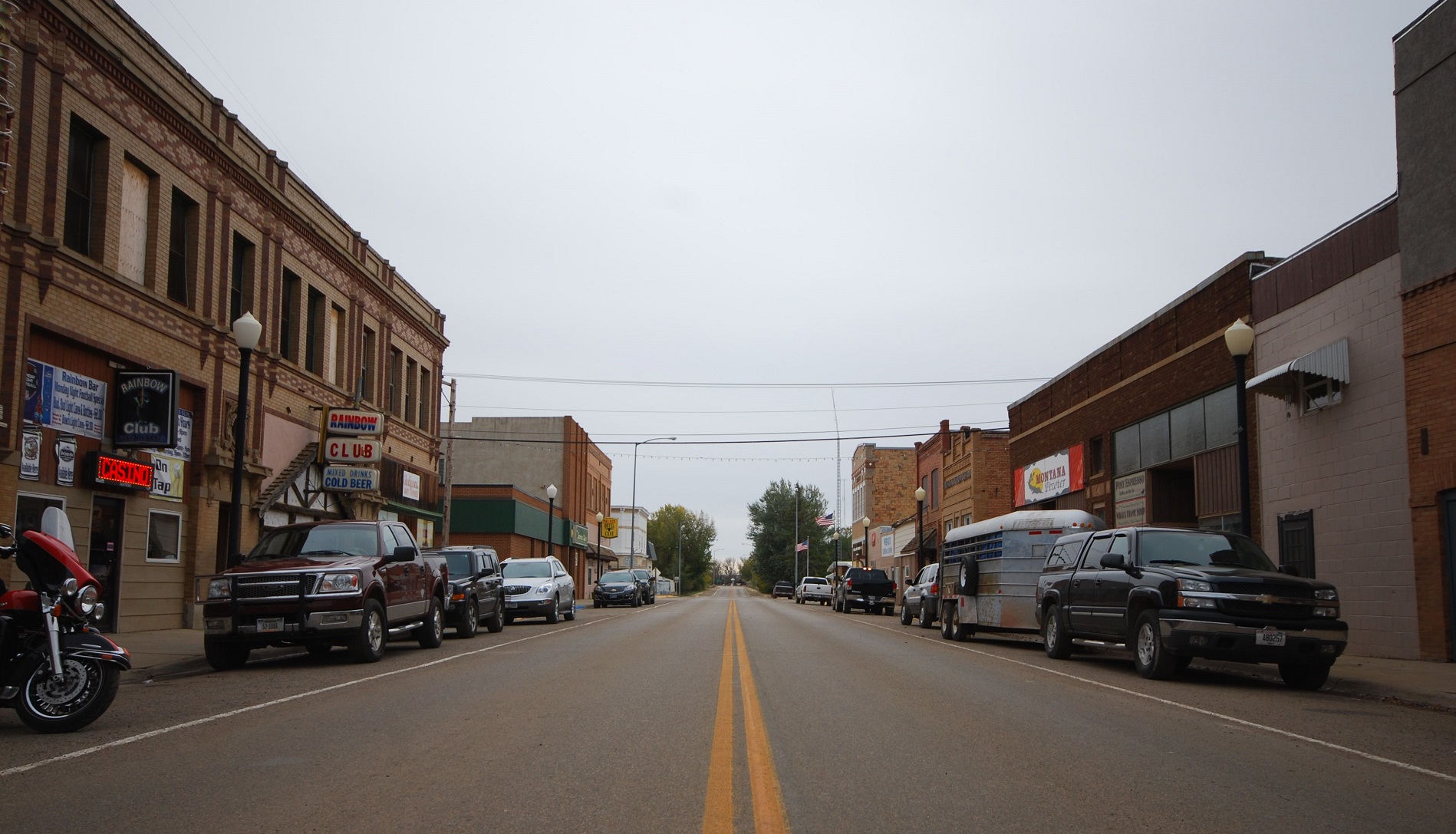
Beaver Creek meanders through the center of town like a snake in tall grass. Wibaux was built around its curves, and there was a time when residents were sustained by its slow current. It's as wide as a tennis court and people say you can catch walleye and northern pike in the deep holes. It flows under Highway 7, past an old grain elevator, the fueling station and a dirt-pocked little league field with a rusted chain-link backstop. The creek comes within a block of downtown — its storefronts mostly vacant but not yet shuttered — and the trucks parked outside of the Shamrock and the Rainbow clubs, storefront bars where you can buy a box of bullets with your beer and where wall calendars track the birthdays of the regulars and their families.
Today, Beaver Creek is mostly used for cooling off in the summer. Wibaux is sustained by something else.
Veterans Memorial Field lies within the footprint of a dilapidated gravel and clay track on the opposite side of downtown. On the rare days when the wind doesn't blow, you can hear the growl of semis on Interstate 94, and the whistle of a coal train miles before it speeds through town without slowing down.
The week after beating Scobey, the Longhorns returned home for the final game of the regular season against a mediocre co-op squad from Froid and Medicine Lake (high schools combining student bodies to field teams is common practice in Montana Class C). As is usual during the regular season, no one in Wibaux expects much of a game — since 2001 they've only lost six times — but, like parishioners outside of their church, people still gather.
An hour before kickoff, Dodge and Chevy pickup trucks are backed up to the edge of the track, camping chairs unfolded in their beds. The adults, some parents of players, huddle around tailgates. Young girls sit in the bleachers and wear hoodies and lean into one another to fit under blankets. Younger boys roam the sidelines in packs. Behind the uprights, they play games of two-hand touch that seem never to begin or end.

 The LaBelle brothers.
"They don't want to let the older generation down by having a losing season."
South of the field, below a soft rise at the top of which stands a statue of Pierre Wibaux — a prominent rancher, who in 1895 decided Mingusville was an unsatisfactory name for a place — a group of blue-and-gold faithful gather between trucks and under a party tent and eat sausage and chili. Among them is Tracy Bakken, wife of assistant coach Shane Bakken, and mother of Jake, Jeff and Joe, all of whom play or played quarterback for the Longhorns. She stands with her mother, Sally Witkowski, a self-proclaimed "sports buff," who has lived in Wibaux all of her adult life. When asked how a town that in most years has fewer than 30 teenage boys can win so often, Witkowski replies as if anyone who didn't already know wouldn't understand the answer. "They're winners, they all are," she says. "They take football real seriously."
Tracy responds by describing her family. She says that when her middle son Jeffrey was in junior high, he stood on the sidelines at games, heard the crack when his older brother, Joe, slammed his helmet into the helmets of his teammates and watched as he ran onto the field and led the Longhorns to victory after victory after victory. She says her youngest son, Jake, did the same. "It's just pounded into their heads," she says. "They don't want to let the older generation down by having a losing season."
Senior lineman Heath LaBelle knows this pressure. His teammates call him Vito — for his resemblance to the MTV reality star — and at nearly 300 pounds, he's of typical size for men in the LaBelle family. His oldest brother, Jordan, graduated in 2007 and played for a state championship in 2006. Their middle brother, AJ, played for three titles before graduating in 2010. When the three of them sit together, they make furniture seem like playthings and Longhorn football seem like the center of the universe.
"It's expected. It's weird to say, but Wibaux football is just expected," says their father Greg. "We're expected to do well, and it doesn't matter who's on the team," he adds, pointing out that this pressure gave all his sons an edge. "Jordan will always say he's better than AJ and AJ says Heath isn't as good as the other two. It's community wide — that's your competition."
No LaBelle boy has lost more than five games in four years of football. And while no LaBelle has won a state title, they continue to measure success on whether or not the team finishes as the best in the state. When asked if it's possible that the Longhorn brand may be changing — considering that in 2012, Wibaux High was the smallest high school playing 8-man football in Montana and three of the four teams that made it to the semi-finals that year drew from students bodies more than twice Wibaux's size — they are incredulous. "They've said it for years, ‘They're not going to be as good, they're not going to be as good,'" says AJ. "I think Wibaux has the mentality. I don't care how many kids are in your school. Being in Wibaux is different. We have the tradition. It's a football town."
Today, that tradition and the power it wields over younger generations is evidenced by other familiar names on the Longhorns roster. There's a Bakken and a Bertelsen, a LaBelle, two Miskes, two Nelsons, two Dschaaks, two Schneiders, and a Quade — Jhett — whose uncles were Longhorns. His father, Kevin, also played and is remembered by people in town as the consummate Longhorn fan. In 2006, during a semi-final home playoff game, he hired a plane and a photographer to take aerial photographs of the 3,000 people in attendance. In photos from that day, the field is unusually green and surrounded by people on all sides. It seems to be the only thing in town still growing.
***
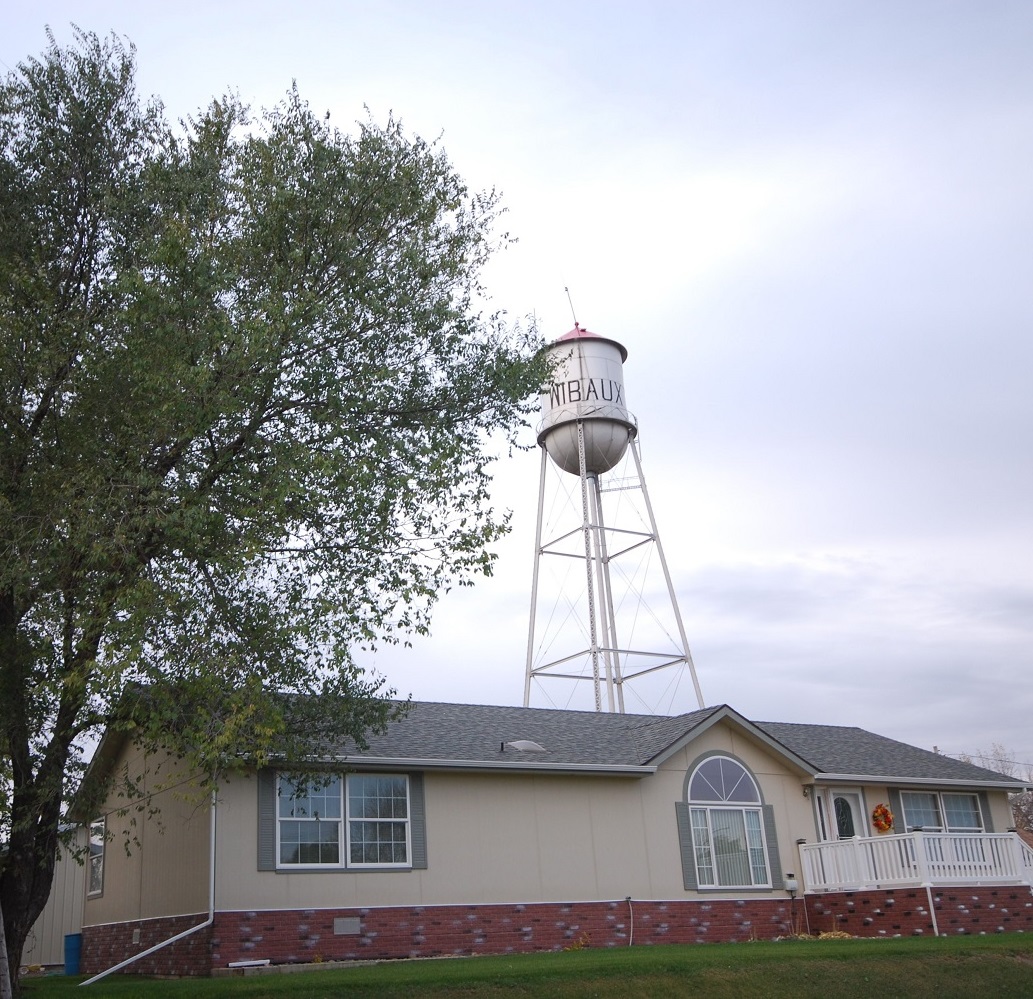
The tallest structure in Wibaux is a water tower, at the center of which the word "Wibaux" is painted in red so that it faces the interstate. Second tallest is the grain elevator on the other side of Beaver Creek. Otherwise, Wibaux creates a squat horizon line of two-story buildings and trees. Driving south on Highway 7 or east on I-94, it's a matter of seconds before Wibaux disappears in the rearview mirror.
When head coach Jeff Bertelsen was in high school, he and some friends plotted to climb the tower. There was nothing much to see, they just wanted to see if they could get all the way to the top. Their plan, though, was foiled by a passing deputy sheriff, and the group scattered, running down streets and through yards to escape. Only a single member of his crew got to the top. Bertelsen laughs when he tells the story. The water tower itself is empty.
Bertelsen moved to Wibaux from the mountains and trout streams of western Montana when his dad got a job as a county agent in 1987. His freshmen year of football was the last year for then-coach Rob Bushman, the man who most Longhorn fans credit with inventing the Wibaux brand of football. "We ran the ball," he says. "Up the gut, hard-nose football." The next year, under a new coach, Wibaux suffered its first losing season since anyone could remember. It would be their last.
Everyone in town — including his players — calls him Bert. He has a face like Paul Giamatti, but he has the physique of someone you wouldn't want to mess with. He wears khaki cargo shorts to every game, no matter the weather, and when you ask him if he would change anything about his job with the Longhorns, it'd be painting the fields. He is not just the coach, but also the grounds crew. "That's the worst thing I do at this job. I measure and paint that field before every game," he says. "It used to take me six hours."
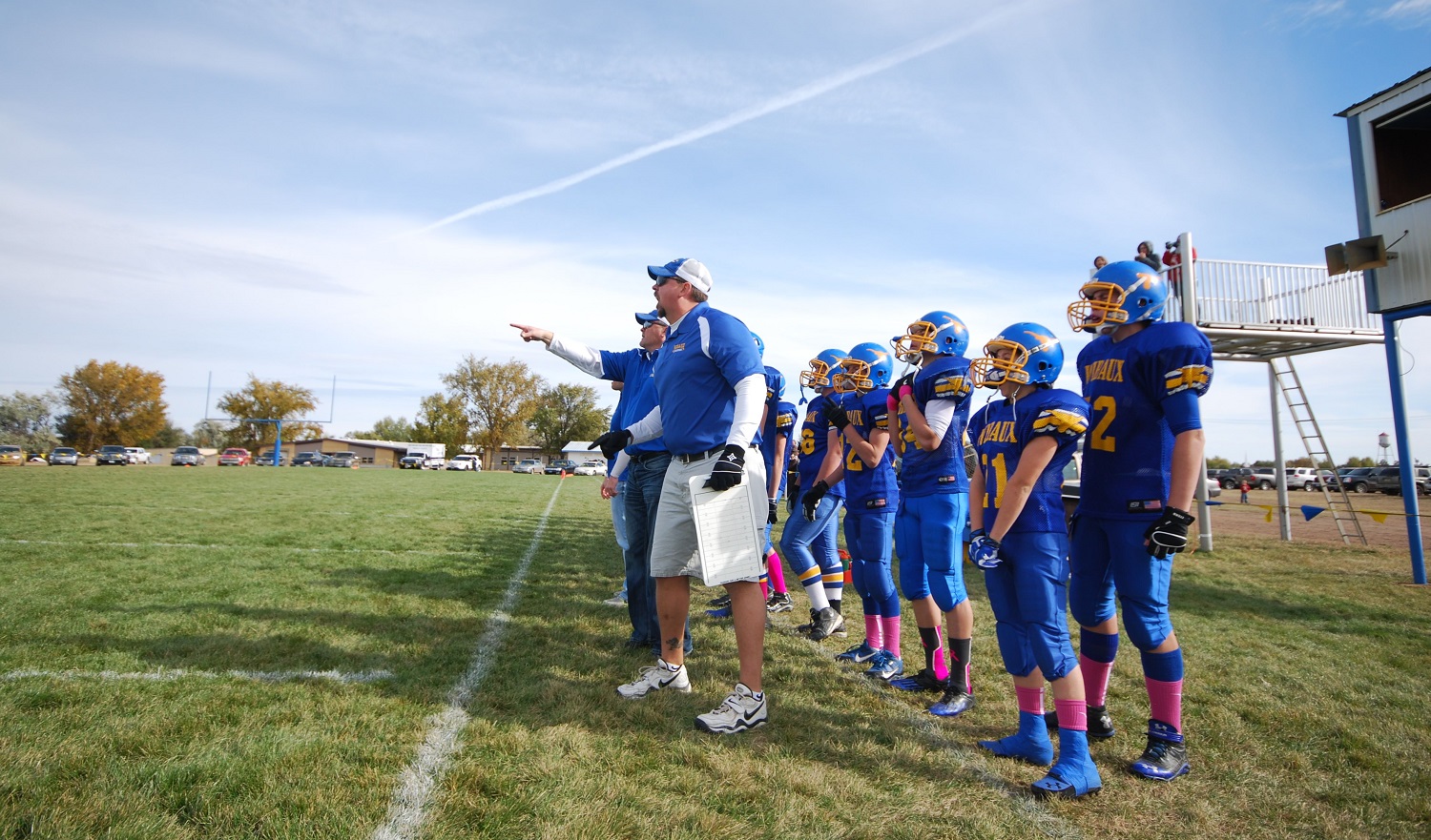
Thirty minutes before the Froid/Medicine Lake game, Bertelsen addresses the Longhorn players in a cramped locker room beneath Wibaux High's gymnasium bleachers. The game is meaningless; Wibaux has had the Eastern Division's No. 1 seed clinched for weeks. Some teams would take the starters out in the first half in a game like this, no matter the score, to preserve them for the playoffs. Not Wibaux. Bertelsen searches for a way to motivate — to remind his players that even in games that don't matter, final scores transcend win/loss columns. Complacency, not the opposition, represents the real challenge to Bert's boys.
"They're gonna come, and they're gonna come hard. You have to take that out of them. They got nothing to lose. This is their state title game for their seniors. It's the last high school football game they'll play," he says and reminds them that they, too, will someday take the field for the last time. "Think how'd you play that game."
 Head coach Jeff Bertelsen in his signature khaki shorts.
Bertelsen knows what it's like to play that game, and unlike anyone else in the locker room, he knows what it's like to win it. In 1991, his junior year, the Longhorns cruised to the school's first state championship. They did it again the next year, and although Bertelsen had already left to play at Dickinson State, the Longhorns did it again in 1993. Bertelsen was a star defender, and he still remembers the rush of bringing home the state title. "Once you know what that feels like, there's sort of nothing else like it," he says. "You want to have that feeling again. I want these kids to have that feeling."
The Longhorns won the program's fifth state title in 2001, Bertelsen's first year as head coach. Since then, they've gone 125-18 and have made it to the championship game five more times, but have yet to win again. "It's title or bust every year. I've heard people say, ‘Oh, he can't win the big one.' You feel the pressure and you know it comes with the job," he says. "I think sometimes I just try to be naive about it — to protect myself. Just do what we do every day and try to get better."
After Bertelsen addresses his team, Rob Bacon, a first-year assistant coach, speaks to the players. He played for the 2006 Longhorns, which Bertelsen describes as "the best Wibaux team to not win a title." After winning a semifinal game, the Longhorns lost the title in overtime. Bacon remembers returning to Wibaux late the night after the loss, the fire engine escort for the Longhorns' bus and the people who had stayed up to honk truck horns and welcome the boys home. "It was bittersweet," he says. "If you grow up saying you want to be good at football, that's one thing. But we grow up saying we want to win state. We know we're going to be good at football. We want to win state."
"We know we're going to be good at football. We want to win state."

When Bacon talks to the Longhorn players about their opponent, he channels the frustration that comes with coming up short in the face of extraordinary expectations. "They have a new coach this year and maybe he thinks things have changed, but they haven't. It's gotten uglier ... Take some pride in that, you are the guys who are going to be knocking their dicks in the dirt. Make them get it. Make every member of that team get it," he says. "Let them know what we're about."
The players stand up and touch hands and count to three. They march out of the locker room and turn right to exit the building and run across a parking lot onto the field. Turn left instead, stairs lead to the polished wood surface of the Wibaux gymnasium, where five state title banners hang from a cinder block wall: '91, '92, '93, '00 and '01. Most people in Wibaux find it disappointing there aren't more, but most people in Wibaux, like assistant coach Shane Bakken, also think it would be cheap to hang runner-up banners. He played quarterback in the '80s and has watched his sons play in four state title games. He believes there is only one way to measure a successful season. "Once you get a taste, that's the drive. You want to get back there again, and we have it. If you're not playing to win it every year, why play?" he says. "No one remembers second place."
***
The Longhorns score on the first series of the game against the Red Hawks. They proceed to recover the ball on an onsides kick and score again. On the first Red Hawk possession, they struggle to crack the line of scrimmage and are forced to kick from inside their own 5-yard line. The punter receives a low snap as blue jerseys crash the backfield. He doesn't appear to panic so much as make a calculation and then a quick decision. He turns his back to the field, drops the ball to his foot and gingerly boots it out of the back of the end zone. The first quarter ends with the score 38-8.
When the Longhorns are playing well, it's like watching a video game between a committed gamer and someone who left the controller on the coffee table — something doesn't quite seem fair. On a special teams play, Chase Bertelsen, who has the same stacked-brick physique as his father, Jeff, draws gasps from the sideline when he topples a Red Hawk gunner flat on his back. Jake Bakken fields a kickoff and moves through traffic like a spooked antelope, his strides covering more ground than seem possible. The Red Hawks don't tackle him so much as shoo him out of bounds. Although every team has its stars, not every team wins so gaudily game after game, year after year. Not every team is the Longhorns.
A few minutes into the third quarter, the score is 57-8, and Bertelsen begins to take the starters out of the game. Bakken and Bertelsen, LaBelle, Miske, Farnworth and Colton Tousignant, the starting running back who is as adept at breaking up passes as he is at running around tacklers, have their places taken by underclassmen.
Colton's younger brother, Chas, a 100-pound freshman, gets in at running back. He receives a handoff and is knocked over before he makes it to the end. He is promptly taken out. When he was younger, Chas watched his older brothers play football at recess. He remembers they would pretend to be Longhorn players of the day — Travis Bertelsen, Rob Bacon, Derek Hartse — and when his brothers got to high school, Chas played recess ball himself and pretended to be his brothers — superstar athletes playing on the biggest stage in the universe. As a ninth grader, he only sees the field when the Longhorns have mercy-ruled a team, if at all. But wearing that jersey is a dream realized, and he's already experienced the chemical surge of winning and the rush it gives him. "It just comes to you," he says.
Nearly to the end of his first season, he does not yet know what losing feels like.
***




 The Tousignant brothers.


