

The play call surprised nobody on the University of New Hampshire sideline. Not the head coach, not the quarterback, and definitely not the receiver who eventually found himself celebrating in the end zone.
On Nov. 4, 2000, UNH was in trouble. But after falling behind 31-3, on the road, to undefeated, soon-to-be No. 1 ranked 1-AA (now FCS) power Delaware in front of nearly 22,000 fans, the Wildcats mounted a comeback. By late in the fourth quarter, they'd pulled within a touchdown, and again had driven deep into Blue Hens territory.
Then the offense stalled. It was fourth-and-19. A field goal was worthless and options were limited; Delaware knew UNH had to throw the ball. Sean McDonnell, in his second year as UNH head coach, asked offensive coordinator Chip Kelly, 36, what he wanted to do. After hearing an unconventional answer, McDonnell replied, "Fine. Run it."
"We didn't have anything else," McDonnell says now.
UNH's quarterback, Ryan Day, knew which play Kelly had in mind. The Wildcats had practiced it before. "I dropped the ball to a back, he lateraled it back to one of the receivers," Day recalls.
The problem was, as The Boston Globe's Allen Lessels later wrote, "in practice, the first pass always went to tailback Stephan Lewis or Imion Powell. On this day, however, Lewis had left the game with an ankle injury. Powell had stayed home with his wife, who was due to deliver a baby."
Kelly was unfazed. During a timeout, he summoned receiver Brian Mallette. According to Lessels, here's how the ensuing exchange went:
"If I send you in, can you do it?" Kelly asked.
"Yep," Mallette said.
Now, down by seven to the No. 2 team in the nation with less than six minutes left, on fourth-and-19 on their opponent's 23-yard line, Kelly decided to run the hook and ladder with a player who had never even practiced the play before. Amazingly, but in hindsight not too surprisingly, the sandlot staple worked. Day hit Mallette, who pitched the ball to receiver Kamau Peterson. After almost losing the ball, he pulled it in and sprinted across the goal line. Peterson, who spent a decade in the Canadian Football League, says today that, "We knew how open it was going to be." He might be stretching the truth a little, but then again, maybe not.
Kelly was its chemist, tinkering and tinkering until his formula was perfect.
The extra point tied the score at 31, and UNH ended up winning, 45-44, in overtime. Kelly's audacious call still makes the gravel-voiced McDonnell, who remains the head coach at UNH, smile. "It was unbelievable when we did it," he says from his office. "Unbelievable. We were both out of our minds."
Thirteen years later, on a sweltering September afternoon, Ryan Day jogs off a practice field in Chestnut Hill, Mass. He stops to chat on a corner of artificial turf inside Boston College's Alumni Stadium, which has a seating capacity five times that of UNH's home field, 8,000 seat Cowell Stadium. Now the offensive coordinator at BC, the 34-year-old former quarterback is a long way from his New Hampshire days.
Still, the win at Delaware is fresh in his memory. The comeback wouldn't have been possible without Kelly, who wasn't afraid to take chances. In that era, Day described UNH as a football "laboratory." Kelly was its chemist, tinkering and tinkering until his formula was perfect.
* * *
UNH's all-in-one field house sits at the top of a hill on the edge of the Durham campus. One wall of the Paul Sweet Oval, the facility's indoor track, has a tiny football coaches box built into it. The makeshift wooden structure is only accessible by first climbing a ladder, then perilously shuffling across a catwalk. It overlooks tiny Cowell Stadium.
Buried in the basement, underneath the indoor track, Lundholm Gymnasium, and Swasey Indoor Pool, was Kelly's football laboratory. In reality, it was just a small office. But it's where he honed an offense that was, in the words of record-breaking former UNH receiver David Ball, "his baby."
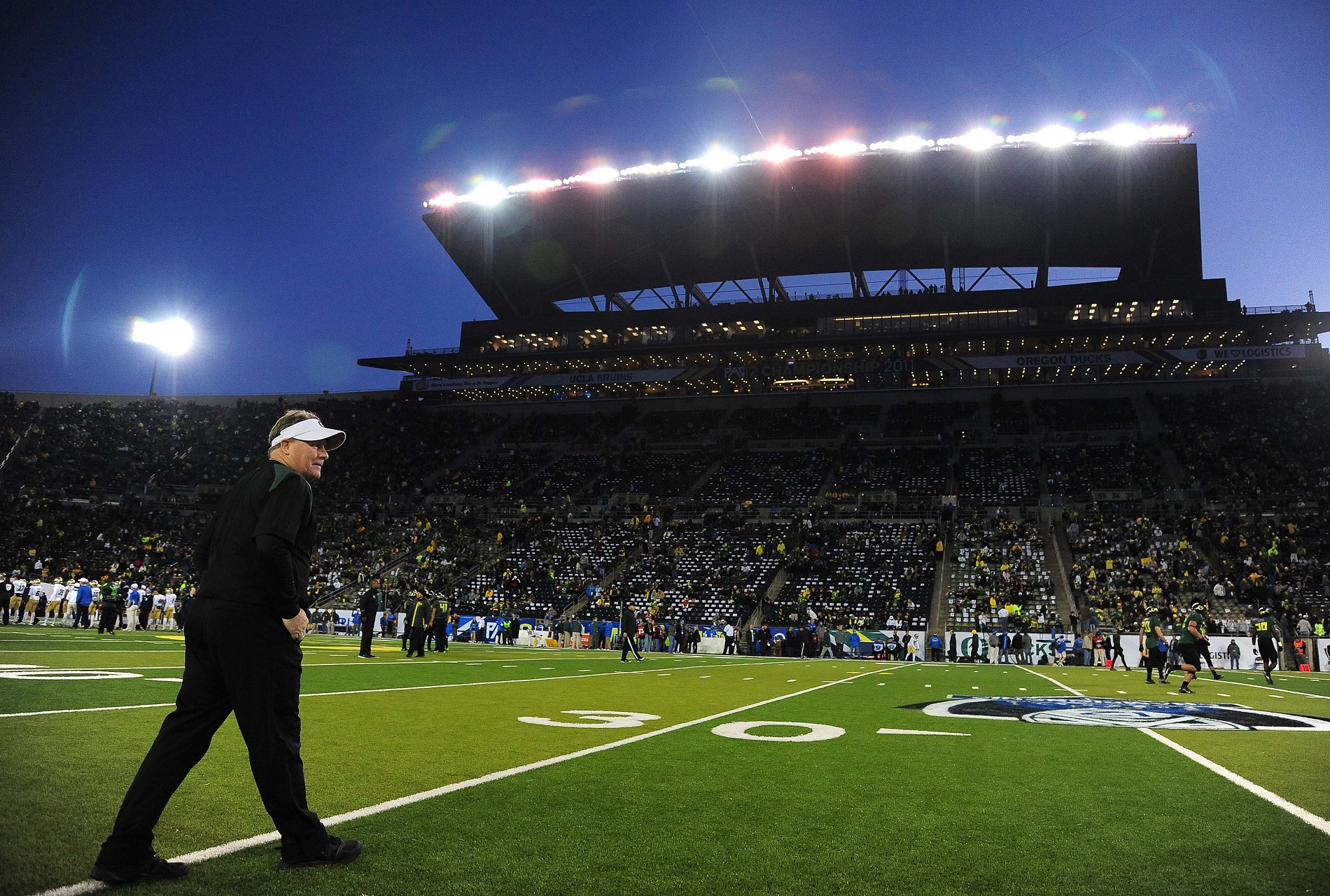
If you've watched college football at all over the last few years, you're probably familiar with Kelly's work. Starting in 2007, he spent six seasons at the University of Oregon, where his dizzyingly fast squads ran an assortment of trick plays and scored points at a historic rate. In Kelly's four years as head coach (he was the offensive coordinator in '07 and '08), the Ducks finished 46-7 and made it to four BCS bowls, including the 2010-11 BCS National Championship Game. Then, last January, he became the head coach of the Philadelphia Eagles. So far, the Eagles are averaging 462 yards per game, best in the NFL. If they ever stop turning the ball over, and their defense gets it together ...
Kelly may not have realized it at the time, but UNH was the optimal incubator for his creativity.
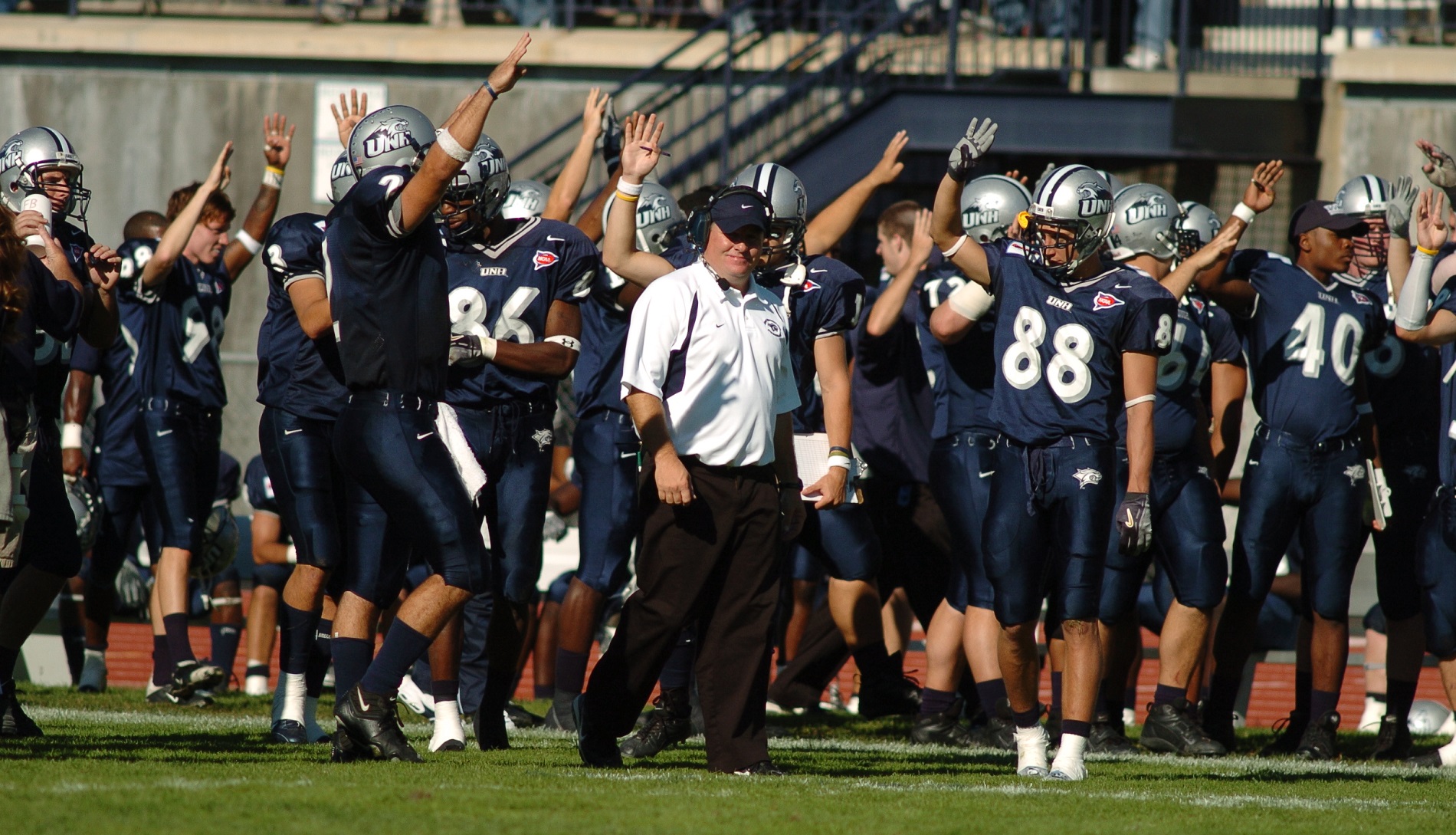
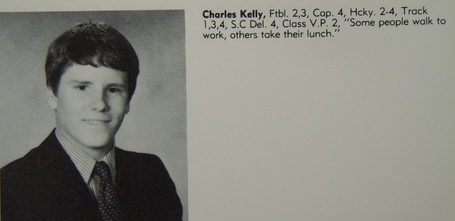
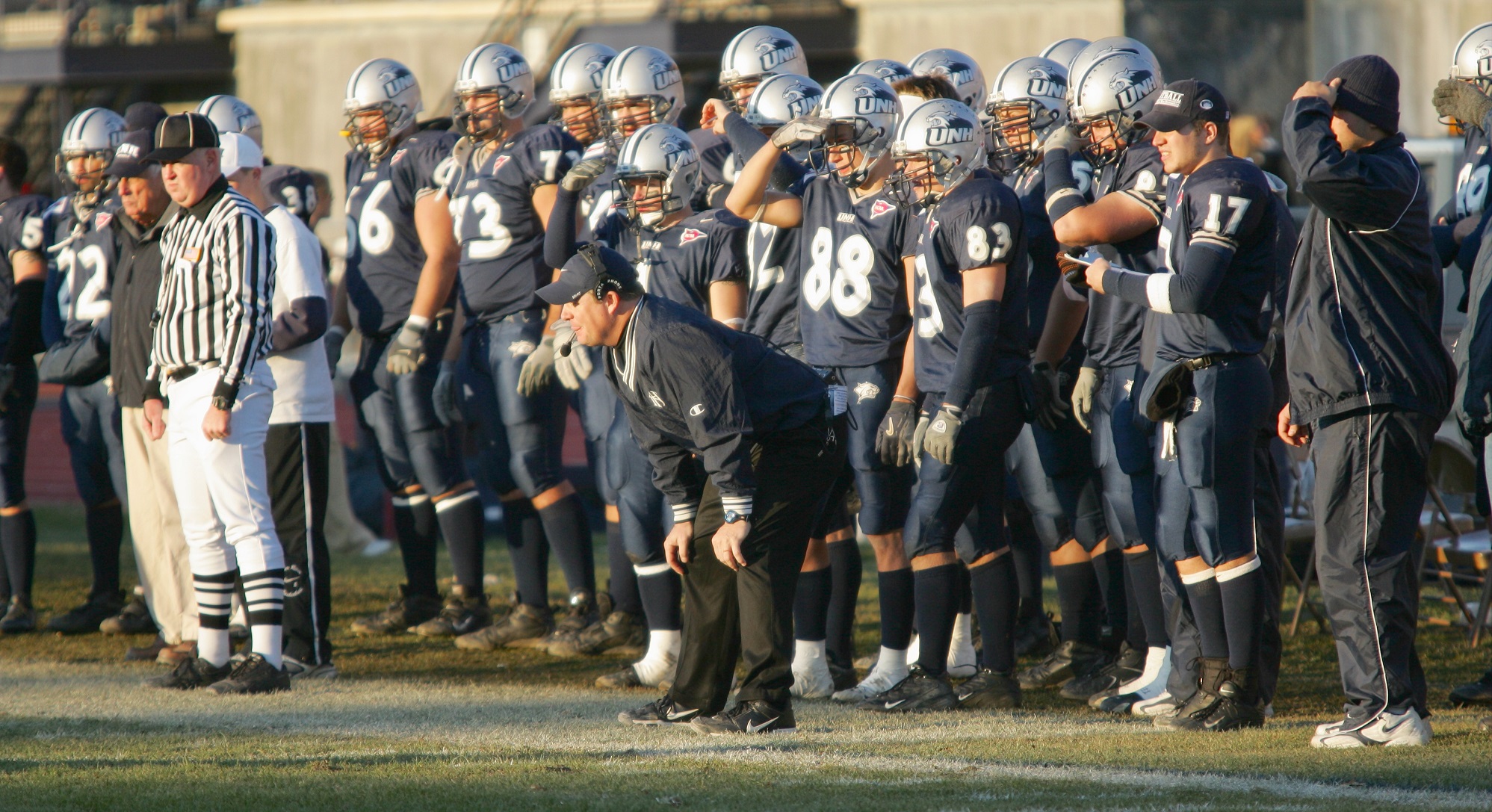
But long before his performance at Oregon earned him the nickname "Big Balls Chip," the iconoclast, Kelly spent 14 years as an assistant football coach at a school much better known for its hockey team. And that suited him just fine. He was in his home state, working at his alma mater, collaborating with coaches he'd known for years. Kelly may not have realized it at the time, but UNH was the optimal incubator for his creativity. He felt comfortable and had freedom to try new things. McDonnell, Kelly's longtime friend, says, "He was given a long leash here." In the coaching world, that's no small privilege.
Even as the UNH offense transformed into a record-breaking juggernaut and Kelly's reputation grew, he didn't immediately chase after bigger jobs. It's not that he wasn't pursued: He just didn't feel the need to leave. "I don't think Chip was looking for that special place," McDonnell says. "He was looking for the right place." And until Kelly found it, he was staying put.
 Courtesy University of New Hampshire

 USA Today Images


