Kemba Walker, king of the stop and pop
Few players in the league can shoot off the dribble like Kemba Walker. How does he do it? We break down the footwork behind Walker’s devastating stop-and-pop game.

Thomas Campbell-USA TODAY Sports
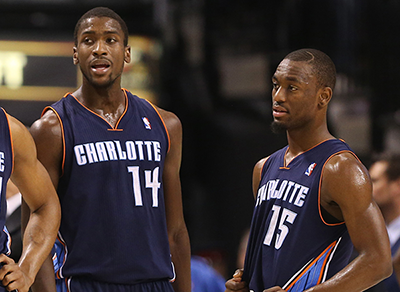
When Kemba Walker entered the NBA, many wondered if he would be able to score in bunches like he did at UConn against bigger defenders. Generously listed at 6'1, Walker would have to play point guard, putting him in positions against big men who can challenge his shot at the rim and in between. Many thought it wasn't going to be as easy as it was in that 2011 NCAA Tournament, when no college player could stop him.
So much for that. Walker's point guard transition hasn't been perfect, as he's still not a great passer, but his scoring has translated easily from Day 1. Walker averaged 12 points per game as a rookie and nearly 18 as a sophomore, making a huge jump that few noticed because the Bobcats were so bad.
You can thank one weapon for that: his deadly pull-up jumper. Few execute the shot better.
It’s essential to Walker’s game because of his size. Walker knows he needs some sort of in-between shot, because he’s too small to score in the paint against bigger players all the time. He has an OK floater, but even that shot can be a struggle because he needs to release the ball from so much lower to the ground than many other point guards. That leaves the pull-up jumper, which is a struggle in and of itself because Walker can’t really shoot over anybody. But Walker’s footwork and shooting mechanics are so good that he’s able to succeed with that as his bread and butter anyway.
To look at Walker’s pull-up jumper closely, let’s look at the four keys to its success.
The setup
For Walker’s shot to be as effective as it is, he must create the illusion that he’s not shooting it. If the defense knew it was coming, it could position itself to stop it. But if it expects Walker to drive and he instead pulls up on them, it’s much tougher to contest the shot. This is the genesis of the “stopping on a dime” cliche that announcers always use.
“Stopping on a dime” doesn’t happen accidentally, though. It requires the ability to easily plant and rise up without giving away the move. How many times do you watch a player relax in his offensive move, thereby giving away that he wants to shoot a pull-up jumper? It happens all the time.
It never happens to Kemba Walker. These are two screenshots of the step right before he drains a jumper. Without knowing the result of the play, would you have any idea he was planning to pull up and shoot?


By making it seem like he's driving to the basket, Walker gets bigger defenders off-balanced. Both Ersan Ilyasova and Emeka Okafor are fully upright, as they plan on trying to meet Walker at the rim. One quick pull-up off the front foot, and both are left in the dust.
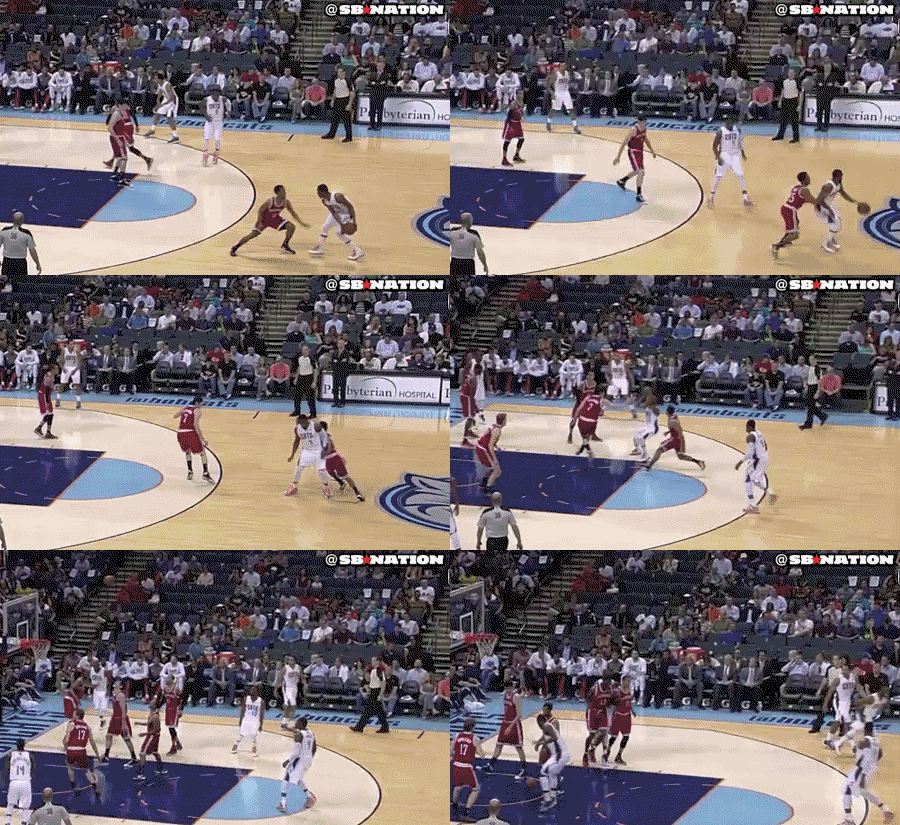

Walker’s also especially good at stepping back to create space. The key to any stepback jumper is the guard’s ability to jam his foot into the defenders as they get into their move. Like a well-placed jab step, this move naturally forces the defender to retreat and prevents him from coming out to properly contest the shot. Look at Walker’s foot placement on these two plays.


Walker has, literally, put his man on his heels. Look at Danilo Gallinari here.

One step has caused a much taller defender to surrender the coveted space needed to block a shot.
The jump
It may seem elementary, but Walker needs to be able to jump very high in order to get a good look at the rim even with these techniques to free himself. There’s a reason some of the league’s best leapers are great jump shooters. The higher you are, the easier it is to see the basket.
Despite being small, Kemba Walker can jump. Look how high he gets on these two shots.


Keep in mind that Kemba is not jumping forward, as one might if he got a running start for a dunk. He’s going full speed, stopping rapidly and jumping straight up. Which leads us to ...
The shot itself
Given how quickly Walker stops and pops, it’s remarkable how balanced his shot ends up being. A player’s momentum naturally pulls his body in different directions. A hard dribble to the right causes most shooters to fade that way. A straight-on dribble causes many shooters to lean into their shot. Worse, a hard dribble backwards easily causes a player to arch his back and fade away. None of those things are optimal for a jump shot.
Somehow, Walker is able to avoid most of these pitfalls, except for the occasional fadeaway that NBA players like him can make because they are the greatest basketball players in the world. The way Walker is able to square up to the rim no matter what is especially impressive.
Take this stepback jumper against the Mavericks, for example. When Walker is preparing to make his move, he's going straight at the rim, and his shoulders are pointed straight ahead because of that.

Walker is preparing to jump sideways, so it should be difficult for him to square his shoulders towards the rim. Yet that is exactly what he’s able to do.

Whenever possible, Walker also properly aligns his feet, with his right foot slightly in front of his left, pointed towards the rim. This foot position on a mid-range jumper over Nate Robinson comes after Walker shoots him with a behind the back dribble. That he stayed on balance after a move like that is impressive.

Balance is the biggest key to jump-shooting success. That Walker is able to balance himself in positions where most would be off-balanced explains a huge part of his stop-and-pop success.
The landing
Speaking of balance, it's a huge help when a player jumps and lands from the same spot. Walker sometimes leaned his front foot back, causing him to fade, but generally, he started and landed from the same exact position. Look at his left foot on this stepback jumper against the Bucks.

Despite Walker’s momentum carrying him backwards, despite a pretty good closeout all things considering, Walker’s left foot takes off and lands in about the same spot. You can surely thank all those offseason hours in the gym for that textbook form.
When it all comes together, this results.
****
Footwork, body control, leaping ability and balance. It’s no accident that Kemba Walker seems like one of the NBA’s quickest players and is certainly one of its deadliest mid-range shooters off the dribble. Few NBA motions are more difficult than the stop and pop; few, if any, do it better than Walker.
Now, let’s see if he can do something about the passing and his teammates.
See More:


