Ryan Anderson has earned a reputation as one of the best three-point shooters in the NBA. He led the league in threes made in 2011-2012, draining 166 while with the Orlando Magic. He thrived as a kick-out target for Jameer Nelson in Stan Van Gundy's four-out one-in system.
How the Pelicans get Ryan Anderson open
Every scouting report in the world says you shouldn’t leave Ryan Anderson open for three, yet he keeps sneaking away. How does he do it? We break down how the New Orleans Pelicans find space for the deadly long-range shooter.

Derick E. Hingle-USA TODAY Sport
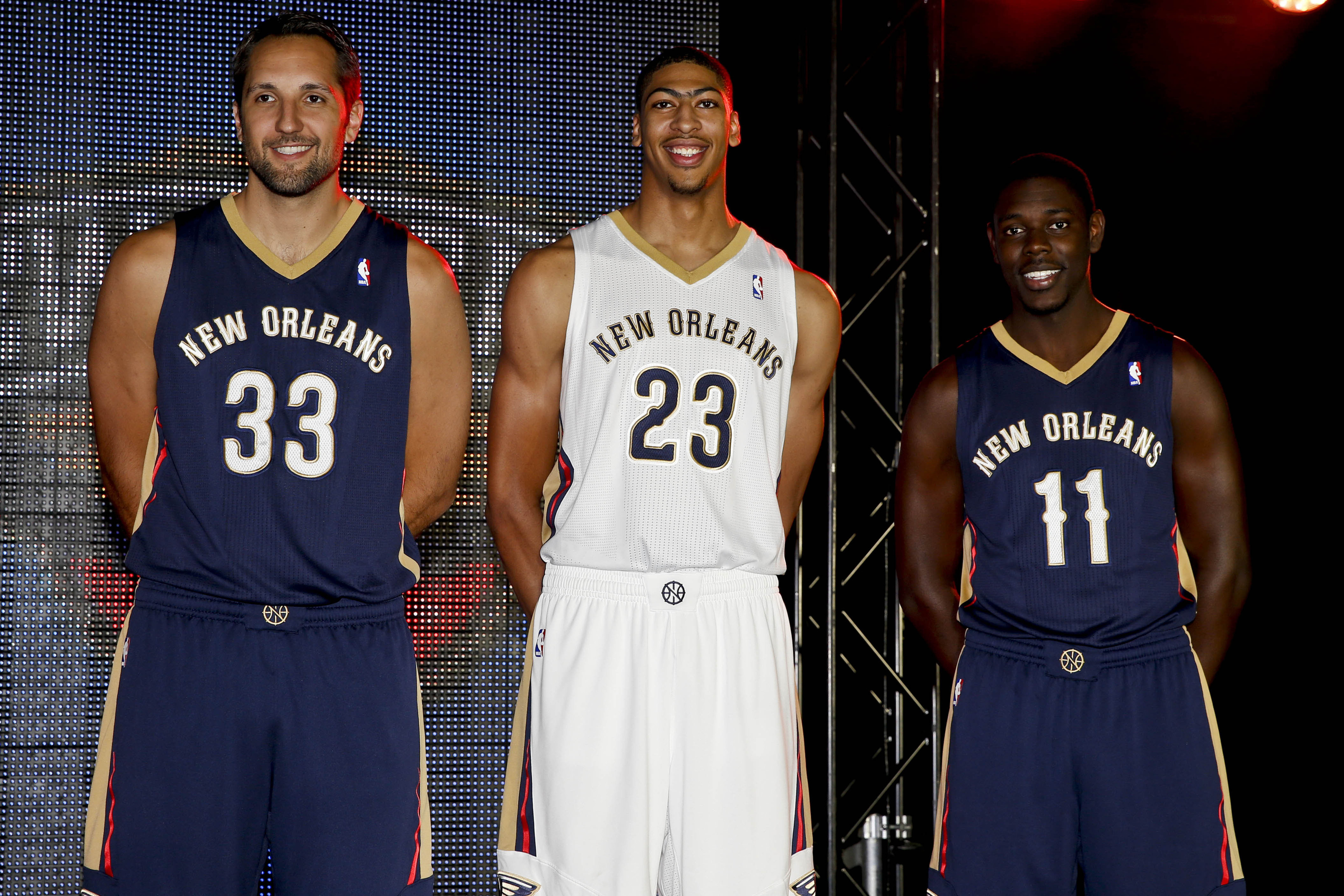
Then, Orlando stripped down it's roster and worked out a sign-and-trade deal with the New Orleans Pelicans, who were ready to give Anderson a four-year, $36 million deal. That may seem like large contract for a player like Anderson, who needs his teammates to create shots for him on the perimeter, but the then-Hornets maximized their asset by building a lot of their offense to complement his shooting ability. He actually made 47 more three-point field goals than his prior league-leading year, but finished second behind some NBA record-breaking shooter named Stephen Curry.
The luxury of having a three-point shooter like Anderson is straightforward. When a team forces the defense to collapse into the paint and away from the three-point shooter, the ball will be swing back out to the perimeter and into his hands. This opens the floor for a penetrating point guard, a rolling big man or a low-post player. It also allows the coaching staff to draw up intricate plays out of timeouts that opponents typically don’t scout ahead of time.
The play below is a good example of a funky set play designed to create an open three for Anderson. It’s so intricate that it’s hard to describe without watching the video.
That funky set play, featuring multiple screens and screeners, is possible because of Anderson’s ability to hit that top-of-the-key three.
Of course, basketball is a fluid sport and it’s unrealistic to expect that type of play through 48 minutes. Pick-and-rolls, off-ball screens and motion are at the heart of every offense. The Pelicans were successful at integrating Anderson’s shooting ability in all three areas.
Anderson is deceptive in pick-and-rolls. Sometimes, he'll absorb contact and wait to spot-up beyond the arc in a routine pick-and-pop. Other times, he'll act as if his intention is to set a screen, like he does below to the Knicks' J.R. Smith:

But instead of standing still, Anderson steps through both defenders and out to the corner without stopping, slipping the screen. Smith aggressively “fights” under a screen that never existed, allowing Anderson space to shoot. He tries to recover but is late. By the time Smith contests the three, it’s out of his reach:


Video of the play:
Anderson mixes in his screen slips and often catches the defense by surprise. This is a good alternative to the standard pick-and-pop play, but isn’t the only way the Pelicans used pick-and-rolls to open the floor for him.
Here, Brian Roberts and Robin Lopez run a high pick-and-roll themselves. Anderson is setting up in the opposite corner, away from the play. Roberts drives away from Anderson's side of the court and stays on the right side, while Lopez dives from the top of the arc toward the rim. As this happens, Anderson begins sliding along the perimeter and out of the corner. These subtle movements will create a wide-open look for Anderson:

Both defenders near Anderson have their attention turned to the pick-and-roll, and there is also an off-ball screen set behind the Darrell Arthur and Quincy Pondexter. Both are unaware of anything happening besides the initial pick-and-roll that is really a decoy:

Anderson is completely alone on the perimeter and is an easy target for Roberts after setting his feet. Pondexter turns to close out, but runs into the screen. He is nowhere near altering Anderson’s shot:


Video of the play:
This is a powerful counter to defenses that pack the paint, an area the Pelicans hope to open up for 2012 first-overall draft pick Anthony Davis. It's no coincidence the Magic used Anderson similarly when teams would try to contain Jameer Nelson and Dwight Howard pick-and-rolls:
The Pelicans also used movement and off-ball screens to create open looks from deep for Anderson. They did this on many areas of the court, but we’ll look at just one.
Here, Lopez is handling the ball on the perimeter and waits for Al-Farouq Aminu to set a screen on Shawn Marion at the elbow. Anderson will step out to the three-point line:


Marion recognized the screen early, but was bumped just enough to buy Anderson the time he needs to take the open shot:


Video of the play:
 Visit The Bird Writes for even more Pelicans coverage.
 Anderson also deserves credit for having an incredibly fast release from beyond the arc. Anderson was blocked just 37 time last season despite taking 1,115 field goals. That’s a very low number, but even more remarkable is that none of those blocks were on three-point attempts, according to NBA.com.
We’ve gone through how the Pelicans used pick-and-pops, pick-and-roll diversions and off-ball screens to create opportunities for Anderson. Now, here’s a four-minute compilation of all three play types. It’s also worth noting how often his defender is close to blocking him, but fails to alter the shot:
A few words of advice from the Sacramento Kings' booth: don't leave Ryan Anderson.
See More:


