* * *
Teams were salivating over the chance to pry LeBron from the Cavaliers. The New York Knicks, mired in a fate worse than mediocrity for nearly a decade, put everything on hold for two years with a high-priced coach just to have a shot at LeBron in 2010. This included trading multiple draft picks just to dump a mid-rung salary at the 2009-10 trade deadline. The Heat - who won a title with Wade in 2006 but fell to the fringe once Shaq disappeared - cut down enough to afford Wade and two more superstars, an unprecedented cap clearing. The New Jersey Nets, fat with cash from their new Russian tycoon and a blueprint for a new arena in Brooklyn, were poised to strike. The Bulls couldn't give LeBron No. 23, but they had the cap space to absorb him, along with a major market, a somewhat familiar Midwestern home and Derrick Rose. The Los Angeles Clippers offered an even bigger market, plus the lure of Hollywood and of Blake Griffin.
Other teams wanted in, but LeBron couldn't consider all offers. So he invited those five teams plus the Cavaliers to visit him in Cleveland's IMG offices and make their pitch. Reporters jockeyed for nuggets: word was that the Knicks' presentation was a disaster, the Nets' was glossy, the Heat's included a roleplaying session involving Pat Riley's championship rings, the Bulls' lacked passion, the Clippers' was everything Clippers, and the Cavs' relied on familiarity. LeBron weighed his options; Worldwide Wes and Maverick Carter became more well-known to NBA fans than any handlers in history.
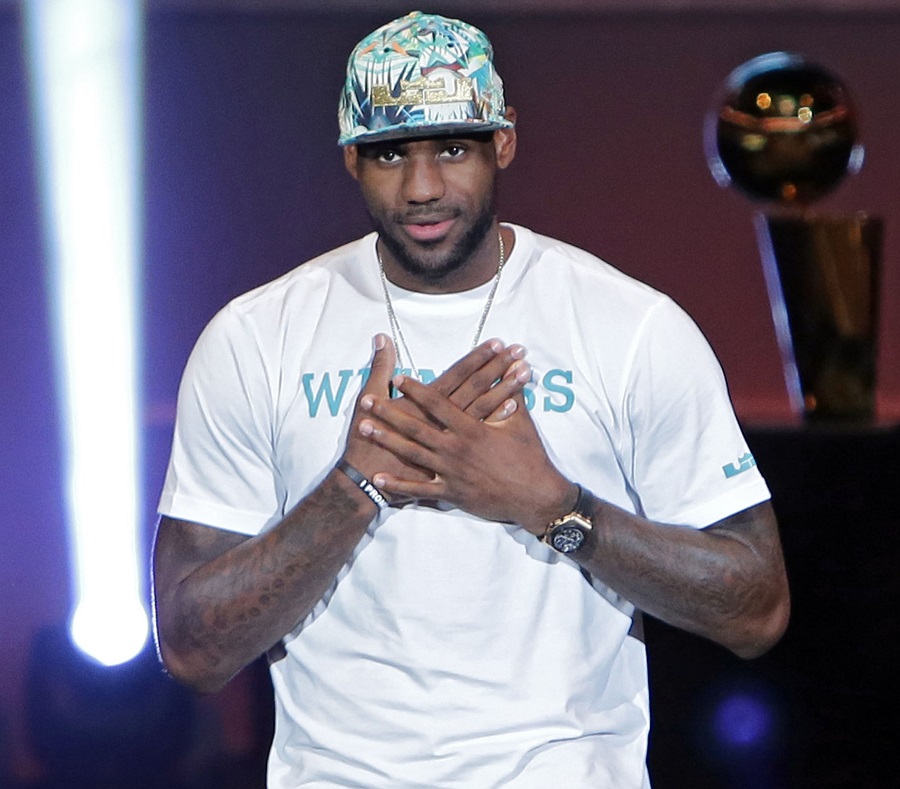
On July 6, after the meetings were done, ESPN announced it would host a one-hour special during which LeBron would announce his decision two days later. On July 7, Wade and Bosh announced live on ESPN they would join forces in Miami. And on July 8:
* * *
That first season in Miami was, in a word, strange. What LeBron and company created pulled at just about every thread possible. It was a must-watch team -- the Heat set myriad local and national viewership records, including in LeBron's return to Cleveland and the Christmas Day matchup with the Lakers. Both games were miserable blowouts.
The basketball-loving free world adored following this team.
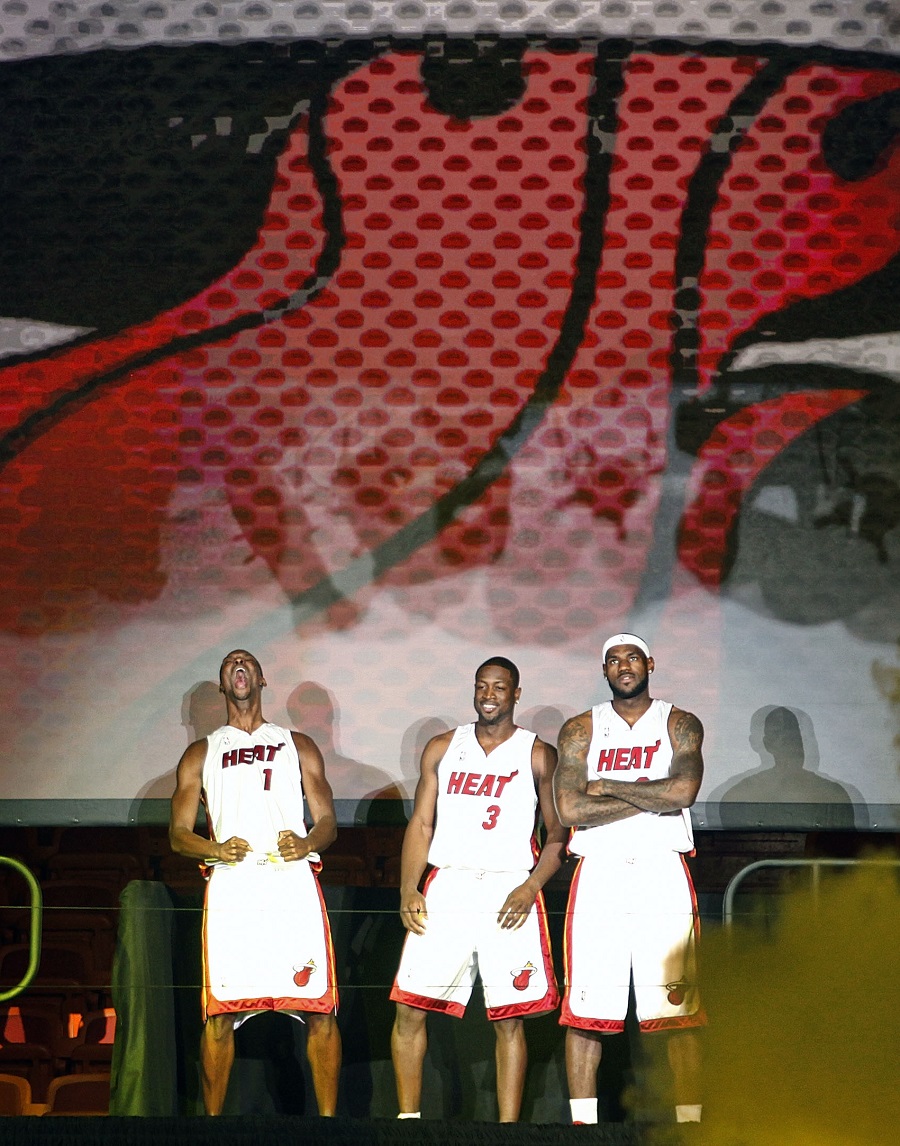
The team totally blew up on the web, too - ESPN.com assigned an elite corps of reporters and analysts to Miami, an unprecedented move for a single NBA franchise. The two-time defending champion Lakers didn't get that kind of coverage. The Heat became the NBA's hottest road ticket. As teams turned to dynamic pricing, Miami's one or two visits became the highest-price ducats of the year everywhere. The basketball-loving free world adored following this team.
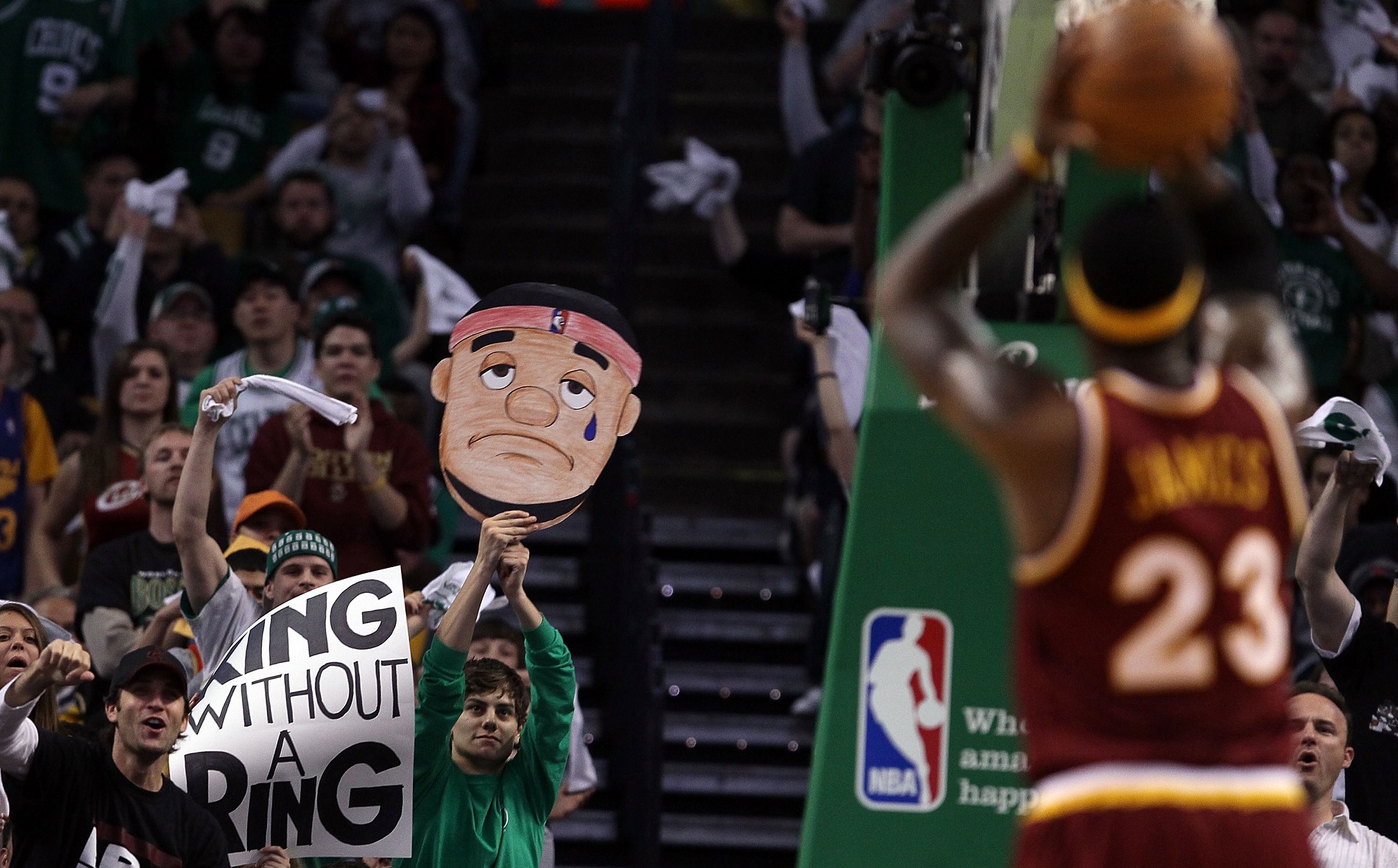
And, it seems, reveling in LeBron's eventual misery.
LeBron had a wonderful season, and the Heat were well-poised to win the title. James didn't threepeat on the MVP, as voters turned toward Derrick Rose, who with Joakim Noah, Luol Deng and rookie head coach Tom Thibodeau landed the best record in the NBA. But the Heat were also excellent, finishing with the league's best margin of victory.
There was one alarming trend through that season, though: the Heat had trouble closing tight games. Analysts suggested LeBron and Wade were uncomfortable taking over in the presence of the other. Others thought it proved (again) that LeBron didn't have the fortitude, mental or otherwise, to make the final shot. The Celtics, and specifically Paul Pierce, fueled up that fire as The Truth mocked LeBron after a Boston win in Miami.
That storyline would hit LeBron again in the postseason. Miami dominated the Eastern bracket, going 12-3 to make the NBA Finals. But James had a truly bizarre series against the Mavericks, who dug in their claws and tore at the Heat. Shawn Marion, one of the best defenders of his generation, surely had a lot to do with it. So did paint defenseman Tyson Chandler, whose presence forced LeBron into more of a perimeter game.
But the narrative wasn't about what Dallas did to slow LeBron, it was about what LeBron couldn't do. All of those criticisms from July -- that LeBron was mentally weak, that LeBron didn't trust his own abilities, that LeBron was soft, that LeBron couldn't make good decisions when the pressure was on -- came back with a vengeance. And with LeBron passing up a lot of shots and deferring to Wade, the Heat lost, 4-2.
No, July 2010 was not rock-bottom for LeBron's reputation. That came 11 months later in June 2011 when in six games, he seemed to prove the critics right.
Of course, the critics were not actually proven right. LeBron had a bizarre series alright, but Dallas -- the quartet of Marion, Chandler, an otherworldly Dirk Nowitzki and coach Rick Carlisle in particular -- wasn't given nearly enough credit.
***
The Knicks: Then and now
The Knicks couldn’t possibly leave 2010 empty-handed. Nine straight losing seasons didn’t fully tell the story of New York’s incredibly bad 2000s. The team was a constant embarrassment, from Larry Brown’s bewildering coaching stint, to the ill-fated Stephon Marbury-Steve Francis experiment, to Isiah Thomas’s disastrous graduation to the sidelines, to the same man’s incredibly-gross court case. In 2006, shortly after being fired from her job as an executive with the Knicks, Anucha Browne Sanders filed a sprawling sexual harassment lawsuit against Thomas and the Knicks. Too proud to immediately settle, Knicks owner James Dolan let the case go to court. Among other revelations as to the depths of Knickerbocker hedonism, Marbury testified about inviting an intern into his pick-up truck. In 2007, a judge eventually decided in favor of Browne Sanders. It cost the Knicks $11.5 million.
But the cost of the lost era was much larger for the Knicks. Once Isiah ran basketball operations into the ground, Dolan turned to famed Suns coach Mike D’Antoni in 2008. He and Donnie Walsh intended to make the Knicks respectable again, using Walsh’s management smarts and D’Antoni aesthetically pleasing style. But the 2009 and 2010 seasons didn’t bear fruit: the Knicks remained among the worst teams in the league.
Still, they were the Knicks. The entire leadership structure apparently still thought that being New York’s team mattered, regardless of the horrible run the franchise had been on. So during the pitiful 2009-10 season, Walsh began to engineer a path out. It would happen during 2010 free agency when, yes, LeBron would be a free agent. But there’d also be other stars on the market: Wade, Bosh, Joe Johnson, Rudy Gay and Amar’e Stoudemire.
Stoudemire was an interesting target. He had to leave Phoenix because Phoenix more or less told him to leave. The Suns had a fantastic season with Amar’e in 2009-10, winning 54 games and making the West finals. Stoudemire averaged 23 points per game during the regular season, and he didn’t fall off in the playoffs. The Suns were keeping an aging Steve Nash around, but didn’t want to retain Stoudemire given his injury history, defensive reputation and other issues. So off he went to find a new home that would reunite him with the coach who featured prominently in Stoudemire’s greatest years.
And so Amar’e flirted heavily with the Knicks, and reached a five-year, $100 million deal with New York on July 5, 2010. He was really the first domino of free agency; all the other big names who had agreed to deals by then had re-signed with their old teams. Amar’e gave New York a big name and an incentive for any perimeter free agents considering the Knicks.
But no one else bit. Wade flirted with Chicago before re-upping with Miami, and LeBron seemed not to care much about the legacy he’d leave as a Knick. So Walsh hustled to fill out the cap sheet with Raymond Felton and mysterious Russian giant Timofey Mozgov. Meanwhile, the team let David Lee flee in a sign-and-trade deal; the return package -- Ronny Turiaf, Anthony Randolph, Kelenna Azubuike and a couple of future seconds -- played a total of 1,200 minutes in New York.
The Knicks, though, quickly made us all forget about the 2010 free agency misfires. By August, New York was the leading contender in the amaranthine quest for Carmelo Anthony. The Knicks finally landed him in February 2011, and after a mediocre start finished the season with a winning record (the first since 2000-01) and a playoff bid (the first since 2003-04). The front office continued to add pieces like Tyson Chandler and Jason Kidd, and last season, the Knicks went 54-28. It was the eighth best season in New York’s 68-year history.
Things aren’t perfect. Stoudemire in particular is a huge salary drain due to age and injury, ‘Melo is flirting with free agency at the end of this season and there are major concerns the team could fall off quite a bit, maybe into one of the lower seeds in the Eastern playoff bracket.
But after the disappointment of July 2010 and the decade of failure that led up to it, quibbling about playoff seeds is a pretty nice place to sit.
The Nets: Then and now
If the Knicks entered the 2010 free agency period with a crummy resumé, the Nets came in with something like an anti-resumé. Fresh off of a 12-70 season, playing in one of the worst gyms in the NBA with a totally barren roster, the New Jersey Nets hardly looked like a franchise that could lure anything better than D-level free agents, let alone the likes of LeBron. But the Nets had a wild card no other team could boast: Mikhail Prokhorov.
A Russian who made his fortune in precious metals, Prokhorov officially took the reins of the Nets in May 2010, three weeks after the disastrous season ended. He immediately became the second-richest owner in the NBA, trailing only Portland’s Paul Allen. He brought a strange allure to the franchise immediately, owing to the wild stories that followed him and a truly incredible 60 Minutes interview in March 2010. The man who would later oppose Vladimir Putin politically gave off a similar vibe to that of the Russian president: he was like a very real Bond villain. And he swore to put his riches to use in the NBA — buying a championship, if that’s what it took.
His money also served to guarantee a vital franchise shift toward that path would take place. Prokhorov ensured the team’s move to Brooklyn would happen in time for the 2012-13 season. Once there, the Nets wouldn’t have to rely on Prokhorov’s bank account too much: the first major league team blaring Brooklyn across its chest since the Dodgers bolted westward could print money alongside jerseys.
The promise of a richer, more successful tomorrow, however, fell short in 2010. The Nets had Jay-Z, who owned a sliver of the team and a major chunk of pop culture for the players Prokhorov wanted. But Jay-Z couldn’t compel the best player in the world to join a 12-win team. No one could have, really. What was more unfortunate is that the Nets struck out on everyone. Joe Johnson and Rudy Gay re-signed in Atlanta and Memphis, respectively, which really damaged the class of star the Nets were chasing once LeBron and Wade demurred. The Nets would need to overpay players to bolster the derelict roster. Johnson and Gay were overpaid in 2010 alright, but the Nets didn’t even get a shot at bidding because they each signed max contracts to stay home.
So, with that enigmatic owner, the rap legend pitchman and the lure of the most glamorous hip hop borough, the Nets ended up with Travis Outlaw, Johan Petro and Jordan Farmar. Seriously: the team signed Outlaw to a 5-year, $35 million deal on July 8, Petro to a 3-year, $9 million deal on July 10 and Farmar to a 3-year, $12 million deal on July 11. That’s a 4-day stretch that is impossible to cite with a straight face. Nothing about it hurt Brooklyn’s long-term flexibility. (New Jersey waived Outlaw under the amnesty clause after one season. Sacramento amazingly picked him up at 43 percent of his salary, saving the Nets some cash.) But the damage of that four-day stretch was done: this was not a team to be taken seriously.
Prokhorov and his new GM Billy King learned a lesson that month: free agency wouldn’t be the way forward. The Nets immediately inserted themselves in the ‘Melo chase, even though it seemed obvious Anthony was more interested in Manhattan. The fact that the Nets had two seasons in Jersey remaining was a problem in terms of recruitment. But a different trade target, Deron Williams, was far enough from free agency that the Nets could risk grabbing him and hoping he’d be convinced to stick around. The day after the Knicks landed ‘Melo, the Nets answered by trading a package of prospects and picks (as in, Derrick Favors and the 2011 No. 3 pick, which became Enes Kanter) for D-Will. The team was still awful, but at least it had a star.
It had two, really, because 2008 lottery pick Brook Lopez would soon come into his own. All other major talent acquisitions for the Nets came by trade: Gerald Wallace for the pick that became Damian Lillard, Joe Johnson for a cornucopia of chaff and now Kevin Garnett and Paul Pierce for Wallace, picks and contracts. The Nets did sign Andrei Kirilenko at a bargain rate and grab Andray Blatche off the waiver wire.
But Prokhorov and King didn’t depend on wooing free agents to Brooklyn this time around. The Nets learned that the willingness to leverage huge bundles of cash could pay off on the trade market much more easily than on the free agent market. And now the team hopes to challenge for a title. It’s not so easy to dismiss Prokhorov now.