What is Boxing Day? Well, it has nothing to do with basketball, though you could definitely name a set or action and people would go “yeah, that sounds right.” Boxing Day is a national holiday on Dec. 26 each year across Canada. Technically, it would be a bank holiday, but has basically become a federal statutory holiday.
A call for an NBA ‘Boxing Day’ special in Canada
Why doesn’t the NBA have a Boxing Day special in Toronto? Plus, this week’s ATO features another brilliant set from Portland’s Terry Stotts.

USA TODAY Sports
With the rush of the holiday season upon us, I figured SB Nation readers would love to learn about a particularly Canadian Christmas tradition. Actually, a tradition throughout the former commonwealth, but we’ll focus on the only other nation with an NBA team: the Great White North.
 More from Doug Eberhardt
Originally, back in Olde England, Boxing Day was set-up as a day that servants and tradesmen would receive a gift from their bosses, known as a “Christmas box.” Since the staff would have to work on Christmas day, they would be given the next day off to be with their families. Hence, Dec. 26.
A more modern Canadian example, before the waiting in line to buy the latest LP or quadraphonic stereo system, is that families would clear away the curled ribbon, torn wrapping paper and discarded “boxes” that populated their shag carpeting like so many corrugated soldiers Christmas Day on Dec. 26.
Today, Boxing Day is primarily a shopping holiday across Canada. A shopping week. A shopping month. It was truly “Black Friday” or “Super Saturday” before those marketing inventions of consumer gluttony ever existed in America. Kudos, Canada. You were far ahead on driving holiday corporate bottom lines.
While the NBA annually has a marquee of five games scheduled for Christmas Day, I would like to begin a one-man petition to have the Toronto Raptors play a home game every Boxing Day. It would be wonderful to always have Canadian NBA on this most Canadian of holidays. What say you, future Commissioner Adam Silver?
Next week, I’ll return to broadening your NBA vocabulary. For now: Merry Christmas (Hanukah, Kwanza, Festivus, etc.) and a Happy New Year. May all of you have a wonderful holiday and all the best to you and families.
ATO OF THE WEEK
Dec. 21, 2013: Blazers 81, Pelicans 78, 1.8 seconds left in third quarter. Blazers ball.
Following a series of shot attempts and offensive rebounds that would make a pick-up game at Portland Community College look organized by comparison, the Pelicans give a foul before Damian Lillard is able to penetrate to the hoop. All of this tomfoolery drives the game clock down to 1.8 seconds remaining in the third quarter. Terry Stotts elects to take a full timeout rather than the 20-second TO that I believe most coaches would use at this point of the game. Given that you're unable to carry more than one full timeout into the last two minutes of the fourth quarter, this is a slick move by Stotts.
Bookmark This
With 1.8 seconds remaining, Portland has many options at its disposal: Catch-and-shoot three, catch-and-shoot two, a moving catch, one dribble and shoot, or a lob play toward the to the rim. In other words, 1.8 seconds is a longer amount of time than you’d think.
The Blazers setup with Lillard at the strong side low block, defended by Jrue Holiday, and with LaMarcus Aldridge and Mo Williams at the high post elbow. This would normally indicate that Lillard would be coming straight up the lane on a what's known as a zipper cut in NBA lingo. Dorell Wright sets up on the weak side, away from the ball, just outside the mid-post. Nic Batum is the trigger man inbounding the ball. Given Portland's previous appearance here at "ATO of the Week," we all know that the Frenchman is obviously "the most dangerous man on the court."
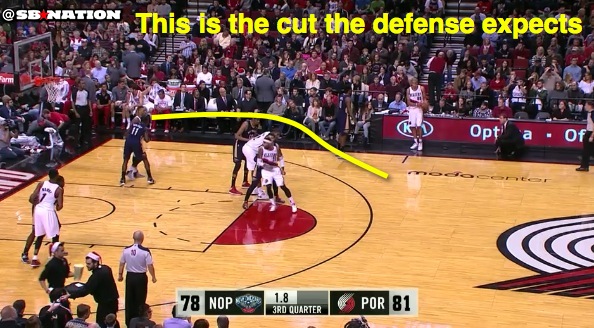
Williams initiates the Portland action by peeling and spinning off Aldridge. Austin Rivers locks and trails on Mo's hip. At approximately the same time, Wright begins a hard baseline cut, with Tyreke Evans in pursuit. Evans has to be thinking Wright is headed for a corner three, but if there's one thing we've learned about Portland's ATO actions, it's that Portland's shooters, whether Wright or Wes Matthews, are the hard-charging and dangerous decoy.
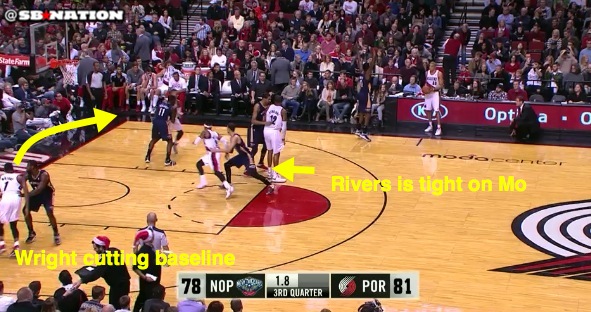
After the first two hard cuts initiate the Rube Goldberg machine-like action, Lillard heads straight up toward the ball. But rather than go toward the ball, Lillard then alters course and cuts sharply for Aldridge’s top shoulder at the high post. Holiday does a good job locking on to Lillard’s hip and staying attached with the cut.
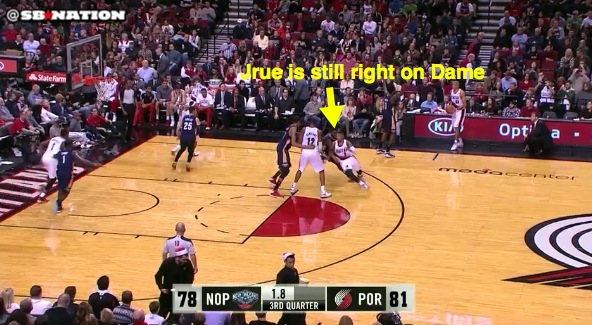
Nevertheless, Dame does an excellent job making a hard curl off Aldridge’s screen at the elbow just as Wright clears under the basket. Aldridge does even a better job moving just a touch and avoiding an offensive foul call, catching Holliday.

Here’s when we get to see defensive decision-making at full speed. Evans, guarding Wright, makes it to the strong-side block before recognizing that the lob is coming, and thus puts on the brakes to reverse his direction. Unfortunately, like a large truck using air brakes, it is difficult to come to a complete stop quickly and change directions. Air brakes are a powerful force multiplier, but don’t particularly help in the speed department.
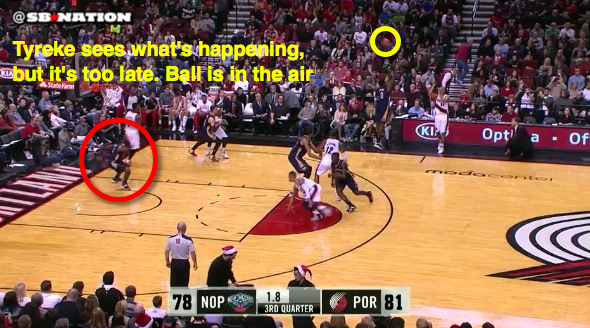
Back at the high post, Alexis Ajinca also must make a decision. Does he step to Lillard and try to make contact with him to divert his path, which is known as "chucking"? If he does, that would free Aldridge to quickly slip for a mid-range catch and shoot. Ajinca chooses to stay attached to the screener, allowing Lillard's cut to proceed unimpeded.
Batum's pass is adequate enough to allow this play to be completed. New Orleans uses the lanky Al-Farouq Aminu to contest the sideline pass. Batum aims for the far corner of the backboard, which is the spot most coaches teach to throw to, and gets it close enough that Lillard can handle the lob.
Here’s where Lillard shows off his underrated athleticism. Dame rises and makes an unbelievable catch and is able to bank in the six-foot alley-oop, all while Evans makes a strong, but ultimately late, contest.
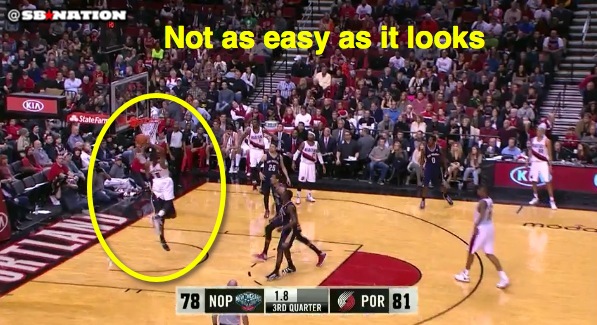
Game. Set. Match. (Except it’s only the end of the third quarter. So, game, set).
This well-executed ATO might ring a few bells, as it looks very much like a Vince Carter cut, curl and lob dunk ATO from the heyday of the New Jersey Nets. A reminder: Imitation is the sincerest form of flattery.
Meanwhile, Stotts is quickly rocketing up my imaginary “Coaches ATO Power Rankings.” He draws up imaginative, creative ATO’s. More importantly, it is obvious through his team’s execution that they’ve worked on these scenarios before at practice, walk-throughs, etc. Add in the Blazers’ overall talent level and the threat of a catch-and-shoot three-pointer from four of their five players, and you have the making for a very potent ATO combination.
I’ll leave the last word to Blazer’s TV analyst and entertaining homer, Mike Rice.
“Terry Stotts, you’re Albert Einstein.”
If you have an ATO to suggest, please tweet or email me with #ebeATO.
More from SB Nation NBA:
See More:


