Poor NFL. (This is the first time in history that those two words have sat next to one another.)
In the NFL Draft, the NFL can't really win. If it picks a great player early on, it's an obvious move undeserving of acclaim. If it finds a great player late in the draft, the NFL is at fault for not picking him earlier. A large chunk of a great draft is spent rummaging through the middle rounds and picking up the little un-sexy odds and ends that might give a quarterback an extra half-second in the pocket, or provide essential insurance in case their middle linebacker tests free agency next year. When done right, it's masterful work, but it's also subtle work that most fans -- fans like me, for instance -- don't notice or care about.
Aside from those thankless maneuverings, there is nothing left for NFL teams to do but screw up and look stupid. Collectively, the NFL spends an estimated $50 million or more to scout the players it will eventually draft. Maybe their failures are telling us that $50 million is being wasted, or that $50 million isn't enough. A team must look at a prospect and plot out how good he really is and how much potential for growth he really has.
At least as daunting, though: the team must determine how this person, with these metrics, will fit into the NFL machine. It's an enormous and hopelessly complicated machine of hyper-specialized parts that break down at random and occasionally fail to work in tandem with other parts for reasons unexplained. So maybe we're to conclude that no money, no resources, would be enough to project the future of a system that's sometimes simultaneously rigid, and sometimes nonspecifically blob-like. Whichever happens to be more confusing, really.
Even if their failures in the draft are understandable, it doesn't mean they aren't funny. Y'all, they are funny as shit.
How can the only people in the world who don't understand that Warren Sapp will be better than Kyle Brady be the same exact people who are in charge of an NFL franchise? Why is a team spending a second-round pick on a kicker? When the Browns select one of the greatest busts of the century in Brady Quinn, why is the great surprise not that he was picked in the first round, but that he wasn't picked far earlier?
With the benefit of hindsight and massive volumes of statistics, these errors are every bit as funny to me as a snap that pops an inattentive quarterback upside the head. After some stat-gathering and number-crunching, I've found lots to laugh at.
I chose to look at the five NFL Drafts between 2004 and 2008. With a minimum of five years of distance between then and now, we have a pretty solid idea of which players did and didn't pan out, and we can identify which picks were terrible. I found a few decisions that were staggeringly, comically bad. But before we get to those:
FIRST, SOME BASIC TRUTHS OF THE NFL DRAFT.
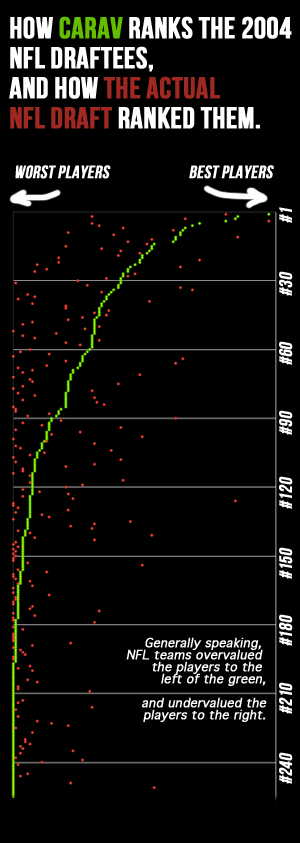
1. When studied as a single, giant organism, the NFL was actually not too bad at drafting.
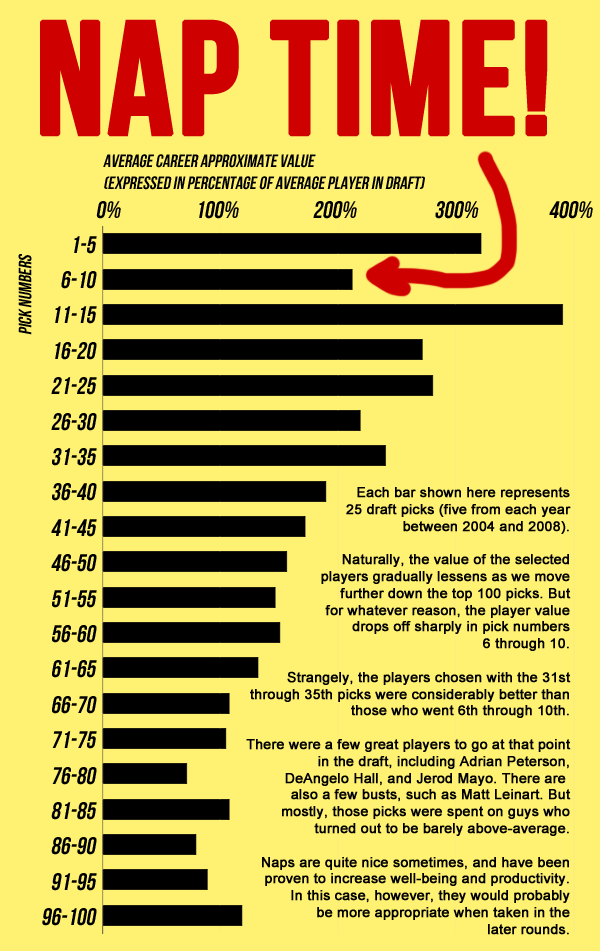
For most of my analysis, I've relied upon a couple of pre-existing statistical models. The first was Pro-Football-Reference's Career Approximate Value (CarAV) score. For starters, Approximate Value (AV) is Pro-Football-Reference's attempt at reducing a player's overall value to a single number. This season, Peyton Manning and Richard Sherman led the league in AV with 19. LeSean McCoy had 15, Tony Romo had 13, et cetera. This stat should be handled carefully -- "approximate" is right there in the dang name -- but it's quite useful for comparing the value of large groups of players across different positions.
CarAV represents the AV of a player throughout every season of his career, but weights it so that his best seasons count a little more. That's swell for our purposes, since a player's maximum potential is what we're really after.
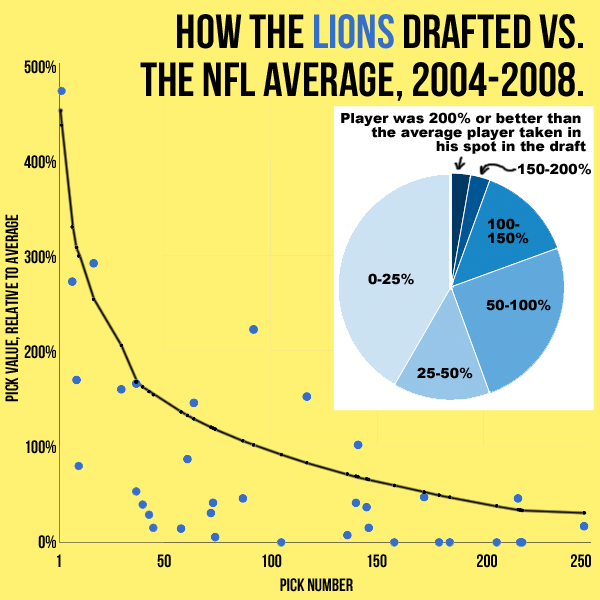
The other is the Harvard Draft Value Chart, which was created by Kevin Meers a couple years ago. The chart assigns a value to every pick number in the draft. The No. 1 overall pick is worth about 494 points, and the 200th pick is worth about 40 points. As the plot to the right demonstrates, pick values don't drop off in a straight line. They start really high with the top pick, bottom out dramatically in the first round, and sort of level off slowly after that.
This statistical model is also just an approximation, and should be regarded as such. But if we wanna cackle at teams for making terrible decisions, we need some way to understand exactly how much value they wasted on their bullshit conclusions.
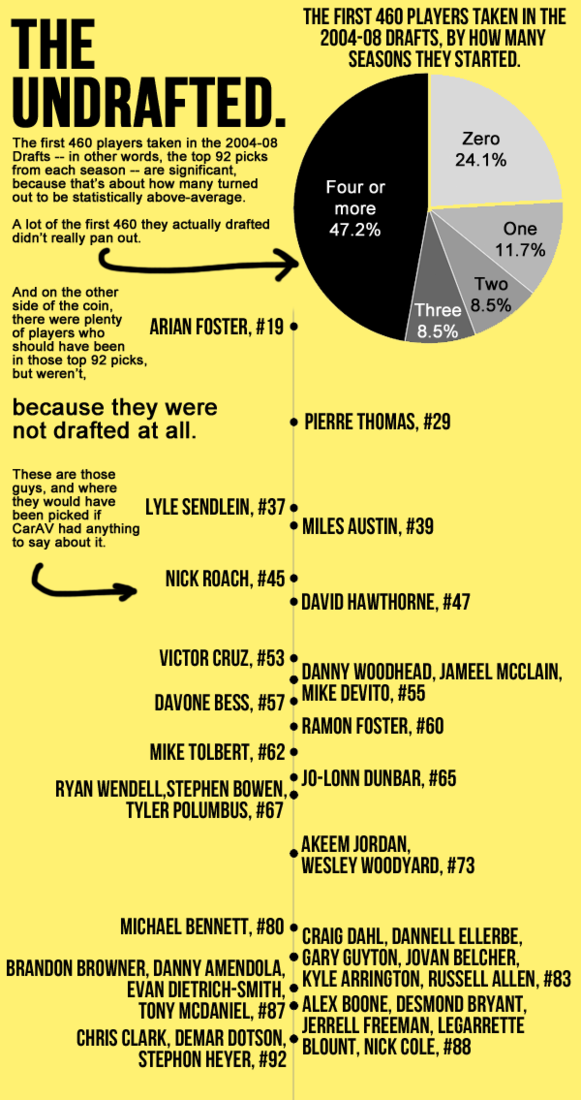
With all that out of the way: no, as a whole, the NFL was not so bad at drafting. They didn't even display bias toward any particular position on the field; I was struck by how similar their grades were from position to position.
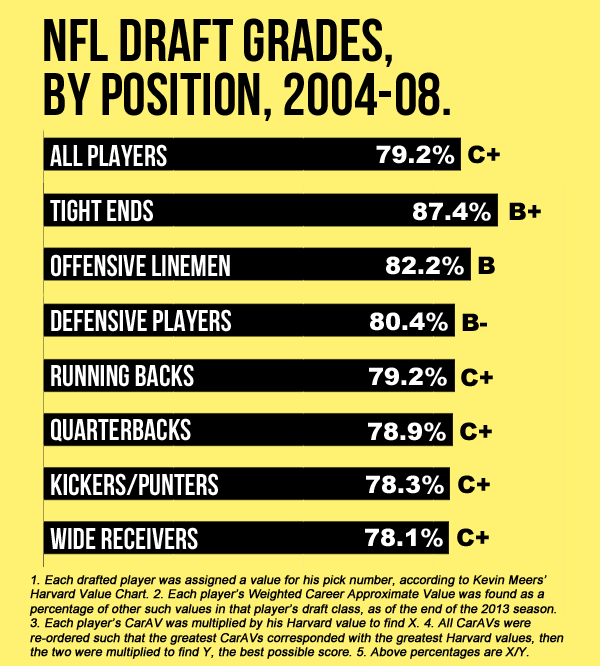

A report card full of Bs and Cs may not seem so impressive, but I put them to an almost impossibly difficult test. A perfect score would represent that every NFL team drafted every player in the precisely correct order, according to the CarAV he would one day accumulate. From that perspective, they did quite well.
There has to be some causality at work here. A team is naturally going to be invested in the future of its top picks. It will spend more time developing that guy and give him more chances to succeed. We can observe this in the career of Alex Smith, the top overall pick in 2005. In his first year, he played like absolute crud and ended up with arguably the worst quarterback season of the 21st century. The 49ers kept starting him, though, and he eventually evolved into a completely serviceable quarterback. In his seventh season, he held one of the best passer ratings in the NFL.
That works the other way, too. Have you heard of Mark Sanchez? The Jets took him fifth overall in the 2009 draft. Through four seasons of bad-to-terrible stats, they stubbornly refused to bench him, and the result was perhaps the worst quarterback career in NFL history.
2. When studied individually, some teams were absolutely God-awful as Hell at drafting.
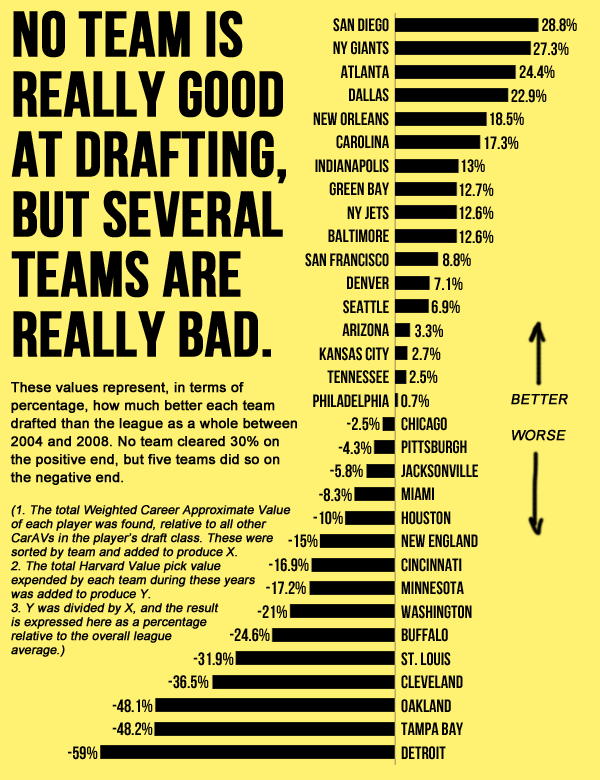
I know I've taken a couple shots at the Jets so far, but look at that! Between 2004 and 2008, they actually drafted 12 percent better than the NFL average. The Chargers did quite well, having grabbed the likes of Shawne Merriman, Darren Sproles and Vincent Jackson. Similarly, the Giants--
--you scrolled straight to the bottom, didn't you? That's cool, I'll join you there. The Lions were twice as bad at drafting as any team was good. Anyone who paid attention to the drafts during those years is not surprised by that, but the specifics of that awfulness are just staggering. We'll get to that later.
Teams, when examined on an individual basis, were more profound in their failures than they could ever hope to be in their successes.
3. The rules of NFL drafts apply to every team but the Patriots.
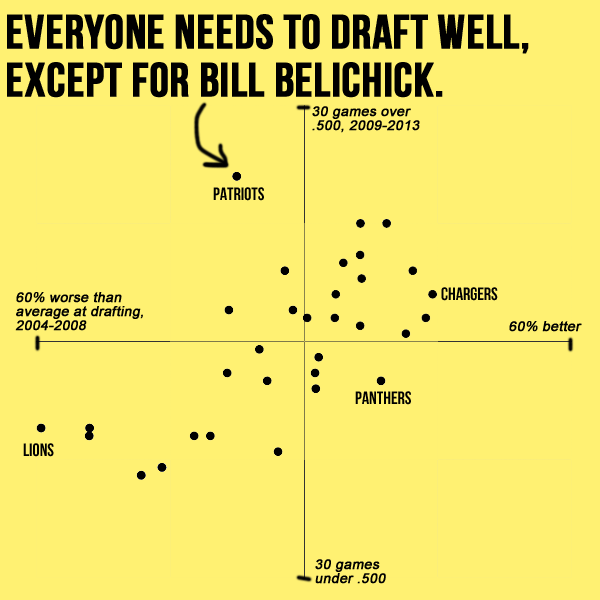
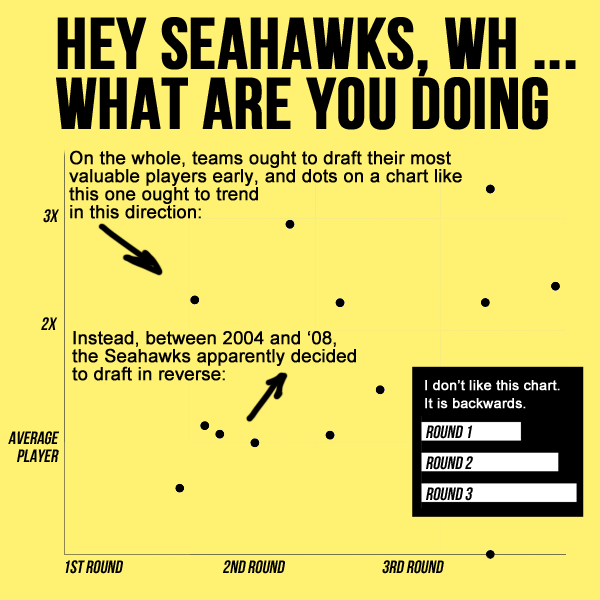
I took those figures above and plotted them against how much success each team found over the next five seasons. As one would expect, they're sprinkled diagonally: by and large, teams that drafted better won more games, and teams that drafted poorly lost more.
Bill Belichick's Patriots are the only team to exist outside of these rules. Their middle rounds were littered with guys who did nothing, or next to nothing, in the NFL. Their draft success ranked in the bottom third of the league during these seasons.
But even in 2009, those guys made up a large chunk of the roster. Nearly a third of the roster was made up of guys who were never drafted at all; the Patriots signed them for cheap and plugged them right in.
The rest of us mortals are confined by the oppression of common logic, our feet held to the ground by laws that stood for millions of years before anyone came around to write them. Bill Belichick is confined by none of them. He is a wizard whose command of elements real and abstract stretches beyond time, space, or any other dimension that the universe fecklessly tosses at his feet, like a single sandbag against a high tide. One day he will run out of idle curiosity, leave football, teleport to the Seahorse Nebula, and cook stews in the craters of unseen planets until animals crawl out. For now, he is content to outsmart your favorite team into oblivion.
He is the best. And now, the worst.