Fisher's first class begins
A strong offense and a defense that improved from 90th to 37th nationally resulted in a 10-win season, the first since 2003.
FSU reached the ACC Championship Game for the first time since 2005, but was soundly beaten by Virginia Tech. The Seminoles were also not competitive in a 47-17 blowout at Oklahoma, which was not anywhere as close as the final score indicated. Much work remained.
Still, there was progress -- and importantly for the fans, wins over rivals Florida and Miami with a combined score of 86-24.
With that momentum and an intact staff of dynamite recruiters, Fisher's state champion Seminoles signed one of the best classes in program history. ESPN's recruiting page led with the headline "SECond to FSU," naming Florida State's class as 2011's best and outlining just how many top SEC programs Florida State beat for the incredible 18 four- or five-stars it signed.
Florida State hit the jackpot, as 13 of the 18 went on to be starters or key reserves.
Florida State hit the jackpot, as 13 of the 18 went on to be starters or key reserves, including Timmy Jernigan, Kelvin Benjamin, Nick O'Leary, Karlos Williams, Bobby Hart, James Wilder Jr., Rashad Greene, Devonta Freeman and Josue Matias. And FSU's eye continued to find less-heralded players, including future starting right guard Tre' Jackson, who was underrated because a knee injury that had limited his high school career. In all, eight of the 22 starters on the 2013 title team were from the 2011 class.
But before any title could be won, Florida State would have to experience a 2011 season marred by the reminder that football is a collision sport. Key offensive linemen Andrew Datko, Bryan Stork, Jacob Fahrenkrug and David Spurlock all missed significant time with injuries. So did junior quarterback EJ Manuel, who missed much of a three-game losing streak.
Florida State would win seven of its last eight games, but a loss to Virginia in the final home game of the year saw Fisher's sideline demeanor resemble a coordinator's more than a head coach's. Even the most casual of observers could tell that Fisher was under great stress, and insiders privately said that he was far too negative and combustible toward his players, coaches and other staff. It also didn't help that his offense dropped to 50th nationally, squandering an excellent defense that ranked third in the country.
Fisher's record in his first 19 games as head coach was an awful 12-7. Fans and media decried the unwatchable offense and the perceived lack of progress. They wondered if Fisher was anything more than a great recruiter. And fans either did not know or did not want to hear that Florida State was considerably better in 2011 than it was in 2010, thanks almost entirely due to its improved defense, despite winning one fewer game and not playing for the conference title.
The Champs Sports Bowl win over Notre Dame, in which Florida State started four freshmen offensive linemen, offered promise for 2012. The Seminoles had gone 9-4, again beating the Gators and Hurricanes. The year would have been one of the better ones in the Lost Decade, but Fisher's offenses and recruiting had raised the bar. Questions lingered about his head coaching.
The questions had little to no effect on the 2012 class signed just five weeks later. Florida State signed a small group that was heavy on star power. Four starters on the defense of the 2013 team came from this class, including Eddie Goldman, Mario Edwards, Ronald Darby, and P.J. Williams, plus reserve Chris Casher. All were highly coveted by the SEC.
"The way Coach Jimbo and Coach [Dameyune] Craig stuck by me through my academic issues in high school. They were committed to me, so I stayed committed to them," defensive end Chris Casher, a Mobile, Ala., native, said of remaining with Florida State despite strong efforts from Alabama and Auburn to keep him in state.
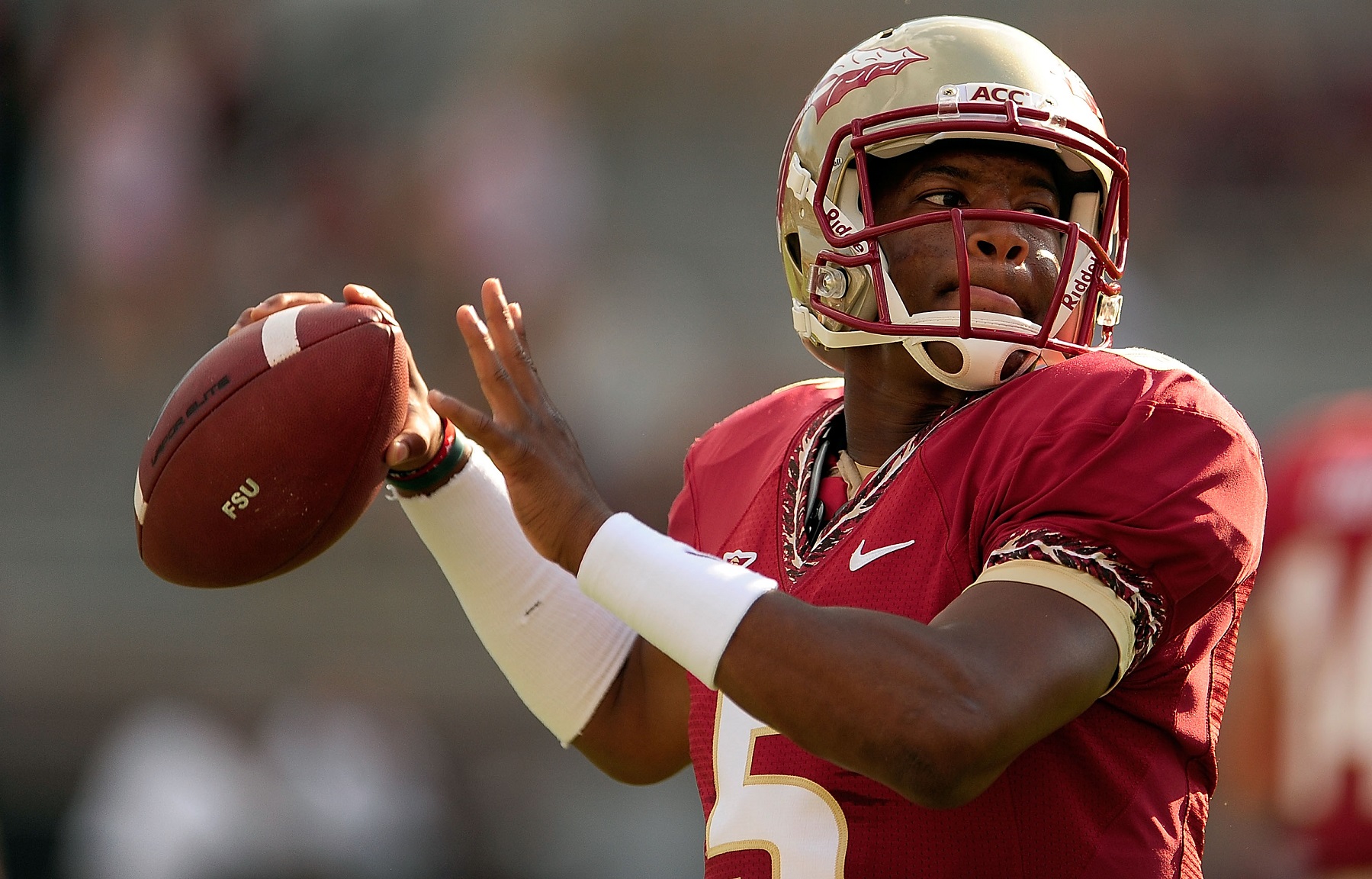
But by far the most important was a quarterback by the name of Jameis Winston, a five-star prospect out of Hueytown (Ala.) High School, just up the interstate where the Crimson Tide plays its football. Winston chose Florida State over Stanford and Alabama.
While all schools in the running said Winston could play both football and baseball, Florida State laid out a plan for him to do so, presenting a genuine, unified front on the matter. This was easy for FSU because Winston's baseball recruiter was hitting coach Mike Martin Jr., son of legendary head baseball coach Mike. Martin Jr. also happens to be one of Fisher's best friends in Tallahassee. Winston believed the two Seminole head coaches would not end up fighting over him, as both were on board with the plan. That Fisher has a true love for baseball and initially went to Clemson on a baseball scholarship, and that Florida State's baseball program is significantly better than Alabama's, probably didn't hurt either.
Quarterback coach Craig was equally important in signing Winston. Craig played for Fisher at Auburn when Fisher was the offensive coordinator for Terry Bowden. He has a unique insight into what it is like to go through the demanding and rewarding (three first-round quarterbacks in the NFL Draft, and counting) experience that is playing quarterback for Fisher. Craig connected with Winston's family and challenged him to blaze his own path, to not just go to Alabama like so many other players from Birmingham have done.
Not back yet
In 2012, Florida State still had Manuel, then a redshirt senior and returning starter. He was a good college quarterback with physical tools, but one of the rare quarterbacks whose production Fisher wasn't able to maximize. Based on those tools, he would go on to be the first quarterback taken in the 2013 NFL Draft.
It was by far the most successful Florida State season since the dynasty days. But it felt a bit hollow.
And based on those tools, a nasty returning defense and a much more veteran offensive line that was unlikely to suffer from the same afflictions as 2011, Florida State went into 2012 with a lot of hype. The home schedule was friendly, as both Clemson and Florida had to visit Doak Campbell Stadium. Many national experts picked Florida State to win the BCS Championship,
It was by far the most successful Florida State season since the dynasty days. The Seminoles won 12 games, the ACC and the Orange Bowl. But it felt a bit hollow. Florida State dropped a game as a heavy favorite at NC State, blowing a 16-point lead and being shut out in the second half while the Wolfpack ran the same plays over and over. Given FSU's schedule, which featured two FCS teams, the loss effectively knocked Florida State out of the title race. And even if it had not, the loss to the Gators in the final home game of the year certainly would have.
And even some of the wins, outside of the great comeback over Clemson, were unsatisfying. Some vocal fans called for Fisher to give up play-calling and hand over offensive coordinator duties, so that he could focus more on being a complete head coach.
The offseason
The 2013 offseason brought more uncertainty. Florida State lost six coaches, including both coordinators, as defensive coordinator Stoops left for the head coaching position at Kentucky and offensive coordinator Coley left for a three-year contract and a chance to call plays at Miami. Defensive ends coach D.J. Eliot followed Stoops to Kentucky. Running backs coach and ace South Florida recruiter Gran left to be offensive coordinator at Cincinnati and reunite with head coach Tommy Tuberville. Linebackers coach Greg Hudson left to become the defensive coordinator at Purdue. Craig left for a raise at Auburn as an offensive assistant.
Somehow, he managed to upgrade a staff that had seen five coaches take coordinator or head coach jobs at other schools.
While all six coaches left for raises or promotions, the undertone was that Fisher was abrasive and difficult to work for. Candidates for the vacant positions were not immediately obvious. Head coaches rarely have to replace nearly an entire staff all at once. Fisher had to get the hires right.
Somehow, he managed to upgrade a staff that had seen five coaches take coordinator or head coach jobs at other schools.
The new staff had some commonalities. On the offensive side of the football, it was clear that Fisher wanted to bring in someone with experience coaching quarterbacks and experience running an offense. He achieved that with new quarterbacks coach Randy Sanders, former Kentucky offensive coordinator. At the time, Sanders was not a popular hire. Fans wanted Fisher to bring in a new and exciting coordinator. Sanders had directed some abysmal offenses at Kentucky. But, he was also a key assistant on the 1998 Tennessee team that beat Florida State for the first BCS title and the offensive coordinator at Tennessee the following seven seasons.
With Sanders came running backs coach Jay Graham, with whom Sanders had coached at Tennessee. Graham proved to be an excellent recruiter and coach. His running backs at Florida State would pass-protect better than any FSU group in recent memory, allowing for the offense to throw down the field with a clean pocket.
The final piece on the offensive side of the football was tight ends coach and recruiting coordinator Tim Brewster, a man with head coaching experience and NFL experience.
"I coached nine years at the University of North Carolina, so I understood what Florida State was all about," Brewster said at BCS Media Day leading up to the 2014 championship game. "The only team we never beat at North Carolina was Florida State. I recruited against Florida State. We knew that a monster once lived in Tallahassee. Jimbo has done a great job of bringing Florida State football back to where it was when I knew it."
There's that word again. Back.
"I still to this day think about Derrick Brooks, Charlie Ward, Warrick Dunn. The ferociousness of how Florida State played defense under Mickey Andrews. It was amazing. It really was," Brewster said. "At this point, with what Jimbo is doing, we're back to being the Florida State people once knew.
"Jimbo has done a great job of collecting thoughts and ideas. I'm a veteran coach. I have a lot of thoughts and ideas. Randy Sanders is the same way. Jimbo does a great job of sitting back and listening to our ideas, and then picking what he thinks are best. It's been like that from Day 1. He knows he has a hell of a staff -- veteran, experienced guys. And Jimbo is very bright, sharp, extremely intelligent. He's been smart enough to utilize the ideas of others if he thinks it will help us win."
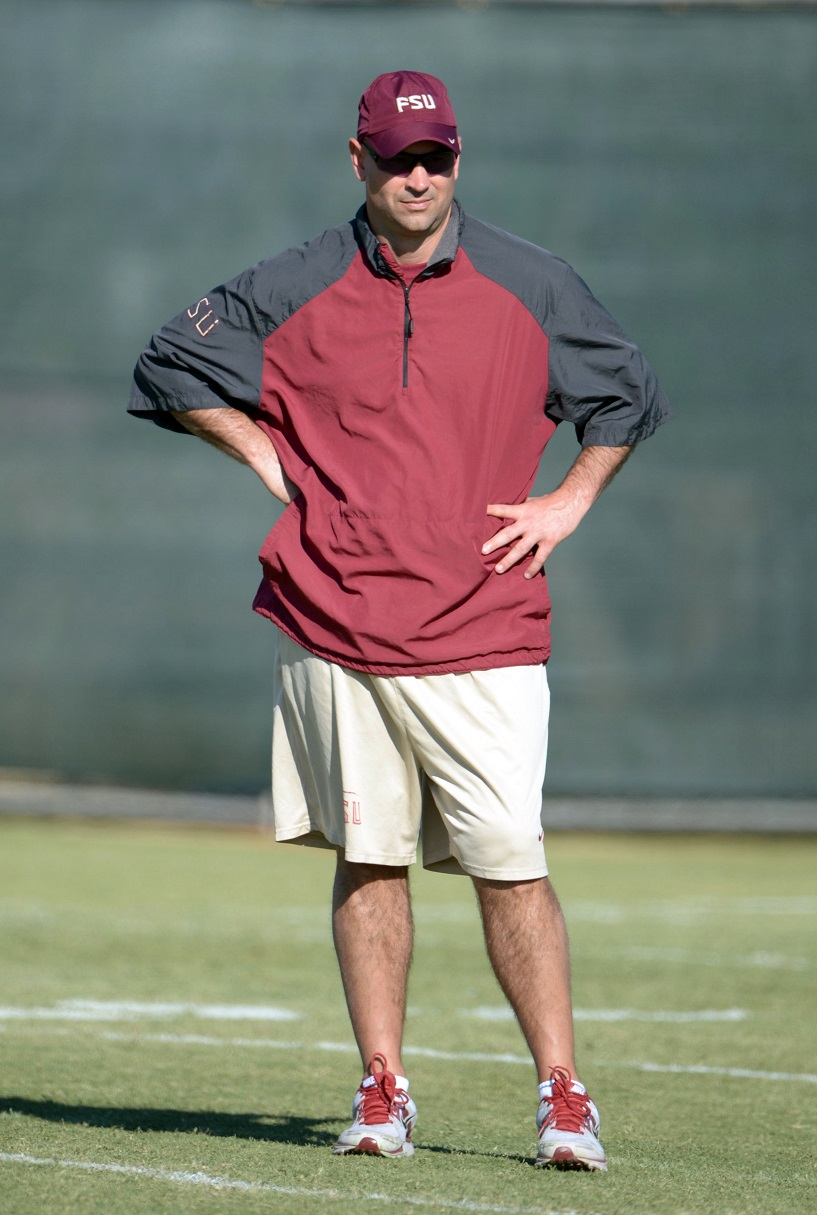
But Fisher wanted more. He wanted the system he used to face every day in practice at LSU. He wanted Saban's defense. And to get it, he took a big risk in hiring Jeremy Pruitt, Alabama's defensive backs coach. The 38-year-old Pruitt came to Tallahassee with no experience as a coordinator and only three seasons as a position coach at the FBS level. Further, since Saban coaches defensive backs as his specialty, many wondered just how much Pruitt had been involved in the excellent Alabama defensive attack.
"His knowledge of the game, his experience in how he has handled some things when he got on the [whiteboard] and his answers to playing spread things," Fisher said in 2012 of his hire. "He's had great success against the open teams that have been out there, from [Gus] Malzahn and all those guys in that league, and the way they've played and done those things. We have a great rapport, and he is no doubt ready to be a coordinator."
The new coordinator had been on Fisher's radar for years. Fisher said he'd been excited as a coach at LSU by Birmingham high school coach Pruitt's blitz packages for defensive backs.
Fisher indicated that the interview process was intense, consisting of him grilling Pruitt on the whiteboard for hours about any number of schematic situations involving teams Florida State has to face on a yearly basis. He was not concerned with Pruitt's experience, but with his intelligence, answers to questions, and instincts.
"How much pro experience did Jim Harbaugh have?" Fisher asked, rhetorically. "If you can coach, you can coach."
He'd also wanted a defensive coordinator with a background in defensive backs, like Saban.
"In today's game, being able to go back to front is very critical, because of the spread," Fisher said. "You have to be able to match your secondary coverages to your fronts. Who's going to fit, how they're going to fit, how you're going to handle certain play actions, how you're going to handle certain coverages. And I think it is much easier to go back to front than it is front to back. I think that knowledge is [crucial], especially the way the game is being played today, with such a spread dynamic to it."
Even so, Fisher made sure to secure the front as well, bringing on Sal Sunseri to coach defensive ends. Sunseri had been on Saban's staff for several years and was on the Carolina Panthers' Super Bowl staff. The brilliance in the hire was in recognizing that Sunseri's failure as a one-year defensive coordinator at Tennessee did not diminish his excellent track record of coaching defensive linemen and linebackers.
"That's another guy that knows [the Nick Saban defense] system," Fisher said. "So you have a front guy as well who knows it, to bridge the gap."
Fisher added Charles Kelly to coach linebackers, another coach with experience in the defensive system Saban uses. Kelly had been at Georgia Tech under Al Groh, a defensive coach who had previously been with Saban and Bill Belichick at other stops in his career. And like Sunseri, Kelly also had defensive coordinator experience at the BCS level.
"We are all off the same tree," Fisher said. "The intensity with which we coach, how hard we coach, the time we put into the game, how guys are done. And we've all had success doing it our way and winning championships. When you believe those same things, you don't have those controversies. It goes back to chemistry of staff."
"It's the most unselfish bunch of coaches I have ever been around."
"I think [coming from the same background has] been a big-time advantage," Sunseri told me, noting that there is still a lot more of the defense that will be installed in Year 2. "Jeremy has done a great job, and he knew what he wanted to do, but all of us being part of the Belichick tree, because that's where this defense is all coming from, it's been pretty darn good. The experience definitely helped."
"The one thing that I was familiar with was the terminology that Jeremy uses with his coverages, and some of the pressures. Al [Groh] and I visited Alabama several times, so that gave me more insight," Kelly told me. "It's the most unselfish bunch of coaches I have ever been around. And Jeremy is a very good teacher. I know how it is being a coordinator. When something tears up, you gotta fix it within your system. But us all understanding that system helps. We had never worked together, but I knew him. I would call him and ask about the secondary when I was coaching the secondary at Georgia Tech. He can see what is coming and adjust in a game."
The coaches quickly got to work and signed another excellent class of recruits, though it was not quite on par with Fisher's first three hauls. After all, it takes time for new coaches to form relationships.
The 2013 class did include defensive back Jalen Ramsey and linebacker Matthew Thomas, both rated among the best nationally at their respective positions. It did not, however, include enough offensive linemen. Florida State had held a commitment from four-star tackle Austin Golson for almost a year, but there is no prize for second place in recruiting, and the lineman chose Ole Miss. Other offensive line recruits showed little interest in the Seminoles, so FSU signed only two. Fisher wanted more like four or five. Still, it was another top-10 class for Florida State.
After four years of recruiting under Fisher, Florida State had signed more players rated four- and five-stars than two- and three-stars, being one of just nine teams to do so entering the 2013 season. That's an important benchmark in the BCS era, as almost every team to win a national title had loaded its roster in such a fashion.
With the massive coaching turnover and National Signing Day resolved, Florida State faced its next problem: It had lost 11 players to the NFL Draft, more than any team in the country. This was part of the reason Florida State was expected to compete for a national title in 2012, not 2013.
The losses to the draft were heavy, including five players in the first two rounds, but they weren't quite as bad as some outsiders thought. Some of the players were drafted based on potential (Manuel, offensive tackle Menelik Watson). Another two (linebacker Brandon Jenkins, running back Chris Thompson) had been unavailable for much of the year anyway. Some losses, like cornerback Xavier Rhodes, were mitigated by Florida State's depth.
In addition to questions at running back, receiver, cornerback and so on, the biggest question was quarterback.
The big loss was at defensive end, where Florida State had to replace the best defensive end tandem in the country. With Bjoern Werner and Tank Carradine went 24 of Florida State's 36 sacks, and its tremendous rush defense on the edges. FSU was going to have to blitz a lot more regardless of whom Fisher hired, meaning Pruitt would have to arrive fully aggressive.
In addition to questions at running back, receiver, cornerback and so on, the biggest question was quarterback. Would it be Winston, redshirt junior Clint Trickett or redshirt sophomore Jacob Coker? The latter was a 6'5, 230-pound gem with one of the strongest arms to ever come through Tallahassee.
With Coker battling a foot injury in spring, Winston gained the early edge. I heard he was making some incredible throws and that his understanding of the offense was advanced for a redshirt freshman. In the spring game, he was ridiculously good, going 12-of-15 for 205 yards with two touchdowns and no interceptions. From the outset, he did it big. His first pass was a 58-yarder for a touchdown.
I was covering the Elite 11 quarterback camp in Atlanta during the spring game. So I was with Trent Dilfer, one of the advisors of the camp in which Winston had previously participated. I told him about Winston's pass. I remember his response like it was yesterday.
"That's Jameis. That's what he does," Dilfer said. "He can be as good as anyone to ever play the position."
That may be, but Fisher did not name Winston as the starter after spring camp. The writing appeared to be on the wall, however, as Trickett took advantage of the graduate transfer rule to go play for West Virginia.
Over the summer, Winston and Coker worked with the first-team offense -- a battle that would extend into fall camp. And Coker, by all accounts, had an excellent fall. Winston had great days and bad days, and the battle was legitimately close between the pair. The concern with Winston was his propensity to try to make the big play too often and not play within the confines of the offense.
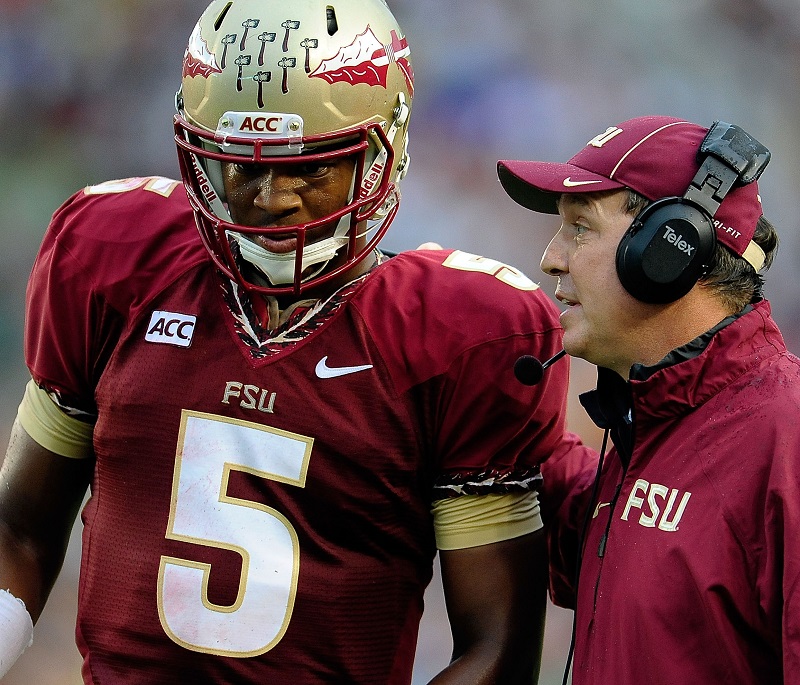
The staff was legitimately torn on which should start, but after consulting with some trusted advisors and coaches, Fisher settled on Winston.
Florida State had made the right decisions all offseason long. But four big things still had to break right.


 (Photo by Bud Elliot)