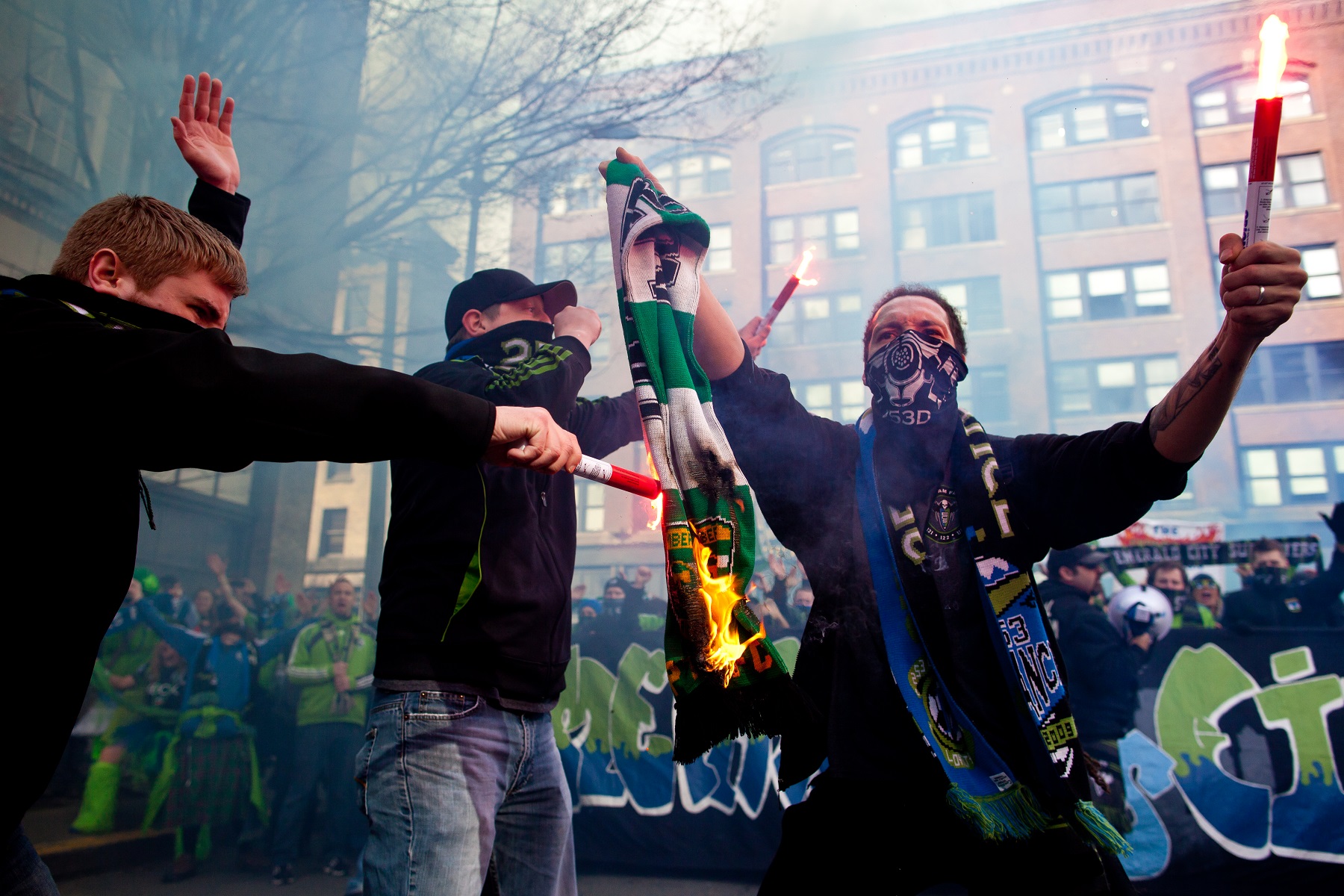
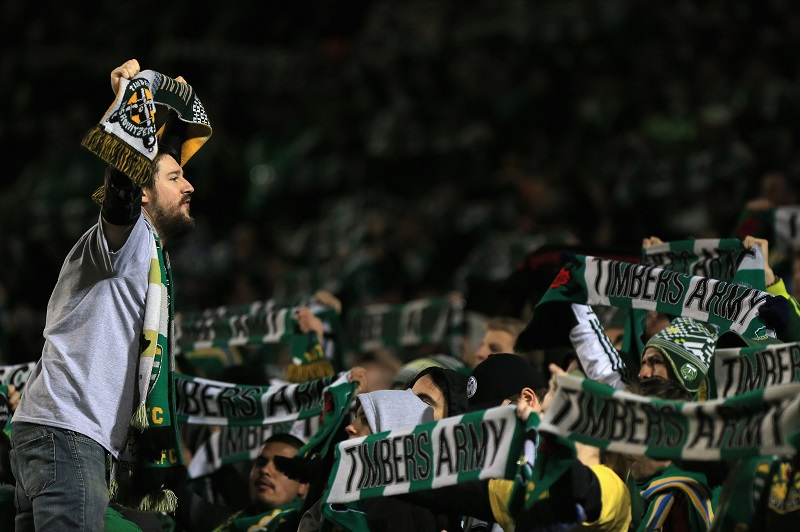
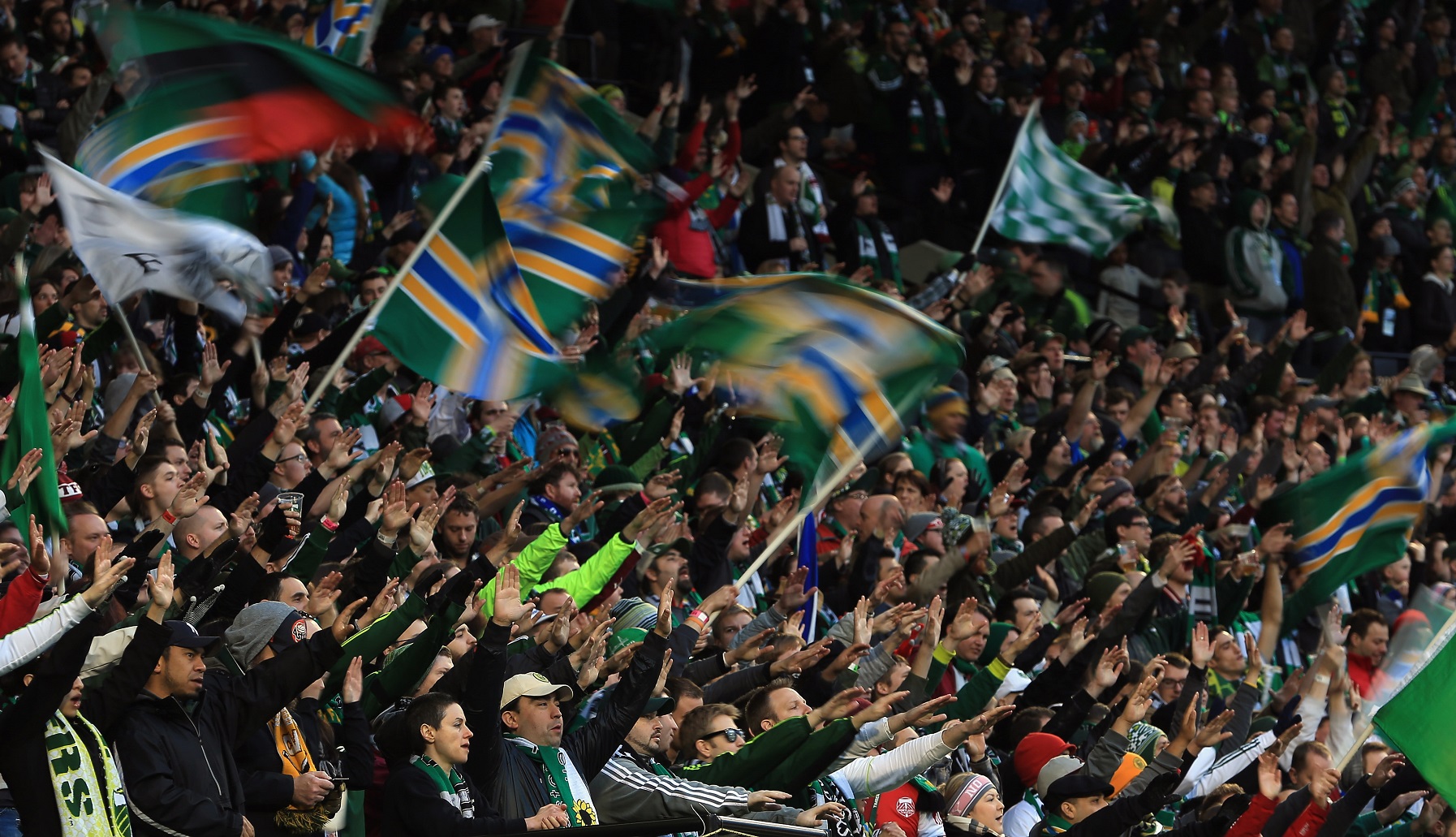
Meanwhile, the room is far from empty four blocks away at Fuel, one of who knows how many official ECS gathering places, where '90s alt-rock is blaring and hundreds of people have been ordering vodka and Red Bulls, mimosas, champagne and beer since 9 a.m.
They're getting ready for the march to the match, too. It's the same march. Kind of.
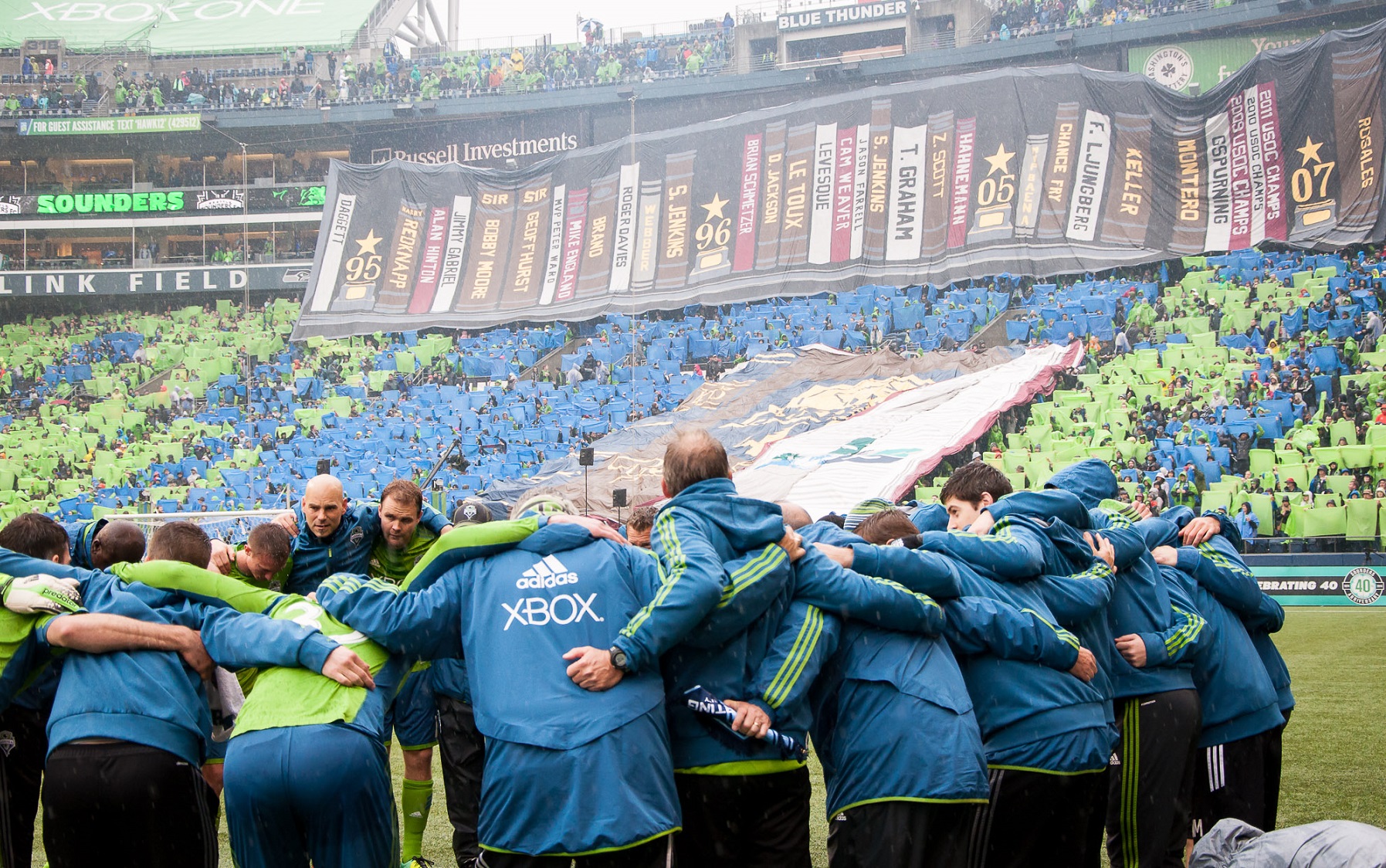
Turns out the Sounders have too many fans. In 2009, their first year in the MLS, the Sound Wave - sponsored by the club — played in the middle of the ECS section. That was bad. The ECS wanted to sing chants that include lines like "We don't hear a fucking thing!" and "I'm always drinking!" The band played music that was more family friendly — still fun, like samba riffs and death metal and classic rock ... but nothing with the word "fuck" in it.
The band got pushed out. Now they set up on the direct opposite side of the field from the ECS, in what's called the "Hawks' Nest" — the eponymous fan section for the Seattle Seahawks, for whom the stadium was primarily built.
On top of that, lots of people in the ECS say the band tried to hijack their march to the match, the weekly parade from Occidental Square to CenturyLink an hour before kickoff. The band tried to get in front of the supporters. So the supporters let them march. Alone.
Now the band marches in the back.
The ECS won. But a lot of their members won't let it go.
"I fucking hate that band. I feel like that's pretty common."
"I fucking hate that band. I feel like that's pretty common," Josh Chambers says the morning of the opener, drinking a vodka and Red Bull at Fuel. "They try to ruin our march every fucking time .... They're still a fucking marching band playing terrible CeeLo Green songs."
I asked two friends named Roman and Zach what they thought of the Sound Wave. "Bullshit," they said together. Then Roman added, "I hope they die in a fire."
The band is more diplomatic. Grateful losers, you could call them, but they're not spiteful. "We have no problem with ECS," says Rousu, the director. "We love those guys."
"You'll have some ECS guys say, ‘Screw Sound Wave, they suck,' " Rousu says, accurately. "They see the value that we bring .... There is a need for both of us."
Don't give the ECS a perfect score for originality either. They're transparent thieves. Some of their chants come from England, where supporters sing nonstop; their flags waving over 30 seats at a time are styled after South Americans'; the section-covering overheads are ripped from Italy. The people who run the ECS, which their "propaganda director" says is impossible: "We run the asylum; we can't control the patients," fully share that they looked to other continents where soccer has thrived to come up with ways to energize their members.
The almost laughable feud between the Sound Wave and the ECS reflects the real mystery about the Sounders: The identity of their fan culture is as cloudy as the Seattle sky. Is it a franchise-backed effort to promote wholesome, gimmicky funk — like so many indoor soccer and minor league baseball teams before them? Or a vehicle for a latent, rambunctious militia ready to turn American soccer into the sport that so many believers think it can be?
***
This part is being written out of a notebook with its pages ripped out.
An hour after the Seattle Sounders beat Sporting Kansas City in the final minute, hundreds of soaking-wet supporters bounced over to Temple Billiards two blocks north of the stadium. That's where I met Ralph.
His real name isn't actually Ralph, but I want to return to Seattle someday, and if I use his real name, he might make sure I don't make it back again.
Ralph grew up poor in Arizona. His mom was an alcoholic bartender and his dad worked in insurance. When he was nine he moved to Seattle and he says he'll never leave. He got his first job at 15, cooking, and later painting houses. Eventually he became an "iron worker," which, when I ask him what that means, means he grabs steel, throws it on his wide shoulders, walks over to a deck and sets the heap down. "We build Seattle."
It's impossible to say what "type" of fan belongs to the Sounders. Certainly, there are a reliable core, like Baker's dad, who bought tickets to the inaugural game in 1974 and followed a changing team through four decades. Then there are the white gamers and developers who uplinked to Seattle through tech giants and saw soccer as their alternative calling.
Not Ralph. He's 35 and he's huge. His friend describes him as a "skinhead," but without the prejudice. He looks like Jason Statham plus 40 pounds. He points to the ironwork in the ceiling; points to the floor; you see that? "That's our work," he says. He has a thin red scar above his right thumb near his wrist, and a thicker and darker-red gash on his knuckle where his middle finger meets the top of his hand.
Ralph's mom just died of alcohol poisoning, in Missouri. He held her hand while she breathed for the last time. "I loved her more than anything in this world." He pauses and looks around Temple, shoulder-to-shoulder with supporters wearing soccer scarves. "Including the Sounders. And it's a close margin."
I tell him that ECS, which he helped found as the Sounders ascended to the majors, seems to me like a cult. He says it is. And he's proud of it.
The last thing I ask him before my notebook is destroyed is what makes people in Seattle different than people anywhere else in the United States. "Because we're different," he says, laughing as if I don't get it. "Write that down in your notebook. Because ... we're ... different."
Sometimes you ask questions when you know the answer; I ask Ralph if he's ever been in a soccer fight. He says he was smoking at halftime during a Sounders-Timbers game in Portland when a brawl broke out after an ECS supporter refused to give a Timbers Army supporter a light. He threw some punches. He hit some targets. I tell him I've never been in a fight.
Ralph stares at me. "Buy me a beer. Buy me a beer."
He looks at my notes — his job as an ironworker, his mother's death — and he rips them out.
"Sure, what do you want?" I said. I'm drinking PBR in a glass.
"PBR," he says. "I think you're drinking PBR."
I go to the bar, order a PBR. I look back and Ralph is thumbing through my notebook, which I left on one of the pool tables covered with a tarp to protect the felt from everyone's damp jackets. He looks at my notes — his job as an ironworker, his mother's death — and he rips them out. He crumples them in his hands, which could crush both of mine in a ball, and tosses them underneath the pool table. He looks up at me to make sure I don't see what he's doing.
I bring him back the PBR. "Why did you rip out my notes?"
Ralph unleashes a string of unconnected sentences, mostly about me landing in Seattle to write about a city and a supporter culture without living there, which is true, and for me to write without my notes so I experience "Seattle football" not as a journalist. His friend comes over and tries to calm him down, and takes him outside for 10 minutes. When he comes back, Ralph grabs my notebook from me and hands it to one of the bartenders. "Throw this in the garbage."
Ralph wouldn't talk to me much after that. Most of the people in the billiards room had picked up their drenched coats and left, and I was about to. On the way out, I handed him a piece of paper with my number, and told him that if he wants to call me, great, and if not, great, and I thanked him for talking with me.
"Not a bad man," Ralph said before turning around and leaving forever. "I fucking like you."

Portland: Whispers and Hideouts
Two Fridays ago, I was standing in one of those bus stop booths with glass walls just before midnight, across from an appliance parts warehouse in southeast Portland, Ore. The nervous, mid-20s guy with me looked at the ground and said, "Look to your left."
I looked around for a few seconds. "You see that bar over there? Across the street" he said. "That may, or may not, be a secret Sounders bar."
This is more like Moscow and Washington, circa 1980 — whispers and hideouts across enemy lines.
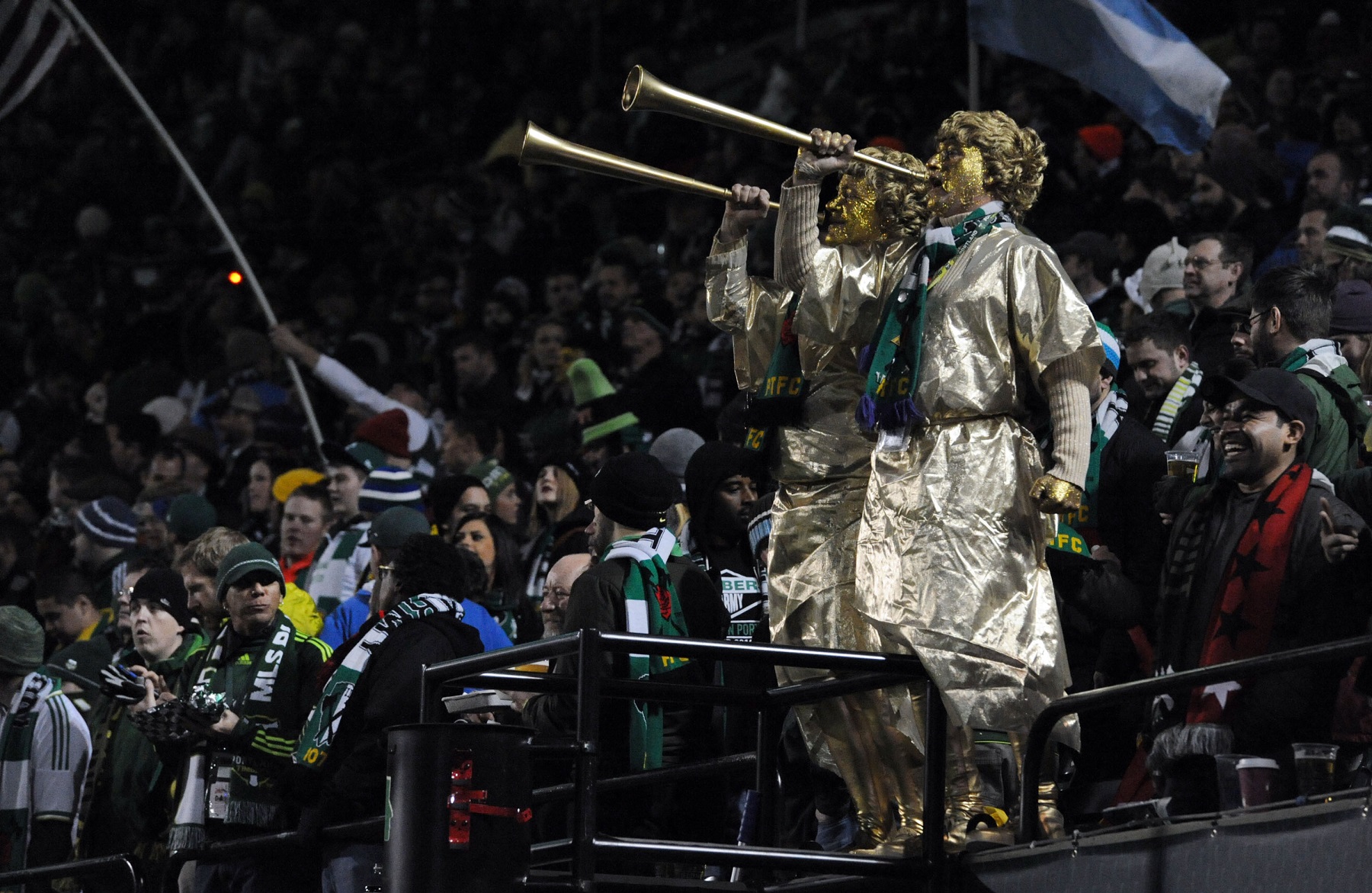
He was referring to Seattle's MLS team, perhaps the biggest rival that the city of Portland has known in its entire sports history. The cities are only a few hours apart from one another, 173 miles, but this isn't like New York and Boston, where ex-pats openly and loudly advertise their home bar away from home.
This is more like Moscow and Washington, circa 1980 — whispers and hideouts across enemy lines.
This is cold war shit.
The day after the bus-stop rendezvous, I got the green light from the secret Sounders crew. In broad daylight, I returned to the bar (it will not be named, and neither will the person, because the rules of war are in effect).
***